
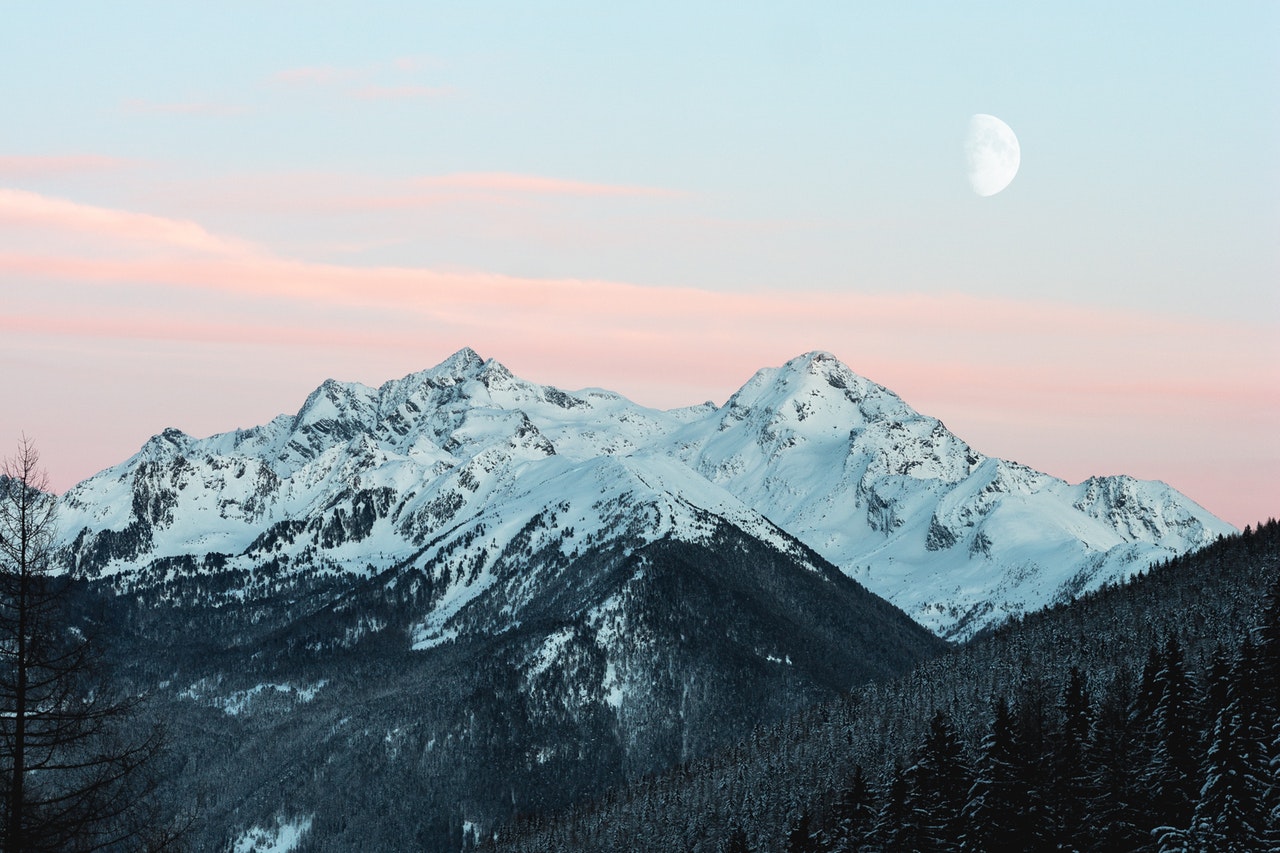
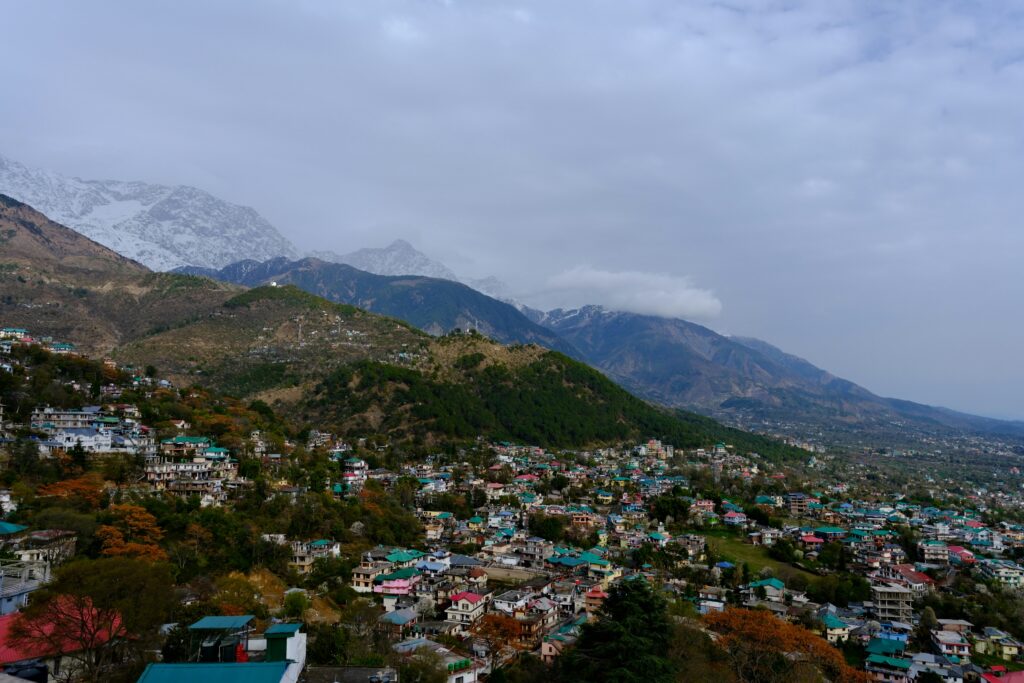
I have lost count of how many times a guest has walked into my homestay, dropped their bags, looked out at the Dhauladhar range, and asked me the same thing: what are the best places to visit in Dharamshala, and what are the best things to do in Dharamshala once you are actually here? This guide is my honest answer to both.
I live in Khaniyara, just below Dharamshala, and I have spent years pointing visitors up to McLeod Ganj, out across the Kangra Valley, and onto a few trails the guidebooks quietly skip. So what follows is not a scraped top-ten. These are the places I send my own guests to, described the way I would describe them to a friend, in the order I would actually plan them.
Below you will find the places worth your time, the things to do beyond the usual sightseeing, the easy day trips just outside town, how many days you genuinely need, and the practical bits: where to stay, when to come, and how to get here. Local, tested, and honest about what is worth it and what is not.
Table of Contents
Best Places to Visit in Dharamshala
The best places to visit in Dharamshala are the Dalai Lama Temple (the Tsuglagkhang Complex), McLeod Ganj, the Bhagsu Waterfall, the Triund Trek, the Naddi Viewpoint, the Norbulingka Institute, the HPCA Cricket Stadium, St John in the Wilderness Church, and Kangra Fort.
I have grouped them the way you would actually visit them, by area, so you are not crisscrossing the hills to tick off a list.
We start in and around McLeod Ganj, where most of the magic is, then move up to the quiet viewpoints just above it, across to the Dharamshala town side, and finally down into the Kangra Valley.
Best Places to Visit in Dharamshala at a Glance
| Place | Best for | Time needed | Entry | Where | Priority |
|---|---|---|---|---|---|
| McLeod Ganj | Tibetan culture, cafés, walking | Half to full day | Free | McLeod Ganj | Don’t miss |
| Tsuglagkhang (Dalai Lama Temple) | Spirituality, the kora | 1 to 2 hrs | Free (Tibet Museum ₹20) | McLeod Ganj | Don’t miss |
| Bhagsu Waterfall & Temple | Easy walk, waterfall, café | 2 to 3 hrs | Free | Near McLeod Ganj | Worth it |
| Dharamkot | Slow days, cafés, yoga | Half day plus | Free | Above McLeod Ganj | Worth it |
| Triund | The big trek, Dhauladhar views | Full day or overnight | Free (camping extra) | From Dharamkot / Gallu | Don’t miss (if you trek) |
| Naddi View Point | Sunset, mountain views | 1 to 2 hrs | Free | 3 km above McLeod Ganj | Worth it |
| Dal Lake | A quiet pause under cedars | 20 to 30 min | Free | Near McLeod Ganj | If you have time |
| St John in the Wilderness | Colonial history, calm | 20 to 30 min | Free | Forsyth Ganj | Worth it |
| Gyuto Monastery | Quiet monastery, morning prayers | 30 to 45 min | Free | Sidhbari | Worth it |
| Norbulingka Institute | Tibetan arts, gardens, café | 1 to 2 hrs | Nominal | Sidhpur | Don’t miss |
| HPCA Cricket Stadium | The view, or a live match | 30 min, or match day | Free (non-match) | Lower Dharamshala | Worth it |
| Kangra Valley Tea Gardens | Tea estates, slow walks | 1 to 2 hrs | Free | Toward Kangra | If you have time |
| Kangra Fort | History, valley views | 1.5 to 2 hrs | Small ticket | 20 km out, Kangra | Don’t miss (history) |
In and Around McLeod Ganj
This is the dense, walkable heart of it. Sitting at roughly 2,000 m, about 9 km and a 30-minute climb above lower Dharamshala, McLeod Ganj packs most of the must-sees into a patch you can cover on foot. You could spend two full days here without once calling a taxi, and most first-timers happily do.
McLeod Ganj
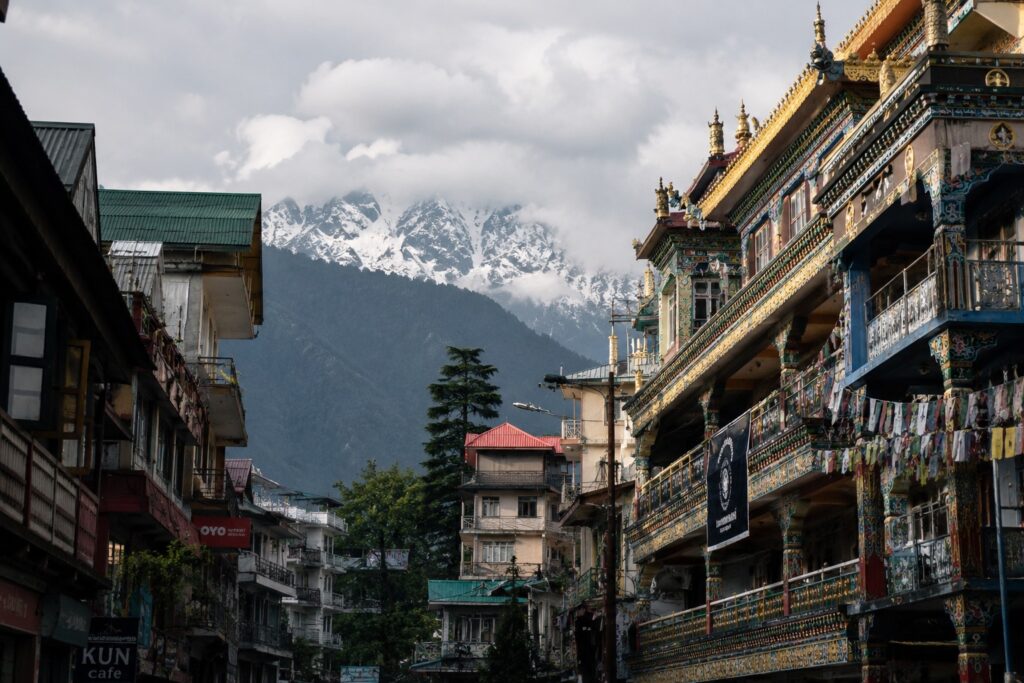
McLeod Ganj is the reason most people fall for Dharamshala. It is the home of the Tibetan community in exile, and it wears that everywhere: prayer flags strung between rooftops, the smell of momos and incense on the same breeze, monks in maroon robes walking past cafés playing soft music.
Shared taxis grind up the 9 km from the lower Kotwali Bazaar bus stand in about 30 minutes, and once you are up top, the main square (really the bus stand) and Temple Road are your two anchors. If you want everything within walking distance, base yourself up here.
I tell guests to give the first evening to nothing but those two streets, letting the place set its own pace before they start chasing sights.
Tsuglagkhang Complex (Dalai Lama Temple)
If you see one place in Dharamshala, make it this.
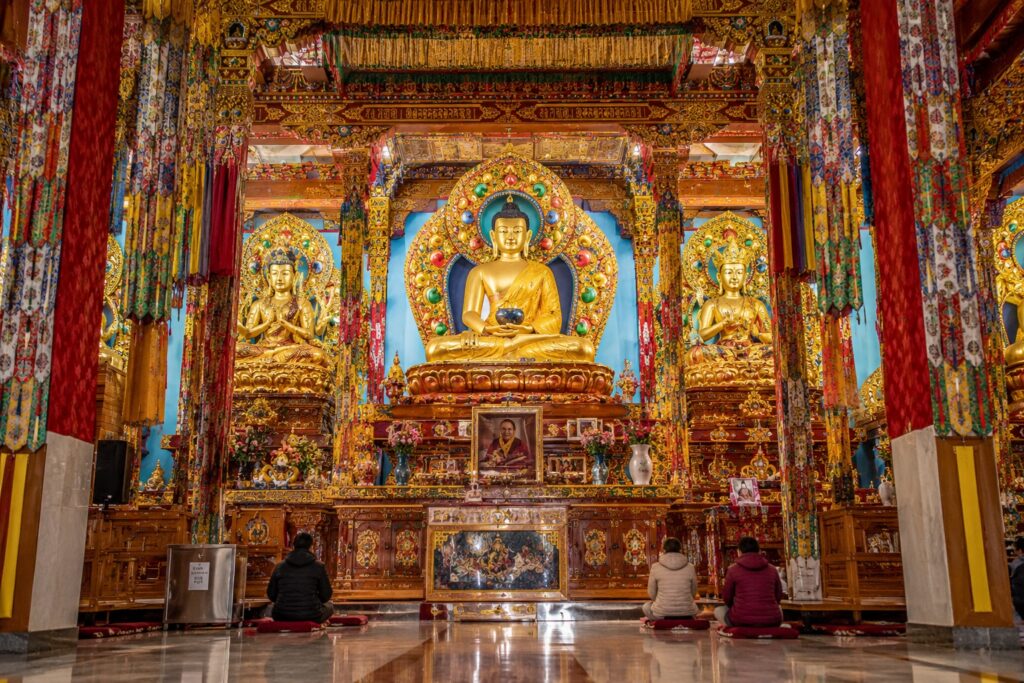
The Tsuglagkhang Complex sits at the southern end of McLeod Ganj, a 5 to 10 minute walk from the main square, and it is both the spiritual heart of the town and the official residence of His Holiness the Dalai Lama.
Inside the same compound sit the main temple, the Namgyal Monastery, the Kalachakra Temple, and the small but genuinely moving Tibet Museum (entry ₹20, closed Mondays). It opens around 5 am and runs to about 8 pm in summer, closing nearer 6 pm through winter. The hour just after opening is the one to catch: soft light, fewer people, and the monks debating in the courtyard.
Walk the kora, the roughly 20-minute prayer path that loops the complex past prayer wheels and mani stones, because most visitors skip it and it is the best part. Entry to the temple itself is free. An hour or two covers it, and if you are here in early July the whole place becomes the centre of the Dalai Lama’s birthday celebrations and stays fill fast.
For the full visitor’s walk-through I have a dedicated Dalai Lama Temple McLeodganj guide, a closer look at the Namgyal Monastery inside it, and a wider guide to the Tibetan monasteries in and around McLeod Ganj. For July, see the Dalai Lama’s birthday and where to stay for it.
Bhagsu Waterfall and Temple
A short, easy walk from McLeod Ganj, about 2 km and 20 to 30 minutes on foot, brings you to Bhagsunag: an old Shiva temple, a freshwater spring tank where people still take a dip, and a waterfall that truly comes alive after the first rains. It runs fullest from July through September and thins to a quiet trickle by late May.
The reward sits at the top, the long-running Shiva Café, where you can rest with something hot and your legs over the valley once you have made the climb. Most people stop at the first fall. Scramble another 10 minutes past the café and there is a smaller, quieter upper cascade the crowds miss.
It costs nothing to visit, and 2 to 3 hours with the café stop is about right.
Dharamkot
Just above McLeod Ganj, a 20 to 30 minute walk or a short drive uphill, Dharamkot is where the pace drops and the cafés get interesting.
This is the slow, bohemian side of Dharamshala: yoga schools, drop-in meditation (the Tushita and Vipassana centres are both up here), long breakfasts, valley views, and a crowd that arrives for a week and stays a month. It is also the staging point for the Triund Trek, with the trailhead at Gallu Devi Temple a short hop above it.
If McLeod Ganj is the heart, Dharamkot is the deep breath, and I send guests here when they want to do less, not more.
For where to eat and linger, here are the best cafés in Dharamshala.
Triund
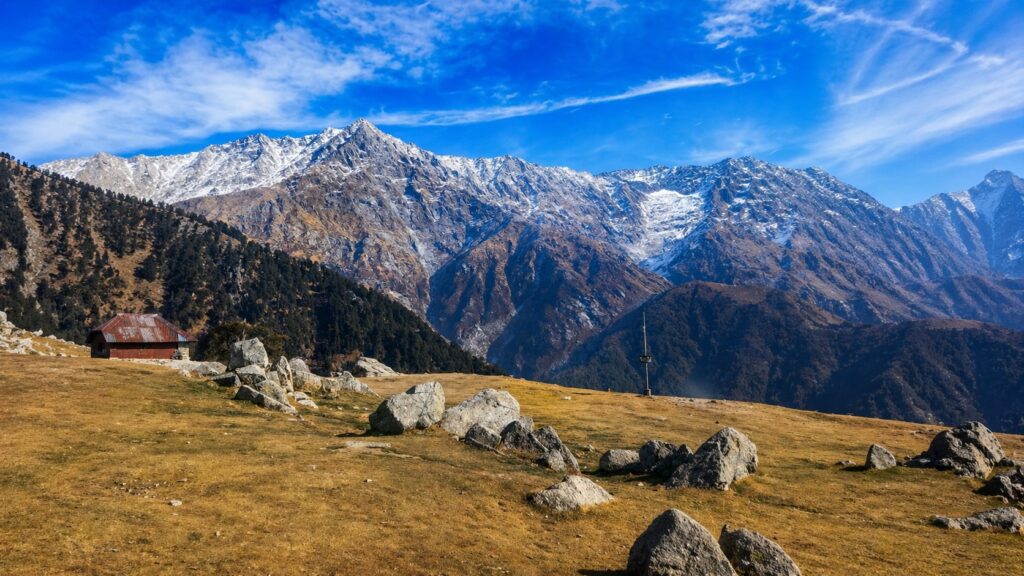
If you manage one trek in Dharamshala, make it Triund.
Starting from the Gallu Devi Temple above Dharamkot, the trail climbs through oak and rhododendron forest to a grassy ridge at about 2,875 m, the Dhauladhar peaks rising sharply on one side and the Kangra Valley spread far below on the other. It takes most reasonably fit walkers 4 to 6 hours up, and there are a handful of chai and Maggi points along the way (Magic View and Snowline are the well-known ones), so you are never far from a refill.
Plenty of people do it as a long day hike. The ones who camp overnight get the part I love most: the hush after the day-trippers leave and a sky absolutely thick with stars.
For the actual distance, full route, costs, and what to carry, see my Triund Trek guide, and for more trails the best treks in Dharamshala.
Just Above McLeod Ganj
A few kilometres above the McLeod Ganj bustle, the crowds thin fast and the views open right up. These two are easy half-day add-ons, and both are best treated as a slow pause rather than a tick-box sight.
Naddi View Point
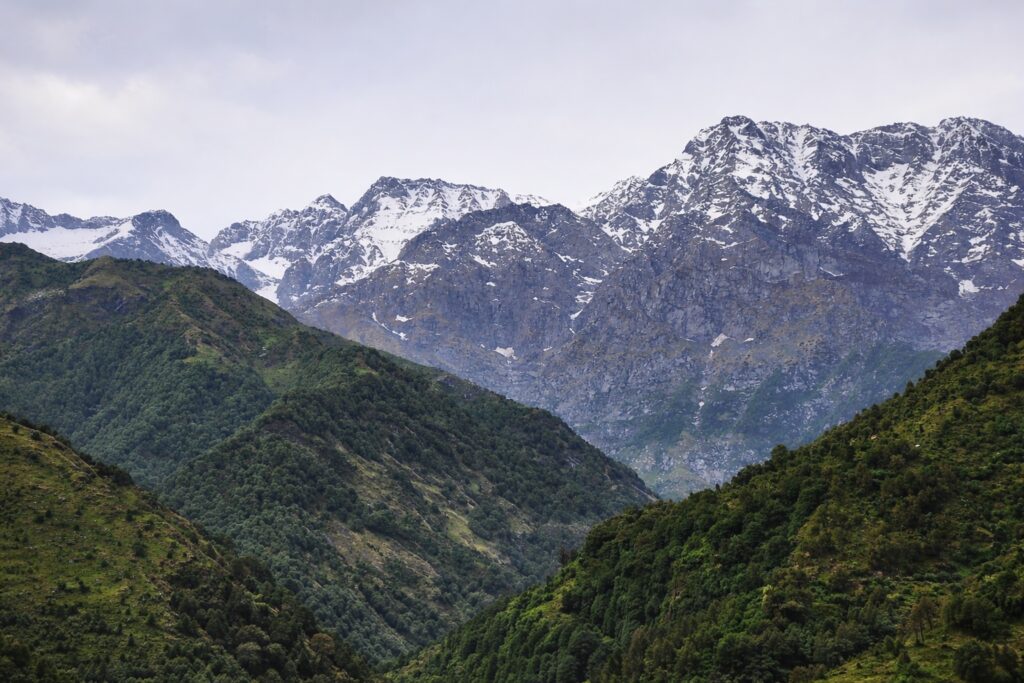
About 3 km above McLeod Ganj, a 15-minute drive or a pleasant 45-minute walk, Naddi is where you go for the Dhauladhar range with nothing in the way. It is a small village that has stayed far quieter than McLeod Ganj, with a clutch of cafés and a viewpoint that looks straight onto the snow line. Come for sunset, when the peaks turn gold and then pink. That is the hour Naddi earns its reputation.
Guests staying in McLeod Ganj often walk up in the late afternoon and taxi back down after dark. It is free, an hour or two is all you need, but it tends to be one of those hours that sticks with people.
Dal Lake (Dharamshala)
Let me set expectations honestly, because the name trips people up: this is not Srinagar’s Dal Lake.
Dharamshala’s Dal Lake is a small, still pond ringed by tall deodar cedars, about 3 km from McLeod Ganj and 11 km from lower Dharamshala. What it offers is calm, not grandeur.
There is a little Durvasa Rishi Temple on the bank, a local legend tying the water to Lord Shiva, and a September fair that brings the Gaddi shepherd community down to its edge. I would not build a day around it, but if you are already driving between McLeod Ganj and Naddi, it is a worthwhile 20-minute stop to sit under the cedars and hear nothing but the wind.
The Dharamshala Town Side
Down on the lower Dharamshala side, the sights spread out, so this is the half-day you will want a taxi for. None of these are far, but they are not walkable from one another the way the McLeod Ganj cluster is. A sensible loop runs from McLeod Ganj down past the old church, through town for the stadium, out to the monasteries at Sidhbari and Sidhpur, and into the tea gardens.
St John in the Wilderness Church
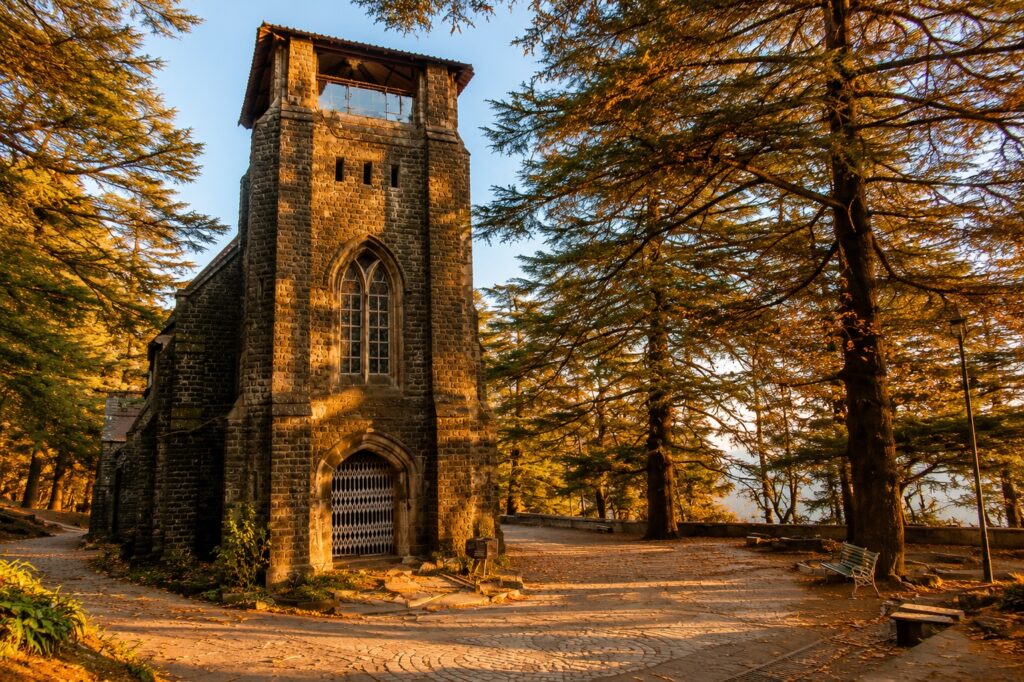
On the forested road between McLeod Ganj and lower Dharamshala, in an old colonial pocket called Forsyth Ganj, stands St John in the Wilderness: a neo-Gothic Anglican church built in 1852 and wrapped in tall deodars. It is a quiet, slightly haunting stop, stone walls, stained glass that survived the 1905 Kangra earthquake, and a graveyard that holds Lord Elgin, one of British India’s Viceroys.
Film buffs may recognise it from Vishal Bhardwaj’s Haider.
Entry is free, 20 to 30 minutes is enough, and it sits right on the way down, so there is no reason to skip it.
Gyuto Monastery
About 8 km from Dharamshala in Sidhbari, Gyuto Monastery is the seat of the Karmapa and a renowned centre for Tibetan tantric study.
It is far less touristed than the Dalai Lama Temple, which is exactly its appeal: a huge gilded Buddha, the Dhauladhar filling the windows behind it, and morning prayers (usually soon after sunrise) you can sit quietly at the back for. Free to enter, 30 to 45 minutes covers it, and it pairs naturally with Norbulingka just down the road.
Norbulingka Institute
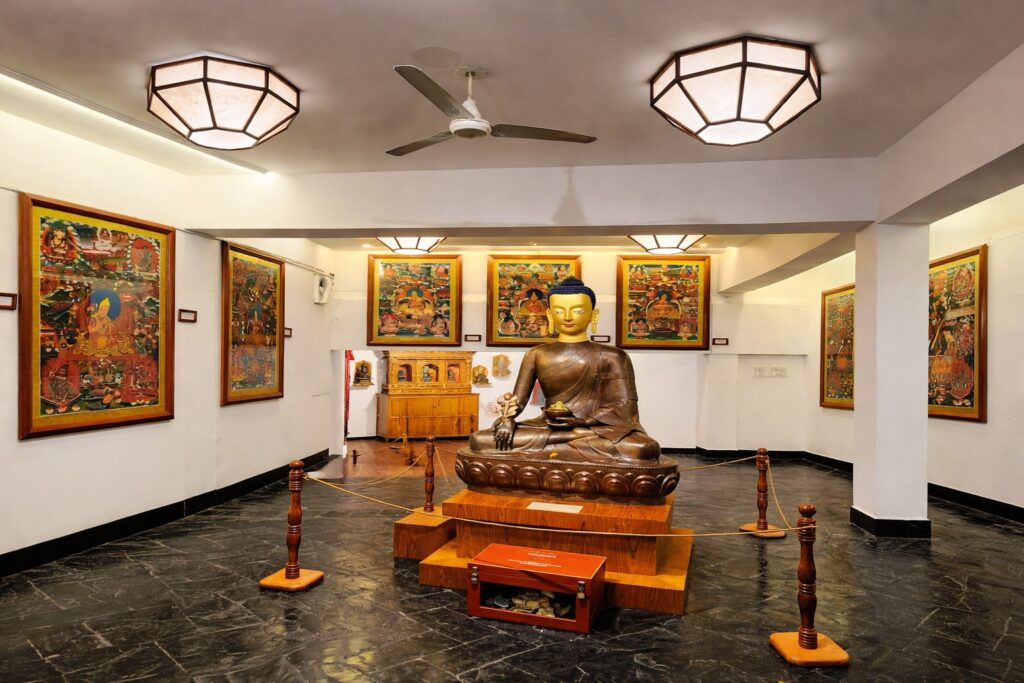
A few minutes from Gyuto, in Sidhpur, the Norbulingka Institute is where traditional Tibetan arts are kept alive: thangka painting, woodcarving, metalwork, and applique, all practised by artisans you can watch at work.
It is built around Japanese-style gardens with streams and koi, has a lovely café and a doll museum that recreates Tibetan life, and it is one of the most genuinely peaceful corners in the whole valley.
It is open through the day (roughly 9 am to 5:30 pm), entry is nominal, and I would keep aside an hour or two.
HPCA Cricket Stadium
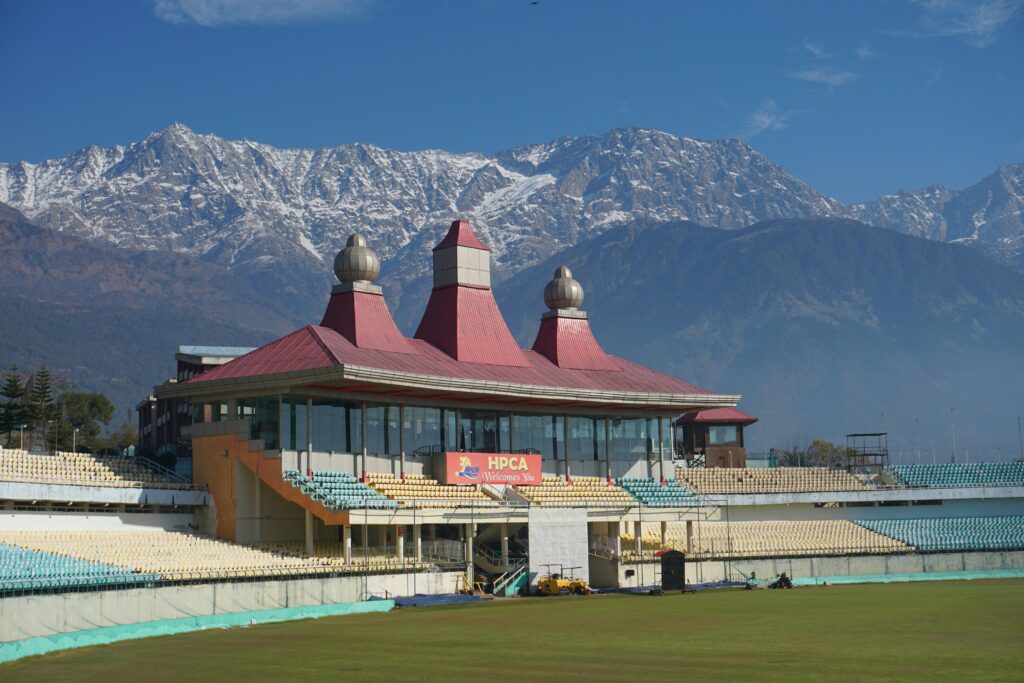
Even if you have no interest in cricket, the Himachal Pradesh Cricket Association Stadium is worth the short stop.
Sitting at about 1,457 m in lower Dharamshala, roughly 3 km from the town centre, it is regularly called one of the most beautiful grounds in the world: a green outfield with the snow-capped Dhauladhar rising straight behind the stands.
On non-match days people simply come to photograph it.
If your trip lines up with a fixture, it is a genuinely special place to watch a game. Here is what it is like inside the Dharamshala cricket stadium, the Dharamshala IPL match details, and where to stay near the HPCA Stadium.
The Kangra Valley Tea Gardens
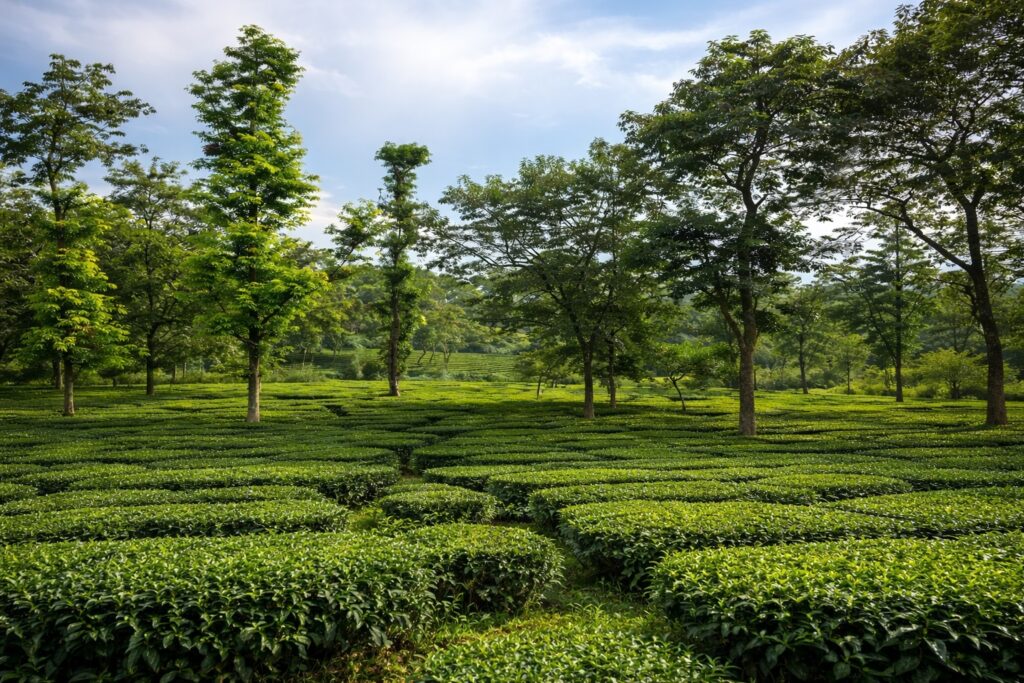
Down toward the Kangra Valley, the old tea estates are the quiet, green surprise of a Dharamshala trip. Kangra tea, grown here since the 1850s, is light and floral, and walking the rows early, with mist still caught in the bushes, is one of those slow pleasures the rush of McLeod Ganj does not leave room for.
You can buy fresh green, black, and white blends straight from small factories nearby, and Kunalpathri Temple, one of Himachal’s Shakti Peeths, is a short walk away if you want to pair the two. Free to wander, and as long or short as you like.
Into the Kangra Valley
The last cluster sits down in the valley, far enough out that it is a half-day drive in itself, but the fort at the end of it is one of the most rewarding sights in the whole region.
Kangra Fort
About 20 km from Dharamshala, where the Banganga and Majhi streams meet, Kangra Fort is the oldest and largest fort in the Himalayas, its stones tracing back well over a thousand years under the Katoch dynasty (local lore stretches it further still, to around 3,500 years).
You climb through a sequence of stone gateways to temples, palaces, and ramparts that look clear across the Kangra Valley. It is a photographer’s fort and a historian’s at once. The small Maharaja Sansar Chand Katoch Museum at the entrance sets the context with manuscripts, miniatures, and royal portraits before you go in, and the audio guide is genuinely worth taking.
Most listings put it at 9 am to 5 pm, entry is Rs 25 for Indian visitors, and an hour and a half to two hours does it justice. If you have made the drive this far, Brajeshwari Devi Temple sits barely a kilometre from the Kangra bus stand and pairs with the fort comfortably. I have written the whole thing up, from the angled gates to what the 1905 earthquake took, in my honest answer to whether Kangra Fort is worth the drive.
A Few More, If You Have the Time
If you are the type who likes to keep going, a handful of smaller spots reward a stop.
The Library of Tibetan Works and Archives, near the Dalai Lama Temple, holds a serious collection of Tibetan manuscripts and a quiet reading room.
The Tibet Museum inside the Tsuglagkhang Complex (entry ₹20) lays out the history behind all those prayer flags in about 45 minutes.
And up in Dharamkot, the Tushita and Dhamma Sikhara centres run short meditation and Vipassana sits if that pull is there.
None are essential. All are easy add-ons once the headline places are done.
Best Things to Do in Dharamshala (Beyond the Sightseeing)
Seeing the places is only half of it.
The best things to do in Dharamshala are the experiences that do not show up on a map: trekking to Triund, riding the Skyway up to McLeod Ganj, sitting in on morning prayers at a monastery, eating your way through the Tibetan kitchens, paragliding over the Kangra Valley, and catching the sun set behind the Dhauladhar.
If you only do five things, here is where I would point you.
Trek to Triund
The one trek nobody regrets: four to six hours up to a ridge at 2,875 m, as a day hike or an overnight camp.
If you want something gentler or wilder instead, I have rounded up the best treks in Dharamshala.
Ride the Dharamshala Skyway
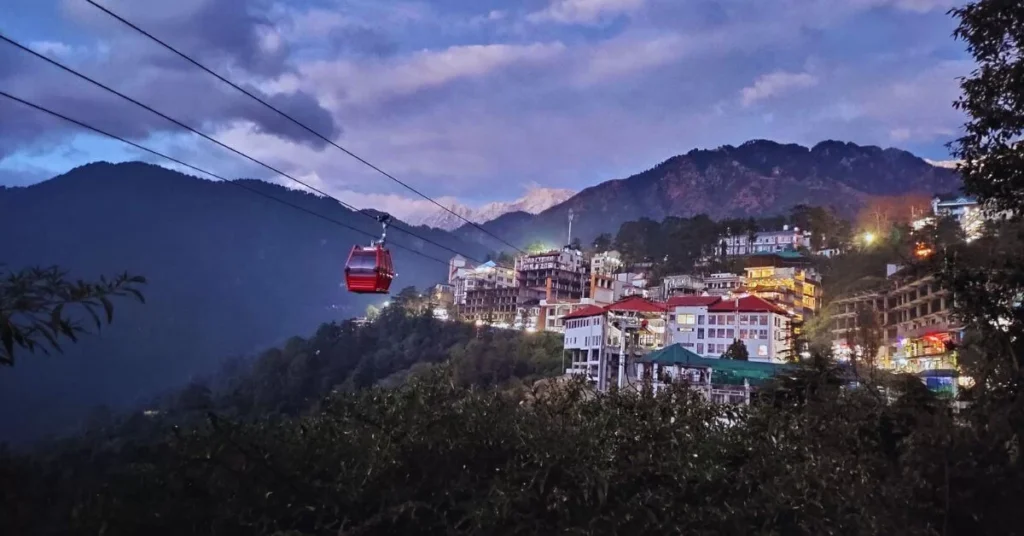
The cable car climbs from lower Dharamshala to McLeod Ganj in under ten minutes, a round trip of around ₹550 that turns a tedious taxi switchback into a quiet glide over forest and valley.
Go on a clear morning for the Dhauladhar views.
Sit in on Morning Prayers
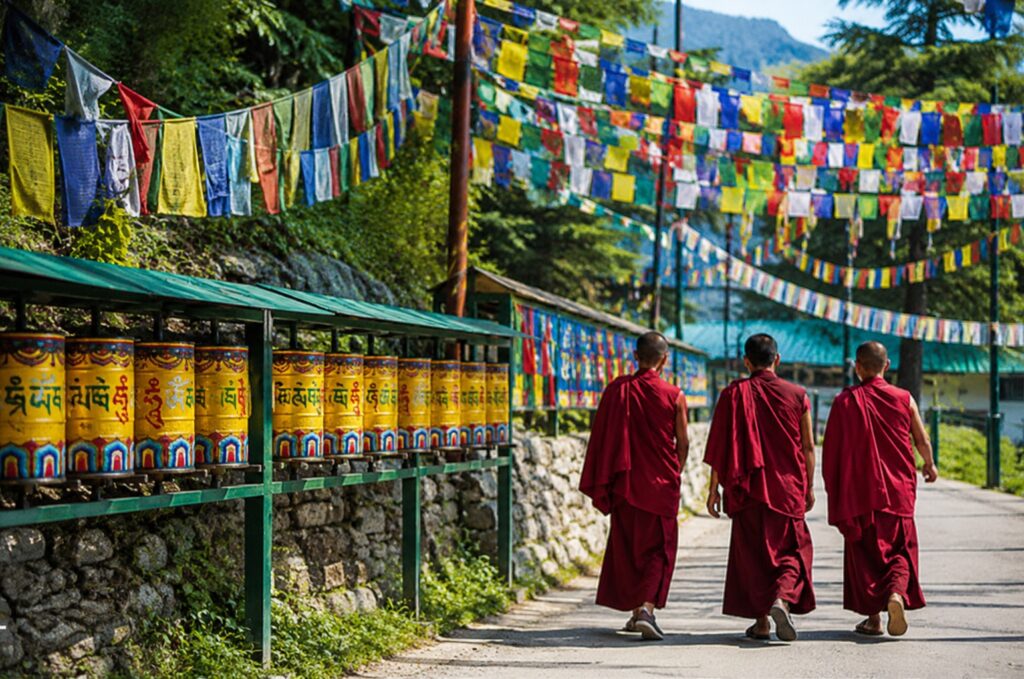
Whether at the Dalai Lama Temple or the quieter Gyuto Monastery, the early prayer sessions, low chanting, butter lamps, and the smell of juniper, are the most moving half-hour in Dharamshala.
More on each in my guide to the monasteries in and around McLeod Ganj.
Eat Your Way Through McLeod Ganj
Steamed momos, a bowl of thukpa on a cold evening, chewy laphing for the brave, and a slice of Bhagsu cake to finish, the food here is half the reason to come.
Where to find the best of it is in my guide to the famous food in Dharamshala.
Paraglide Near Bir Billing
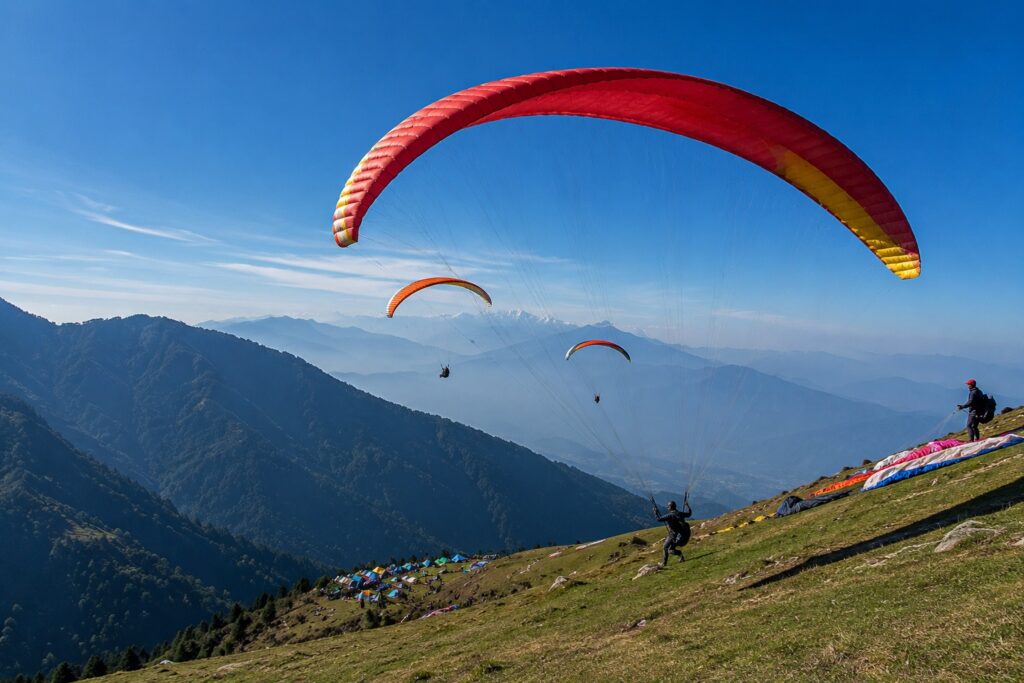
About two hours away, Bir Billing is one of the world’s top paragliding sites. For something closer, short tandem flights run from Indru Nag on Dharamshala’s edge. I’ve flown it myself, and my honest guide to Bir Billing paragliding covers the cost, whether it’s safe, and what the flight actually feels like.
The flying season is roughly March to June and again after the monsoon.
Explore Kangra Art
The Kangra Art Museum near Kotwali Bazaar (entry around ₹50) holds Kangra miniature paintings, Pahari crafts, and old coins, a small, underrated stop for anyone curious about the valley’s artistic legacy.
Here is my complete guide to Kangra painting, its history, themes, and where to see and buy the real thing.
Chase a Sunset
Naddi is the classic, but the Triund ridge, a Dharamkot café terrace, or even the tea gardens all deliver.
The hour before dark is when the Dhauladhar puts on its real show.
Things to Do in McLeod Ganj
If your time is short and you are based up top, McLeod Ganj alone fills a happy day or two: walk the kora at the Dalai Lama Temple at dawn, browse Temple Road and Jogiwara Road for Tibetan handicrafts, singing bowls, and prayer flags, café-hop your way through Dharamkot just above (start with my pick of the best cafes in Dharamshala), and finish with momos and a sunset.
It is the most walkable, do-nothing-but-still-feel-full corner of the region.
Places to Visit Near Dharamshala (Easy Day Trips)
The best places to visit near Dharamshala are Palampur, the Masroor rock-cut temples, and Bir Billing, with Dalhousie and the Kareri Lake trek worth it if you have more time. Together these all sit within the wider Kangra Valley, and if you would rather plan the whole region as one trip instead of a series of day trips, my full Kangra Valley travel guide maps out how the valley fits together.
A couple of these are genuine day trips. A couple are honestly better as an overnight, and I will tell you which is which rather than send you on a four-hour drive each way for nothing.
Palampur
The easiest and prettiest of the lot, Palampur sits about 35 km from Dharamshala, roughly 1.5 hours by road, in the middle of working tea estates.
Spend a slow day among the gardens, walk down to the Neugal Khad ravine with the Dhauladhar rising behind it, and if you have the appetite, add the Tashi Jong Monastery or the Andretta artists’ village with its old pottery studio.
It is the day trip I recommend most often.
Masroor Rock-cut Temples
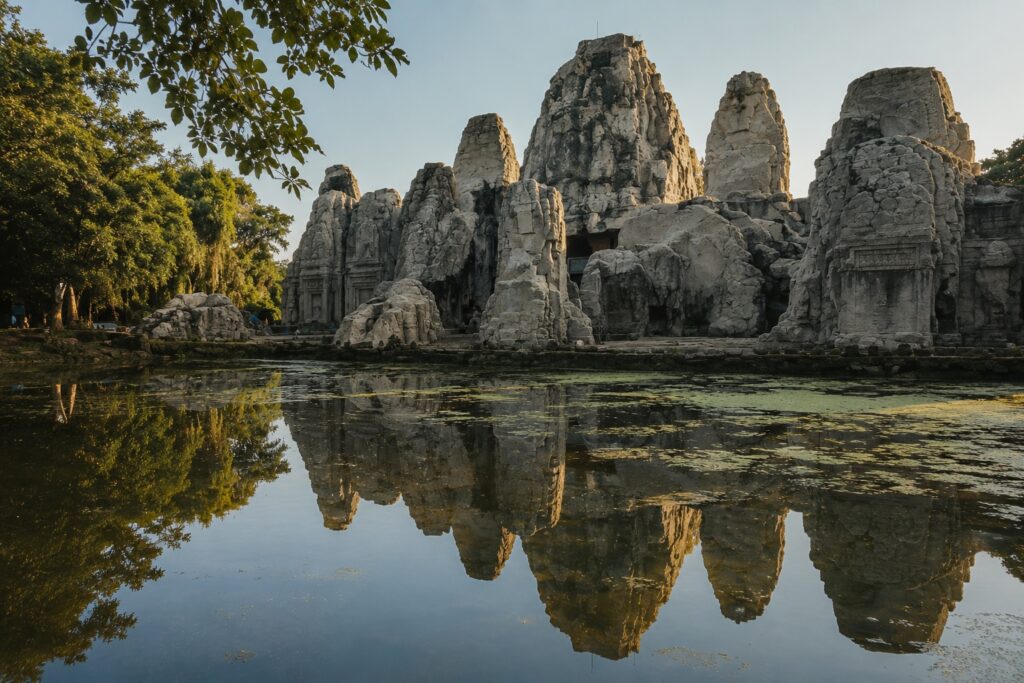
About 40 km out, and only 15 km from Kangra Fort, the Masroor temples are the region’s most underrated stop: a cluster of 8th-century shrines carved straight out of a single sandstone ridge, sometimes called the Himalayan pyramids, with a small pond mirroring them out front.
The 1905 earthquake damaged the carvings, but enough survives to leave you quiet.
Pair it with Kangra Fort for one history-heavy day and you will likely have both half to yourself.
Bir Billing
Roughly 65 km and 2 to 2.5 hours from Dharamshala, Bir Billing is the paragliding capital of India: takeoff at Billing around 2,400 m, landing down in Bir.
Even if you do not fly, Bir has a Tibetan colony, and monasteries like Chokling monasteries and the grand Kagyu seat of Palpung Sherabling, the Deer Park Institute and a handful of cafes worth your time. There is genuinely enough to fill a couple of slow days, here is my full guide to the things to do in Bir Billing.
You can manage it as a long day trip, but if you actually want to fly without rushing, give it an overnight.
Dalhousie
I will be straight with you: at about 120 km and 3.5 to 4 hours each way, Dalhousie is not a day trip, whatever the taxi drivers tell you.
It is a lovely old colonial hill station with Khajjiar, the so-called mini Switzerland, close by, and it deserves an overnight rather than seven hours in a car to spend two on the ground.
Go if you have the days. Skip it if you do not.
Kareri Lake
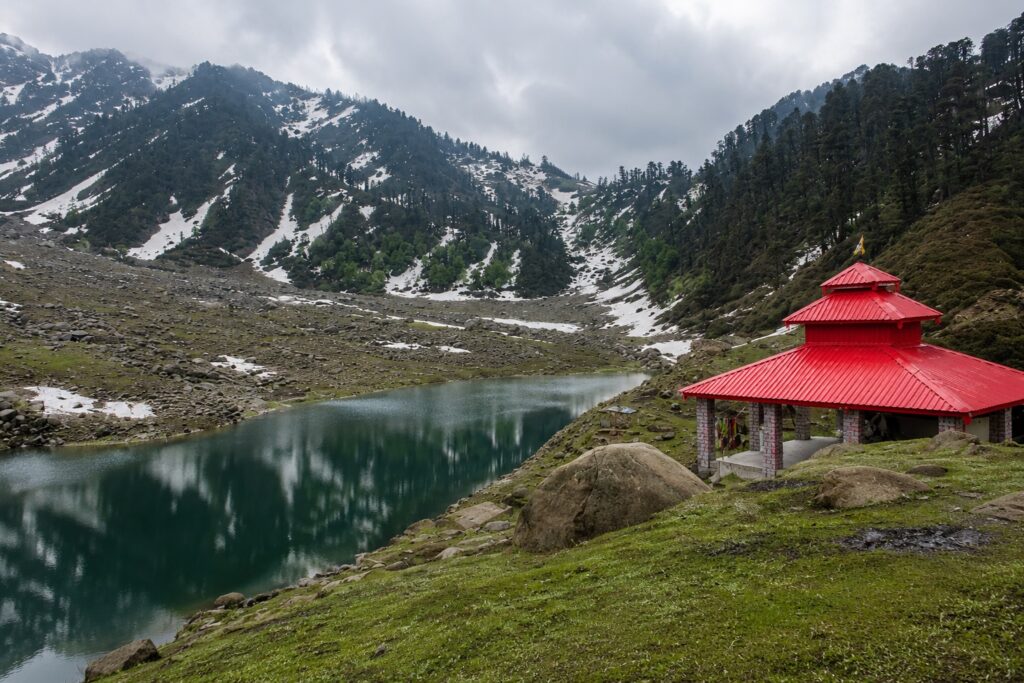
Kareri is a trek, not a drive, and worth flagging because people spot it on lists like this and assume they can pop over.
You drive about 22 km to Kareri village, then walk: a high glacial lake at roughly 2,934 m, usually done as a one to two day hike.
For anyone who likes their payoffs earned on foot, it is among the most beautiful in the whole Dhauladhar.
For the spots most travellers never reach, the quieter villages, the smaller trails, and the corners well beyond this circuit, see my guide to the offbeat places in Dharamshala.
How Many Days Do You Need in Dharamshala?
Two to three days is enough to see the essentials of Dharamshala, and four lets you do it justice without rushing.
One day really only covers McLeod Ganj and the Dalai Lama Temple. With two you can add Triund or the town-side sights. With three or four you can fold in a day trip like Palampur or Kangra Fort.
Here is how I would shape the shorter trips.
If You Only Have One Day
Start early at the Tsuglagkhang Complex for the morning calm and the kora, wander McLeod Ganj’s square and Temple Road, walk up to Bhagsu Waterfall and the Shiva Café for lunch, and save the last hour for sunset at Naddi.
It is a full day, but an honest taste of the place.
If You Have Two Days
Give day one to all of the above.
On day two, choose your mood: trekkers should take on Triund (an early start, back by evening), while everyone else can do the town-side loop, St John’s Church, Norbulingka, Gyuto, and the cricket stadium, then finish with a café-slow afternoon in Dharamkot.
For three, five, and seven day plans, with the routes mapped out day by day, see my full Dharamshala itinerary.
Where to Stay in Dharamshala
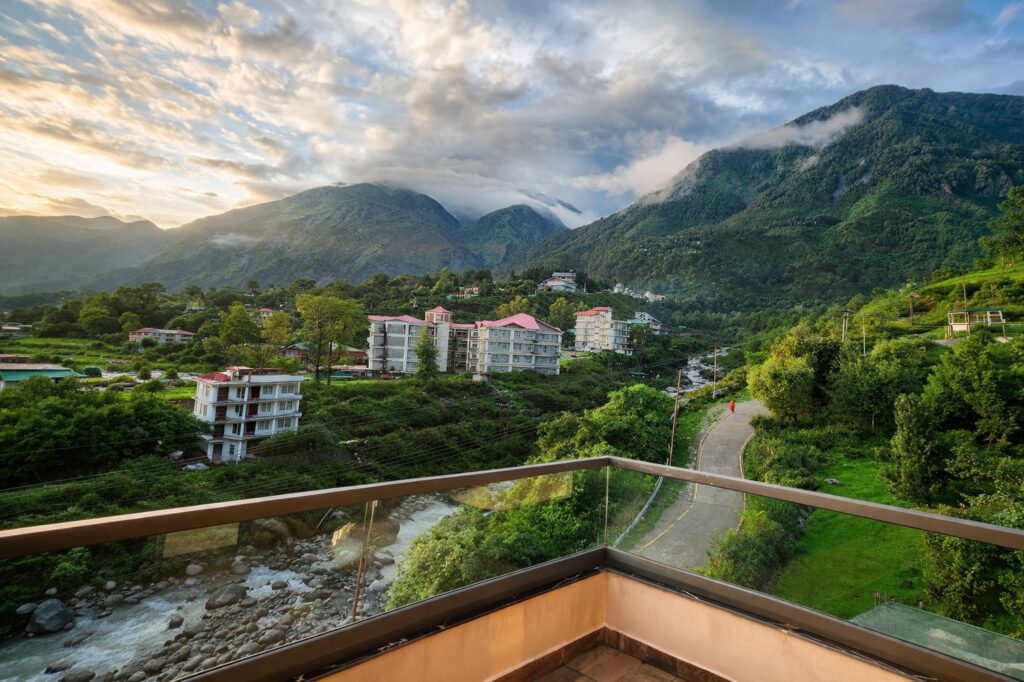
Where you base yourself shapes the whole trip.
McLeod Ganj is lively, walkable, and closest to most of the sights, the easy choice for a first visit. Dharamkot, just above, is quieter and slower, all cafés and long mornings, and suits anyone staying a while. Naddi trades convenience for views and calm. Lower Dharamshala town is cheaper and handy for the stadium and transport, but short on charm.
My own pick, and I will be upfront that it is my own place, is to stay a little outside the rush. I run Manoratham Villa down in Khaniyara, just below McLeod Ganj, and it is built for exactly the traveller this guide is written for: someone who wants quiet, clear mountain views, home-cooked food, and a proper local welcome over a busy hotel lobby.
You give up a few minutes’ drive into town and get back stars at night and a host who can actually point you to the right places. If that is your kind of trip, I would genuinely love to host you.
For the full area-by-area breakdown and specific picks, see my guide to Dharamshala hotels and where to stay, and if you are coming for a longer or remote-work stay, my guide to the best homestays for long-term stays.
Best Time to Visit Dharamshala
The short version: the best times to visit Dharamshala are March to June and September to November, clear Dhauladhar views, comfortable days, and good trekking weather.
The monsoon (July and August) turns the valley impossibly green but brings heavy rain and landslide risk, and winter (December to February) is cold and quiet, with occasional snow up high.
For a month-by-month breakdown see my guide to the best time to visit Dharamshala, for the rainy season specifically the monsoon weather guide, and if you are travelling in June, Dharamshala in June.
How to Reach Dharamshala
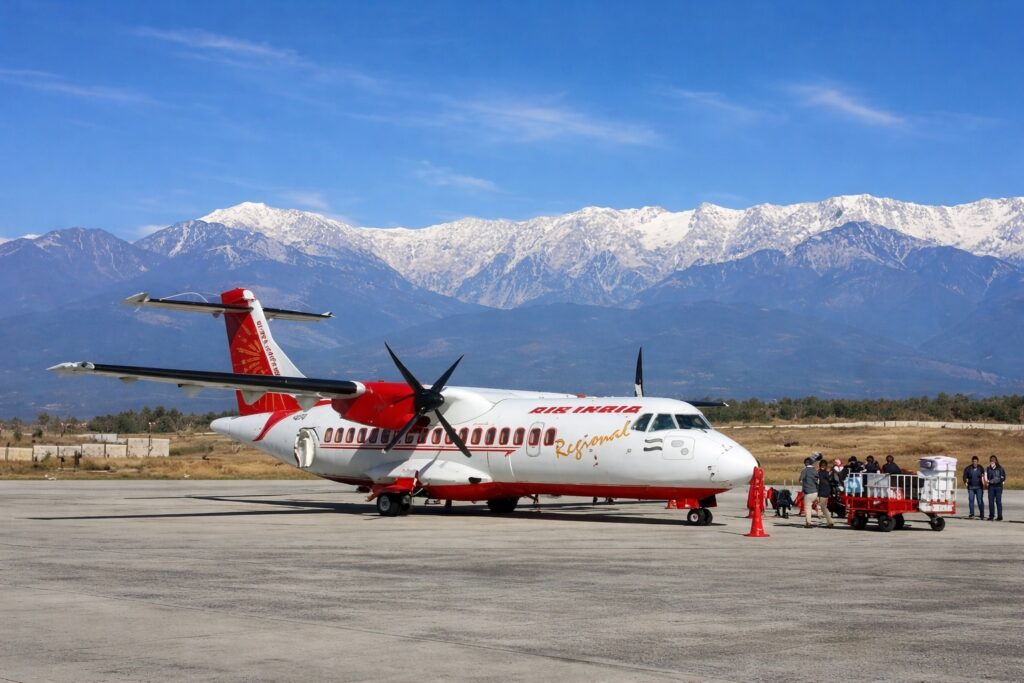
By air, the nearest airport is Gaggal (Kangra Airport), about 13 km away, with flights from Delhi.
By train, the closest broad-gauge railhead is Pathankot, roughly 85 km out, from where you can drive or take the slow, scenic Kangra Valley toy train.
By road, Dharamshala is about 485 km from Delhi (an overnight bus or a 10 to 12 hour drive) and around 250 km from Chandigarh (6 to 7 hours).
For exact routes, timings, and tips from specific cities, see my guide on how to reach Dharamshala.
My Local Tips for Visiting Dharamshala
A few honest things I tell every guest before they arrive:
- Carry layers even in summer. Mornings and evenings turn cold fast at this altitude, whatever the afternoon felt like.
- Leave slack, not a checklist. Mountain weather and mountain roads do not care about your itinerary, and the people who enjoy Dharamshala most are the ones who leave room to do nothing.
- Walk where you can. McLeod Ganj’s lanes are steep but short; save taxis for the spread-out town-side sights, not the McLeod Ganj core.
- It is gentle on the wallet. Dharamshala is one of the more affordable hill stations. You can eat and stay well on very little. I have put real numbers to it in my guide to the cost of living in Dharamshala.
- It is easy to settle into for a while. If you are thinking of working remotely from here, I have written honestly about the Wi-Fi, the cafés, and the catches in my guide to remote work in Dharamshala.
- It is safe, including for women travelling solo, with the usual hill-town common sense (skip isolated trails after dark, use registered taxis). My full, honest take is in the guide to solo female travel in Dharamshala.
Final Thoughts
That is my honest, lived-in answer to the two questions every guest asks me: the best places to visit in Dharamshala, and the best things to do once you are here.
Take the clusters in the order they fall, leave room to do nothing, and let McLeod Ganj set the pace.
This is a place that rewards people who slow down for it.
Come for the mountains, stay for the quiet, and if you ever find yourself down in Khaniyara, say hello.
Frequently Asked Questions
What are the best places to visit in Dharamshala?
The best places to visit in Dharamshala are the Dalai Lama Temple (Tsuglagkhang Complex), McLeod Ganj, Bhagsu Waterfall, the Triund Trek, Naddi Viewpoint, Norbulingka Institute, Gyuto Monastery, the HPCA Cricket Stadium, St John in the Wilderness Church, and Kangra Fort. Most sit in or around McLeod Ganj, so you can see a lot on foot.
What are the top things to do in Dharamshala?
The top things to do in Dharamshala are trekking to Triund, riding the Skyway cable car, sitting in on morning prayers at a monastery, café hopping in Dharamkot, eating Tibetan food in McLeod Ganj, paragliding near Bir Billing, and watching the sun set over the Dhauladhar range.
How many days are enough for Dharamshala?
Two to three days covers the essentials, and four lets you add a trek or a day trip without rushing. One day is enough only for McLeod Ganj and the Dalai Lama Temple.
Should I stay in McLeod Ganj or Dharamshala?
For a first visit, stay in McLeod Ganj: it is walkable, lively, and closest to the main sights. Lower Dharamshala town is cheaper and quieter, but you will lean on taxis. For slower stays, Dharamkot or Naddi are calmer still.
Is Dharamshala worth visiting?
Yes. Few places in India combine Himalayan views, living Tibetan culture, easy treks, and a genuinely relaxed pace the way Dharamshala does, and it manages it on a modest budget.
What is Dharamshala famous for?
Dharamshala, and McLeod Ganj in particular, is famous as the home of the Dalai Lama and the Tibetan government in exile, along with the Dhauladhar mountains, the Triund Trek, and one of the highest, most scenic cricket stadiums in the world.
When should I avoid visiting Dharamshala?
Avoid the peak monsoon weeks of July and August if you can. Heavy rain brings landslides and road closures and hides the views. Deep winter, especially January, is beautiful but cold, with the chance of snow disrupting travel.
Pingback: Best Treks in Dharamshala: A Local Guide from Easy Walks to Himalayan Passes - manoratham.com
Pingback: Remote Work in Dharamshala: Why People Are Moving Here & What To Know First - manoratham.com
Pingback: Best Homestay in Dharamshala for Long-Term Stays: A Local’s Practical Guide - manoratham.com
Pingback: Dharamshala Weather Guide: Monsoon Season, Rainfall, Safety & Travel Tips - manoratham.com
Pingback: A Complete Guide to Tibetan Buddhist Monasteries In & Around McLeod Ganj - manoratham.com