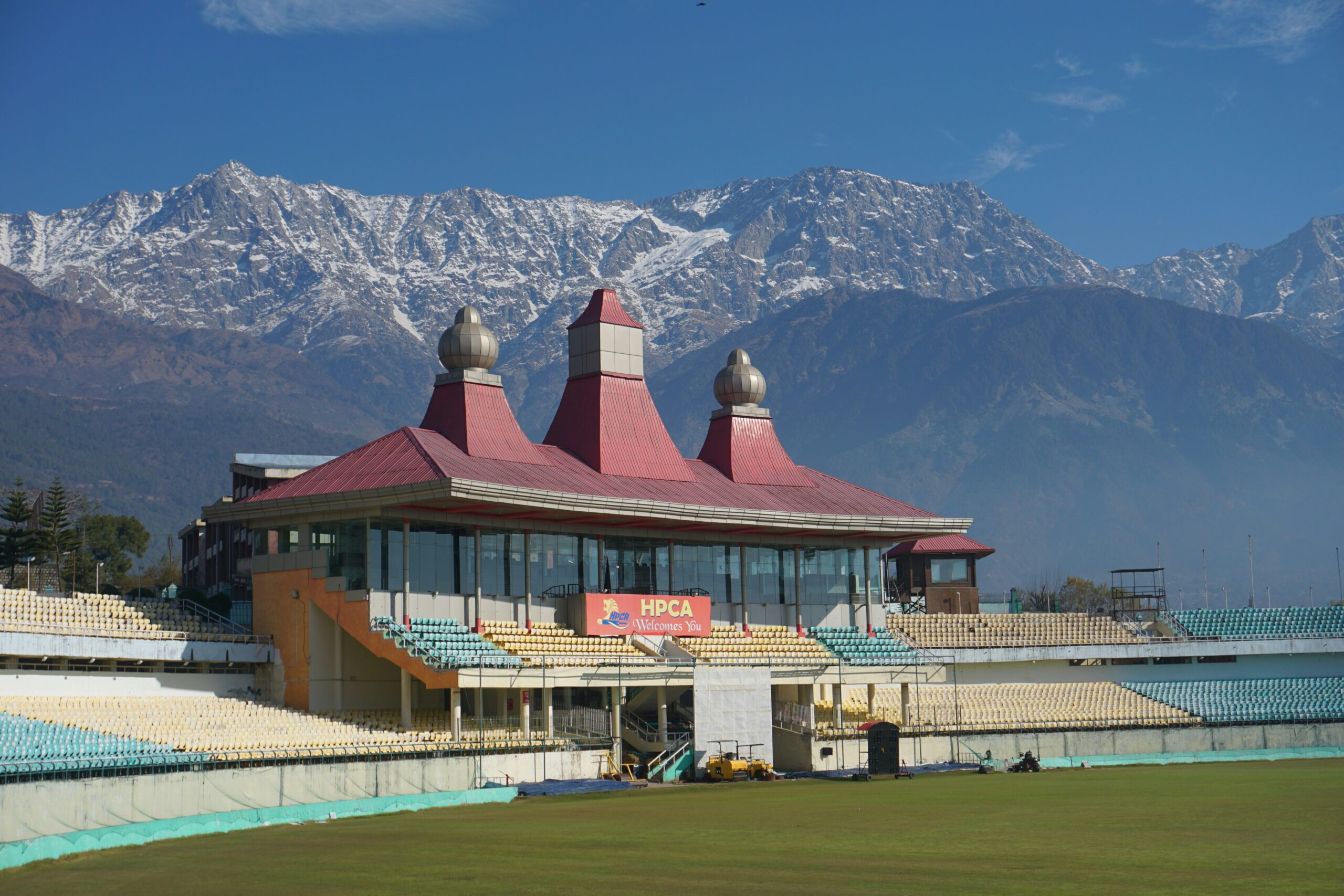
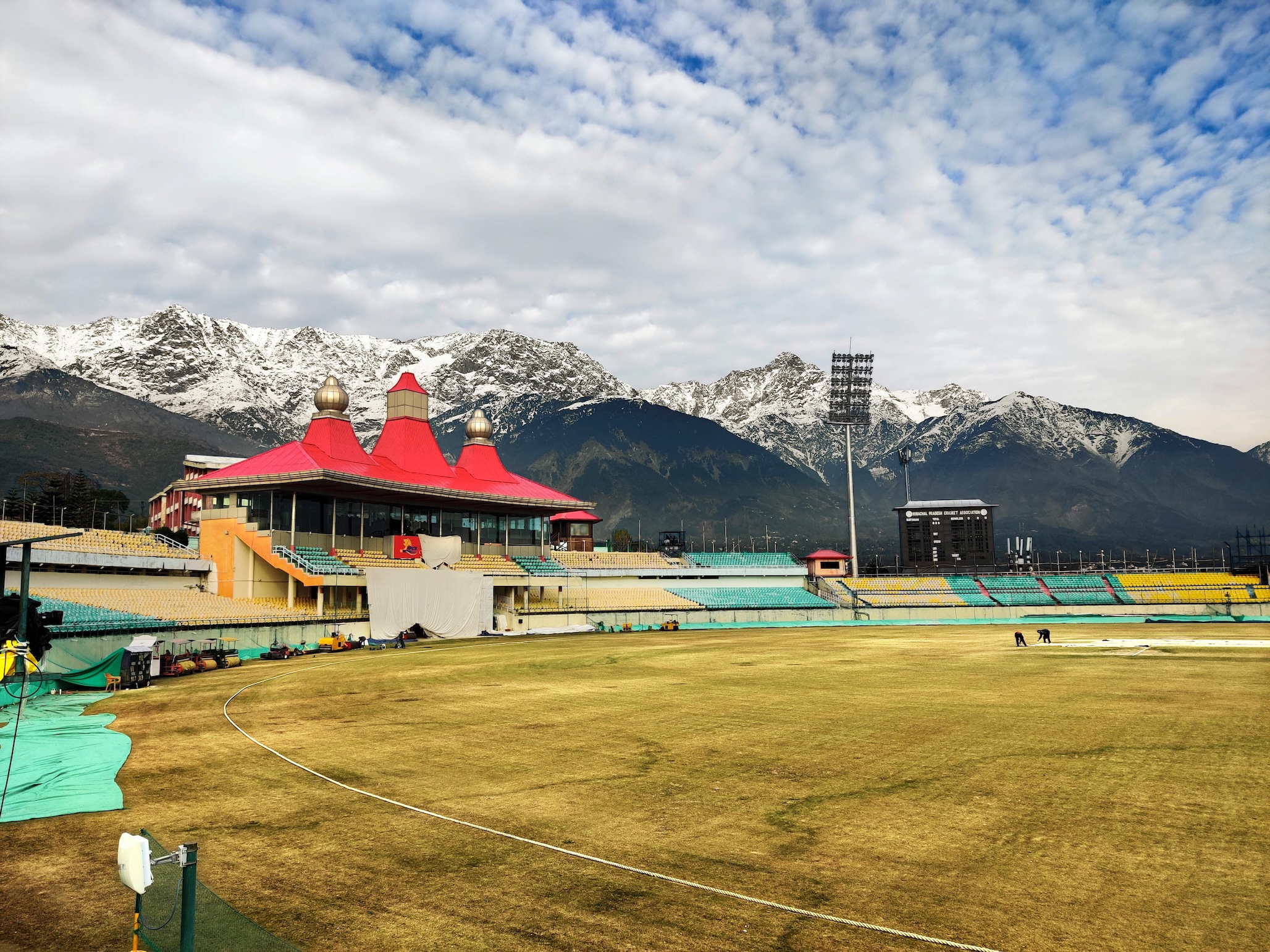
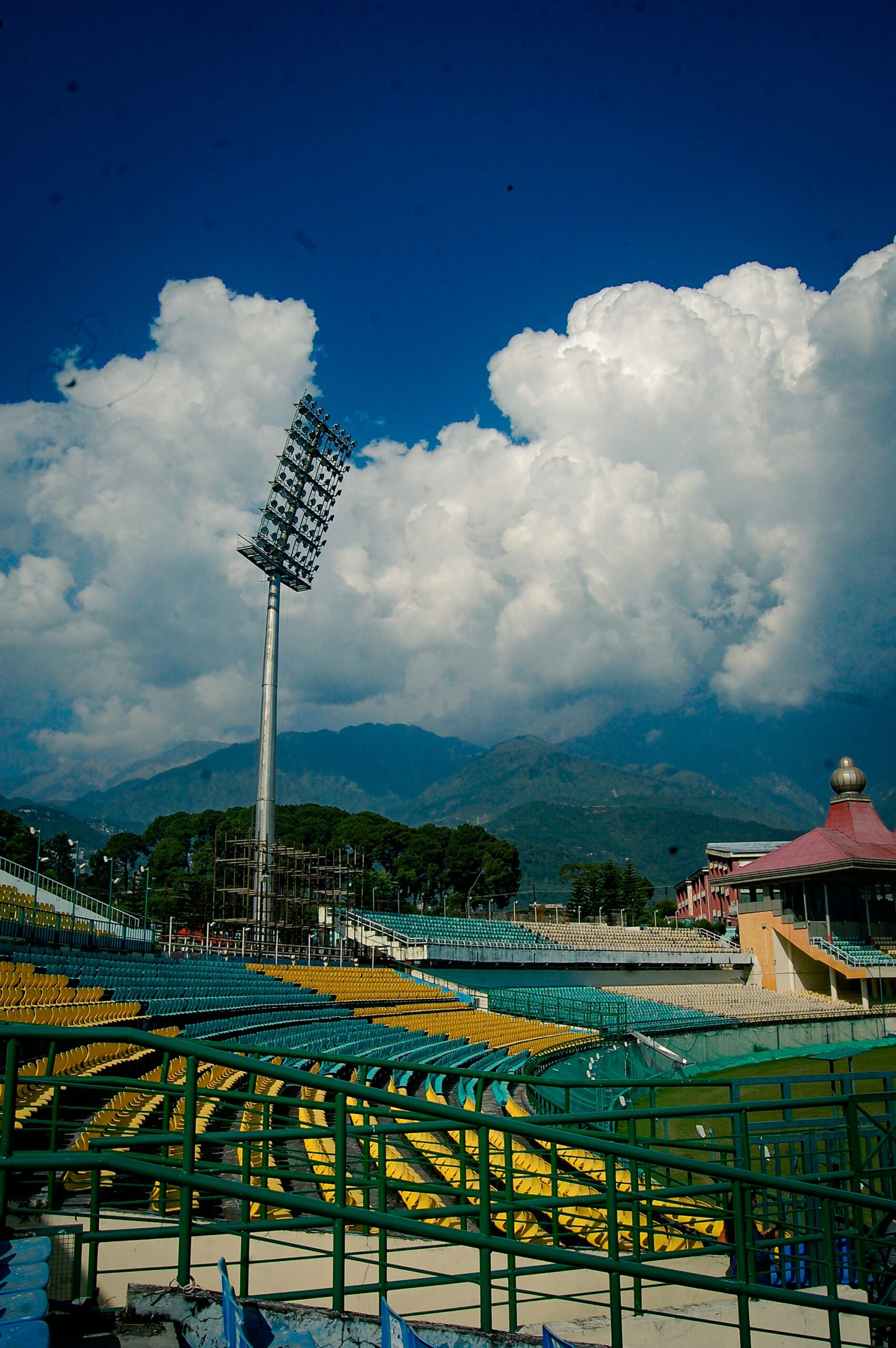
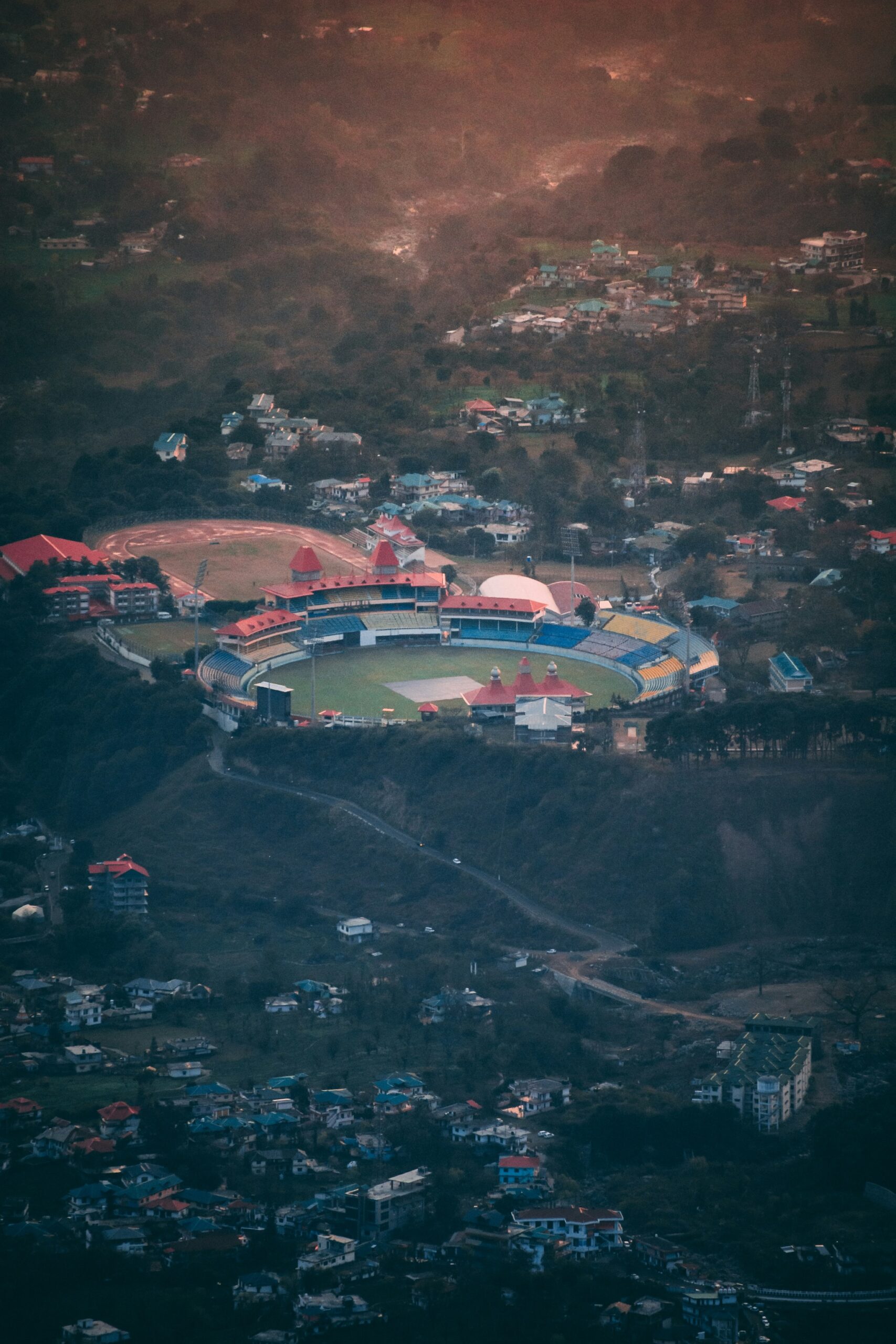
Unlike other major cities, cricket in Dharamshala doesn’t overtake the place. It fits into it. This is evident with the placement and setting of the stadium in Dharamshala. On your way to the stadium, you will find no billboard hoardings taking over the view and announcing the stadium. Instead a gentle bend in the road will give way to the pine trees and almost casually the HPCA Stadium will appear.
Green. Quiet. Backed by mountains that don’t seem impressed by sport, or crowds, or floodlights.
And that difference shapes everything that follows, how matches are played, how crowds behave, how players talk about the ground long after they’ve left.
Long before the stadium was made, Dharamshala was known for a very different rhythm. If you’re visiting for the first time, this broader Dharamshala travel guide2026 will help you understand how experiences like the stadium fit into the larger character of the town.
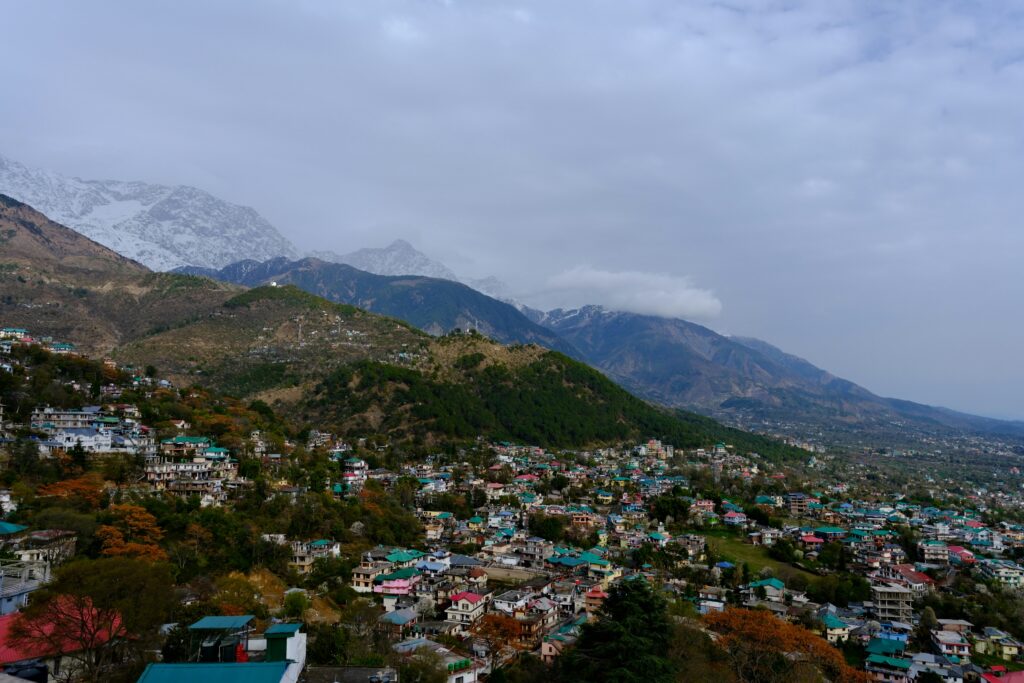
It was associated with monasteries, forest walks, cafes where conversations drifter and did not feel rushed. Everyday was decided by the weather and not the calendars. Even today, Dharamshala resists urgency. Shops open a little later in the day. Afternoons stretch longer than expected.
When I first heard that a cricket stadium was proposed to be open in my town, I wondered whether the world of professional sport could coexist with the mountain stillness or not.
I later realised, that it was not a takeover, but a compromise.
Table of Contents
Table of Contents
The Geography That Changes the Game
The HPCA Stadium sits at roughly 1,450 metres above sea level, making it one of the highest international cricket grounds in India. This change in altitude isn’t just a statistic but is felt like a a sensation.
Players feel it when they warm up. Spectators feel it when the sun dips and the temperature drops faster than expected. The ball feels it when it carries just a little more crisply off the bat.
Fast bowlers often talk about the first few overs here with a mix of excitement and caution. The air is thinner, the bounce sharper and the margin for error is smaller. Batters, feel the difference too when their mistimed shots don’t travel the way they do at sea level.
Just like mountains challenge people, without noise, drama or warning the Dharamshala cricket stadium also challenges the players who hold matches here.
Why This Stadium Feels Smaller Than It Is (And Why That’s Good)
Over the years, international players have commented on how Dharamshala cricket stadium feels like a more neutral and respectful stage rather than being competitive and hostile.
This is attributed to a comparatively low seating capacity of 23,000. In my experience, the stands are low, open and designed in a way to step back from the scenery rather than block it. There’s no sense of being swallowed by concrete. Even when the stadium is full, it feels breathable.
This intimacy changes crowd behaviour.
Instead of constant noise, there are waves of sound. Instead of tension, there’s curiosity. Instead of hostility toward visiting teams, there’s appreciation for good cricket.
Cricket Arrives, But Dharamshala Remains
On match days, the town changes — but subtly.
Taxis run more frequently. Tea stalls outside the stadium do brisk business. Locals walk past the gates, pause for a moment, and continue on with their day.
There’s no sense that the town belongs to the match, but the match belongs to the town. This balance is what gives Dharamshala its strange power as a cricket venue. It doesn’t feed off chaos or pressure. It feeds off calm.
And that calm seeps into the cricket itself.
A Ground Players Remember Long After They Leave
Ask players about Dharamshala Cricket stadium months later, and their memories are rarely technical.
They talk about:
waking up to mountain views from hotel balconies
evening walks without being mobbed
Peaceful morning runs on mountain roads
quiet dinners before high-pressure games
feeling oddly relaxed before high pressure international games
Many have said it feels more like an overseas tour than a home series — not because it’s unfamiliar, but because it pulls them out of routine.
For some, that’s unsettling. For others, it’s liberating.
The Making of a Mountain Stadium: Architecture, Intent, and the Matches That Defined HPCA
A Stadium That Didn’t Want to Dominate
Most cricket stadiums are built to announce themselves. They rise abruptly from their surroundings, loud even when empty, designed to impress long before the first ball is bowled. The HPCA Stadium took the opposite path.
Here, the intent was never to overpower the landscape, but to become a part of it. The brief was simple: build a world-class cricket venue that doesn’t interrupt the mountains behind it.
That philosophy explains why the stadium feels different to us the moment we walk in. The stands are lower than expected. The lines are clean. There’s an openness to the structure that allows the Dhauladhar mountain range to remain the most dominant presence in our field of vision.
Why Capacity Was Never the Point
With a seating capacity of around 23,000, HPCA Stadium is smaller than many Indian venues. But this was a deliberate choice, not a limitation.
In cities, capacity equals revenue and spectacle. In Dharamshala, capacity was weighed against:
evacuation feasibility in a hill town
environmental impact
visual intrusion into a sensitive landscape
The result is a stadium that fills comfortably without feeling congested. Even when sold out, movement remains fluid. Sound carries evenly, without becoming oppressive. The crowd feels present, not packed.
For players, this creates a rare sensation: pressure without claustrophobia.
The Pavilion and the View Players Never Forget
Ask players what they remember most vividly about Dharamshala, and many will mention the pavilion view.
From the dressing rooms, the direct view is of the mountains. It’s not uncommon for players to pause mid-stride, kit bag slung over a shoulder, just to take it in. Several have admitted that it’s one of the few grounds where you need to remind yourself to focus on the game.
In the Dharamshala cricket stadium the player’s where nerves soften, their routines slow down, and the seriousness of international cricket briefly gives way to awe.
The Test That Changed Everything: India vs Australia, 2017
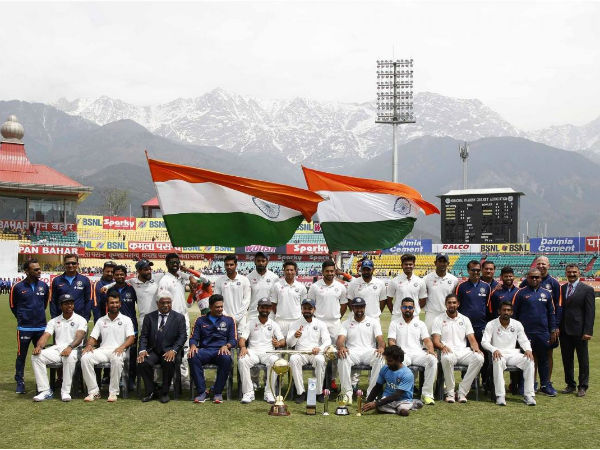
Every stadium has a moment that defines it. For Dharamshala cricket stadium, that moment arrived during the 2017 India vs Australia Test Match.
By the time the series reached Dharamshala, tension was already high. The pitch became the centre of intense scrutiny even before the first ball was bowled. Critics questioned its preparation. Commentators debated its fairness. Cameras lingered on the surface as much as the players.
What followed was a Test match that demanded adaptability above all else.
Fast bowlers found movement. Batters had to earn every run. Mistakes were punished quickly. Australia emerged victorious, handing India a rare home Test defeat.
The aftermath was noisy, but something important happened beneath the controversy: the cricketing world realised Dharamshala was not ornamental.
It was capable of producing results. It could test technique. It could host the game at its most demanding level.
For many players, that Test cemented the ground’s reputation — not as an outlier, but as a legitimate venue with its own personality.
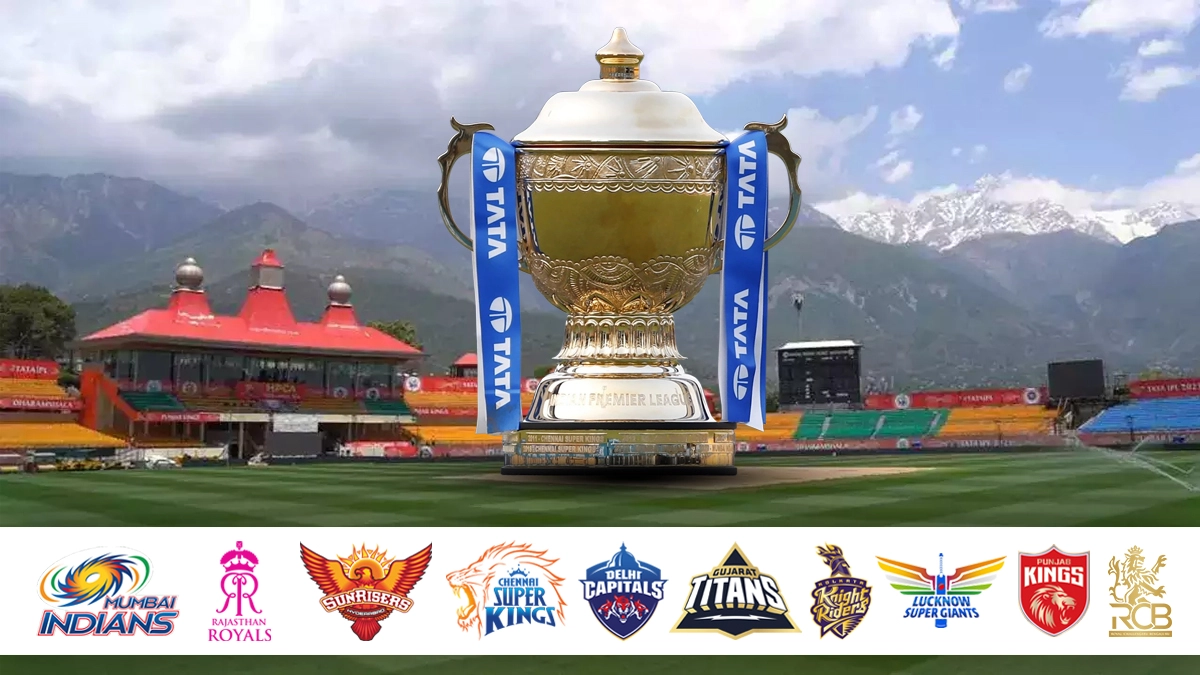
When the IPL Came Calling
The arrival of the Indian Premier League added another layer to Dharamshala’s story. While Test cricket revealed Dharamshala’s edge, white-ball matches revealed its charm. In ODI’s and T20Is early overs often favour bowlers especially under overcast conditions. Which is why, white ball matches here tend to unfold with a different rhythm.
IPL matches here feel almost celebratory. Because fixtures are limited, anticipation builds quickly. Fans plan trips around dates. Hotels fill with a mix of cricket followers and mountain travellers who’ve timed their vacations just right.
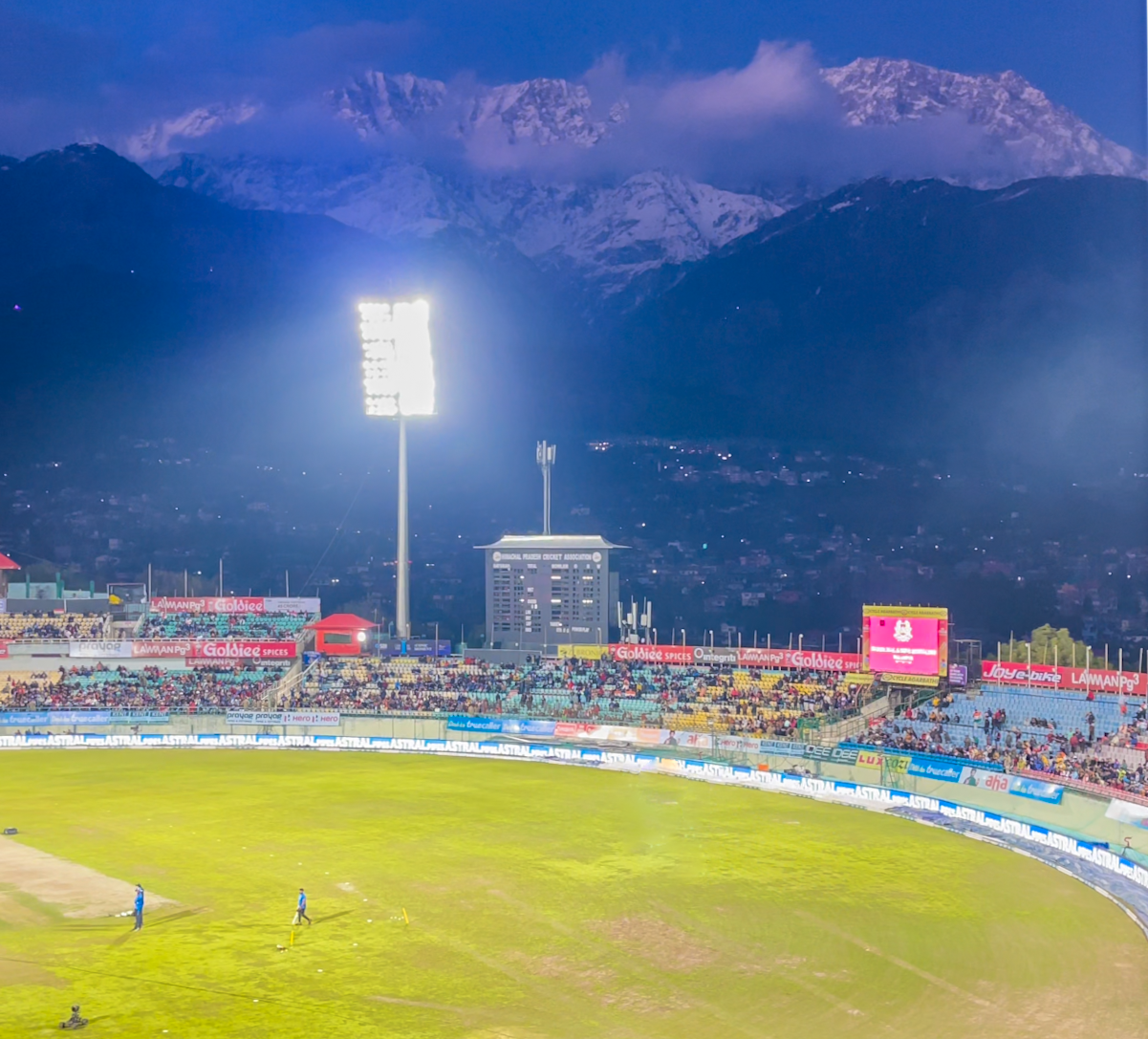
Day games feel cinematic, bathed in mountain light. Night games feel surreal, floodlights cutting through cool air while the mountains recede into darkness.
Players often describe IPL matches here as a welcome contrast. It is high-pressure cricket in a low pressure environment.
When the IPL Comes to the Hills: Crowds, Characters, and Evenings Under Floodlights
This is a particular evening in Dharamshala when the town begins to feel different. Taxis arrive a little earlier. Café tables fill faster. Jackets are pulled from cupboards even though the sun is still out. Near the stadium gates, the first vendors set up flasks of tea and stacks of momos, steam curling upward as if to announce what’s coming.
This is what match day feels like when the Indian Premier League comes to the hills.
How Players Experience IPL Pressure Here
IPL is relentless — travel, media, expectations, short turnarounds. Dharamshala offers players a rare pause within that chaos.
Several players have mentioned:
sleeping better here
feeling less mentally crowded
enjoying the slower evenings
Some teams arrive earlier than necessary, just to adjust and soak in the environment. Others schedule lighter practice sessions, allowing players to explore briefly or simply rest.
It’s one of the few IPL venues where calm becomes a competitive advantage.
Off the Field: Small Rituals, Quiet Moments
Between matches, players are often spotted doing very ordinary things.
A quiet coffee in McLeod Ganj. A short walk near their hotel. A drive toward Khaniyara just to see the valley open up.
They are rarely mobbed. Locals notice, nod, and move on. This anonymity is precious during a tournament that otherwise offers very little privacy.
The Pitch, the Air, and the Evening Chill: How Dharamshala Shapes the Game Itself
No matter how beautiful the mountains are, cricket grounds are ultimately judged by one thing: how the game behaves once the ball is in motion.
And the HPCA Stadium does not behave like most Indian grounds.
The First Over Tells You Everything
Players often say you know what kind of day it’s going to be in Dharamshala within the first two overs.
The ball comes on just a little quicker than expected. Not dramatically, not violently but enough to make batters recalibrate. Fast bowlers, especially those who hit the deck hard, feel encouraged almost immediately. There’s carry through to the wicketkeeper. Edges don’t always die in front of slips.
It’s subtle. But cricket is a game of subtleties.
This is why the Dharamshala cricket stadium pitch report almost always begins with a caveat: conditions matter as much as the surface.
A Pitch That Rewards Patience, Not Ego
Dharamshala isn’t the kind of surface where brute force bails you out. Unlike flatter tracks, this pitch quietly asks batters to slow down and listen. In my experience, the ones who succeed here do the basics well which is playing the ball late, keeping their movements compact, and trusting timing over muscle.
There’s a subtle trap too. The outfield and altitude might whisper go big, but mistimed shots don’t always travel far enough. Lofted drives tend to hang in the air just a fraction longer, inviting fielders into the game. This is a pitch that doesn’t punish aggression but it simply exposes impatience.
For spectators, that’s what makes Dharamshala special. The early overs unfold like a thoughtful exchange between bat and ball, where every run feels earned. It’s not a mindless assault it’s a contest, and that’s where the beauty lies.
Why Fast Bowlers Love It Here
The fast bowlers feel a sense of joy to play in Dharamshala.
The reasons are layered:
Altitude: slightly reduces air resistance and gives sharper carry
Several international pacers have described Dharamshala as one of the few Indian venues where bowling fast feels genuinely rewarding, especially with a new ball.
It’s not swing-dominated like England. It’s not seam-heavy like New Zealand. But it sits somewhere in between which makes it a hybrid challenge that requires thought rather than muscle.
The Altitude Factor: Not Dramatic, But Decisive
At around 1,450 metres above sea level, Dharamshala doesn’t scream “high altitude” the way some overseas venues do. Instead, it whispers.
Players don’t struggle to breathe. There’s no dramatic fatigue. But over long spells, especially for fast bowlers, the thinner air does begin to matter. Recovery between overs feels slightly slower. Hydration becomes more important. Warm-ups stretch longer.
Batters, notice it, when they judging catches and boundary distance becomes difficult. The ball behaves just differently enough to disrupt muscle memory built on sea-level grounds.
This is why visiting teams often schedule longer practice sessions here. Familiarity matters.
Weather: The Invisible Third Team
Cricket at HPCA Stadium is rarely just a contest between two sides. Weather is always present. It is sometimes cooperative, sometimes intrusive and always influential.
Morning Sessions
Morning matches or early Test sessions often begin under crisp conditions. The air is cool. The pitch retains a hint of overnight moisture. Seamers feel in control.
Batting at this time requires patience and respect.
Afternoon Calm
As the day progresses, the pitch settles. Batting becomes easier. Shadows shorten. The game finds its balance.
This is often when partnerships are built.
Evening Shift
Then comes the moment Dharamshala is famous for.
The sun dips behind the Dhauladhars. Temperatures drop quickly. Dew begins to settle. The outfield grows slick. Bowlers wipe their hands repeatedly. Spinners struggle for grip.
This is where captains’ decisions at the toss begin to echo loudly.
Why the Toss Matters More Here Than Most Places
In white-ball cricket, the toss at Dharamshala is rarely a formality.
Captains often prefer to bowl first, anticipating:
improved batting conditions under lights
dew reducing grip for bowlers
faster outfield in the second innings
Several IPL matches here have followed this script equals tight first innings, freer chases later on.
Yet, the ground has enough variability to punish overconfidence. Chasing teams that start too aggressively often lose wickets quickly, reminded that conditions help only those who respect them.
When Conditions Interrupt the Script
Dharamshala has produced moments that simply don’t occur elsewhere.
There have been instances where:
low-hanging clouds delayed play despite no rain
visibility dropped suddenly as mist rolled in
temperatures fell sharply mid-session
Players have waited in jumpers, fans wrapped shawls tighter, and the game paused not by weather in the conventional sense, but by the mountains asserting themselves.
Instead of frustrating you, the interruptions quietly changes how you experience the game. You are reminded that here, cricket operates with permission, not control.
Groundsmen: The Quiet Custodians of Balance
Maintaining a pitch in Dharamshala is an exercise in patience and precision.
The grounds staff work against:
cold nights
fluctuating moisture
sudden weather shifts
Preparation often begins before sunrise. Covers are monitored obsessively. Drainage is watched closely. Every decision is about balance between firmness and moisture, pace and playability.
Their work rarely makes headlines, but players frequently acknowledge the challenge they manage.
What Players Say About Playing on This Pitch
Across interviews and casual remarks, a pattern emerges.
Players describe Dharamshala as:
“honest”
“testing without being unfair”
“a thinking player’s ground”
Many also say it’s a venue where you feel rewarded for preparation. Those who arrive early, practice longer, and pay attention tend to do well.
It’s a ground that respects effort.
The Approach to the Stadium
As you get closer to the HPCA Stadium, the energy sharpens. You hear it before you see it.
Outside the gates:
families take photos with mountains in the background
children argue over team colours
locals explain the best stands to first-timers
There’s excitement, but also a sense of courtesy. Lines form naturally. Conversations happen easily. Even security checks feel calmer than usual.
It’s IPL — but without the frenzy. You can view the exact location here.
Day matches in Dharamshala are almost unfair in their beauty.
As the first innings unfolds, the mountains sit clearly in the background, sunlight moving slowly across ridges. Shadows lengthen across the field. Every lofted shot feels framed.
Players often talk about how difficult it is to stay focused during these games. Your peripheral vision keeps pulling you outward toward the sky, the clouds, the changing light.
For spectators, this is cricket at its most visual. You don’t just watch the game; you watch the day pass.
Night Matches: When the Stadium Becomes a Lantern
Evening IPL matches are where Dharamshala becomes unforgettable.
As the sun slips behind the Dhauladhars, temperatures drop quickly. Jackets appear across the stands. Floodlights come on one by one, illuminating the field while the mountains retreat into darkness.
The effect is surreal — a bright oval suspended in cool mountain air.
Sound behaves differently at night here. Cheers echo softly, then fade. You can hear appeals clearly. The thud of ball on bat feels sharper.
Players often say night games here feel intimate despite the stakes. There’s pressure, yes, but it’s a quieter, more focused kind.
Crowd Culture: Passion Without Hostility
One of the most commented-on aspects of IPL matches in Dharamshala is the crowd itself.
They are passionate, certainly. Boundaries are celebrated loudly. Wickets bring roars. But there’s also restraint which is an understanding of the game that shows in applause for good cricket, regardless of team.
Visiting players have spoken about this with appreciation. It’s rare to feel supported and challenged at the same time.
For neutral fans, this makes Dharamshala a particularly pleasant venue. You don’t feel drowned in allegiance. You feel included in the experience.You can view the exact location below.
Match-Day Checklist: Watching Cricket at Dharamshala Cricket Stadium
Use this checklist to plan your visit so you don’t miss anything important.
Tickets & Entry
Check official ticketing platforms (BookMyShow / Paytm Insider)
Buy tickets as soon as sales open (7–14 days before match)
Save mobile ticket + carry photo ID
Note your entry gate number mentioned on the ticket
👉 If you’re travelling specifically for a match, it’s best to book accommodation early. You can refer to my detailed guide onbest hotels in Dharamshala and nearby areasto choose a stay close to the stadium.
Match Timings & Arrival
Check match start time (day matches often start early)
Plan to reach stadium area 90 minutes before start
Expect traffic restrictions near the venue
Be prepared to walk the last stretch
Getting to the Stadium
Book a local taxi or hotel-arranged cab
Avoid driving yourself (limited parking)
Wear comfortable footwear
👉 Staying in Dharamshala town makes match-day travel easier than McLeod Ganj.
What to Carry (And What Not To)
Carry
Mobile phone
Wallet / small purse
Sunglasses / cap
Light jacket or sweatshirt
Do NOT carry
Power banks
Large bags or backpacks
Outside food or drinks
Professional cameras
Seating & Viewing Experience
Choose upper stands for mountain views
Choose lower stands for closer on-field action
Expect a compact, intimate stadium layout
No truly “bad” seats due to smaller capacity
Food & Facilities
Eat before arriving if you prefer full meals
Expect basic snacks and beverages inside
Use washrooms during overs, not breaks
Weather Prep (Very Important)
Check forecast on match day
Carry a light jacket even for afternoon games
Be mentally prepared for sudden cloud cover or rain
Keep plans flexible during monsoon months
Stay Planning (Strongly Recommended)
Book stay before buying match tickets (flexible cancellation helps)
Prefer Dharamshala town for late-night convenience
Choose McLeod Ganj only if sightseeing is your priority
👉 For a detailed breakdown of areas, budgets, and hotel types, see my complete guide onwhere to stay in Dharamshala.
Final Things to Keep in Mind
Facilities are simpler than metro stadiums
Crowd size is smaller, atmosphere is calmer
The setting is the real highlight — enjoy it
Plan ahead and keep expectations realistic
Where Players Retreat: Hotels, Off-Days, and the Quiet Life Between Overs
If the stadium is where the spectacle happens, Dharamshala’s true influence on players is felt after the stumps are drawn and the floodlights switch off. This is the part of the story cameras rarely capture — the hours when professional athletes become, briefly, ordinary travellers in a hill town that doesn’t demand their attention.
Choosing Quiet Over Closeness
Teams arriving in Dharamshala are selective about where they stay. Proximity to the ground matters, but quiet matters more. Unlike cities where teams tuck into central business districts, here they gravitate toward properties that offer space, views, and insulation from crowds.
Three names surface again and again in conversations around touring sides:
Hyatt Regency Dharamshala Resort
HPCA Pavillion
Radissons Blu Resort
All are situated away from the tourist bustle, offering mountain-facing rooms, controlled access, and the kind of calm that matters when bodies are bruised and minds are busy replaying the day’s overs.
Players often speak about waking up here and instinctively stepping out onto balconies to look at the mountains and weather, to recalibrate before the day begins.
Mornings That Start Without Rush
Match mornings in Dharamshala begin differently.
Breakfasts stretch a little longer. Conversations are quieter. There’s less urgency in movement. Coaches might review footage, but often they don’t. Sometimes the best preparation here is simply allowing players to feel rested.
Several team staff members have mentioned that Dharamshala is one of the few tour stops where sleep quality noticeably improves. Cooler nights, cleaner air, and fewer distractions combine into something deceptively powerful.
By the time the team bus leaves for the stadium, players are already settled and energised mentally and physically.
Off-Days: How Cricketers Spend Time in the Hills
On off-days, players disperse quietly.
Some head towards McLeod Ganj, blending with the international crowd easily into cafés and bookshops. Others prefer the open roads toward Khaniyara or Dharamkot, where the town thins and valleys widen.
What’s striking is the absence of spectacle. No entourages. No social media moments staged for attention. Just cricket players in hoodies and caps, sipping coffee, browsing shelves, sitting in silence.
Local café owners often say the same thing: players here want normalcy, not novelty.
Mental Reset: Why Players Talk About Dharamshala Long After
In interviews months later, players often mention Dharamshala when asked about favourite tour stops — even when matches there didn’t go well.
They talk about:
feeling grounded
having space to think
enjoying cricket without constant noise
One international cricketer once summed it up perfectly: “You feel like yourself again there. Not just a player.”
That sentiment explains why teams rarely complain about the logistics or weather. Dharamshala gives something back which is intangible but valuable.
Visiting the Stadium Without the Noise
On days without matches, the stadium returns to itself.
Visitors walk the stands quietly. The pitch sits untouched. Wind moves across the grass. Without a crowd, you see how small the stadium really is. There is no attempt to impress. No sense of theatre. Just space, light, and restraint.
It’s here, in the absence of cricket, that the design makes the most sense.
Frequently Asked Questions:
1. Is Dharamshala cricket stadium difficult to adjust to for visiting teams?
Yes, especially for teams arriving directly from low-altitude venues. While the altitude isn’t extreme, the thinner air, cooler temperatures, and sharper bounce require a short adjustment period. This is why visiting teams often schedule longer practice sessions here compared to other Indian venues.
2. Does the mountain weather affect match schedules frequently?
Weather plays a role, but outright washouts are less common than people expect. More often, cloud cover, mist, or sudden temperature drops influence visibility or playing conditions rather than causing cancellations. Matches here are more likely to be interrupted or slowed than abandoned.
3. Why do matches in Dharamshala feel quieter even when the stadium is full?
The relatively low seating capacity, open stand design, and surrounding terrain absorb sound differently. Instead of constant noise, the crowd reacts in waves. This creates an atmosphere that feels intimate and attentive, rather than loud or chaotic.
4. Do players actually find it harder to focus because of the scenery?
Surprisingly, yes. Several players have mentioned that Dharamshala is one of the few grounds where the visual surroundings can be distracting, especially during day matches. The shifting light, clouds, and mountain backdrop require a conscious mental reset to stay game-focused.
5. Is the pitch in Dharamshala more suited to fast bowlers or batters?
Neither exclusively. The pitch rewards discipline and patience. Fast bowlers benefit early from carry and bounce, while batters who play late and stay compact tend to succeed. Aggression without adjustment is often punished, especially in the first session.
6. Why is the toss considered especially important at this ground?
Because conditions change noticeably as the day progresses. Evening matches often bring dew, cooler air, and faster outfields, making chasing slightly easier. Captains who misread the weather here tend to feel the consequences more sharply than at flatter venues.
7. How does Dharamshala compare to other scenic cricket venues worldwide?
Unlike grounds built around scenery, Dharamshala feels built within it. The stadium does not dominate the landscape, which is why players often describe it as feeling closer to an overseas tour venue than a typical Indian home ground.
8. Is it possible to visit the stadium on non-match days?
Yes. On non-match days, the stadium is quiet and accessible from the outside, and visitors can walk around the perimeter and nearby stands. Without crowds, the scale of the stadium and its integration with the landscape become even more apparent.
9. Do IPL matches here feel different from international games?
Very much so. IPL matches in Dharamshala feel celebratory but restrained. With fewer fixtures, anticipation is higher, but the town never feels overtaken by the tournament. The result is high-pressure cricket played in a surprisingly calm environment.
10. Why do players often mention Dharamshala long after their matches here?
Because it disrupts routine. Players talk about better sleep, quieter mornings, and a mental reset that’s rare during packed tours. Even when results don’t go their way, Dharamshala tends to be remembered for how it made them feel, not just how they performed.
Final Thoughts: Why Dharamshala Stays With You
Most stadiums are remembered for moments — a six, a spell, a scorecard.
Dharamshala is remembered for shifts.
The shift from light to shadow. From silence to tension. From calm to unease and back again.
It teaches you that peace is not the absence of pressure, but the ability to sit with it.
That’s why people leave this ground changed not exhilarated, not exhausted just quietly affected.
And long after the final over fades from memory, the feeling remains.
Dharamshala, also known as the summer capital of Himachal Pradesh, is situated in the lower Himalayas. It is one of the most loved tourist destinations…