Most guides about famous food in Dharamshala are written by people who visited for a weekend, ate momos at the first place they saw, and called it a food guide. This is not that. I have lived in Dharamshala my entire life. I have eaten at places that don’t appear on Google Maps. I know what locals eat in Dharamshala, what changes with the seasons, and which famous restaurants are genuinely worth your time, and which ones survive purely on tourist footfall.
This guide covers the famous food in Dharamshala, Tibetan food, Himachali food, street food, and the best restaurants across every area, from McLeod Ganj to Lower Dharamshala to Dharamkot and beyond.
If you are planning your trip, start with our complete Dharamshala travel guide 2026, then come back here to plan your meals.If you want a structured plan, our Dharamshala itinerary guide breaks down exactly how to plan 2, 3, 5 or 7 days.
Table of Contents
What to Eat in Dharamshala (Complete guide to famous Food i dharamshala)
Dharamshala is not a single food culture. It is three, layered on top of each other.
The first layer is Himachali: the oldest. Kangri and Gaddi communities have been cooking here for centuries. Madra, siddu, dham, these dishes existed long before Dharamshala became a tourist destination. Most visitors never encounter them because they never leave McLeod Ganj.
The second layer is Tibetan. When the Tibetan exile community settled here in the 1960s, they brought momos, thukpa, thenthuk, and a food tradition built for high-altitude survival. Over decades, this cuisine has evolved into something uniquely Dharamshala, part Lhasa, part adaptation, part fusion.
The third layer is backpacker-international. Israeli shakshuka in Dharamkot. Korean bibimbap in Bhagsu. Italian wood-fired pizza at 1,500 metres. This layer is the newest and the loudest but it is not what makes Dharamshala’s food special.
What makes it special is the first two layers. And that is what most food guides miss entirely.
There is also a geographical split that nobody talks about. Lower Dharamshala and McLeod Ganj feel like two different food cities. Lower Dharamshala is where Himachali families eat, dhabas serving rice, dal, rajma, and seasonal sabzis for ₹80 a plate.
McLeod Ganj is where travellers eat, Tibetan kitchens, Instagram cafes, and international menus. Both are worth exploring, but if you only stay in McLeod Ganj, you are eating in only half of Dharamshala.
If you want to understand the cultural roots behind this food, our guide to Tibetan Buddhist monasteries in and around McLeod Ganj gives you that context.
Famous Tibetan Food in Dharamshala: What to Eat and Where
Tibetan food is what Dharamshala is most famous for, and rightly so. This is one of the largest Tibetan exile communities in the world. The food here is not restaurant-Tibetan. It is home-kitchen Tibetan, cooked by families who brought recipes across the Himalayas and adapted them over sixty years.
Here is what to eat, where to find the best versions, and what most visitors get wrong.
Best Momos in McLeod Ganj: Where to Eat and What to Order
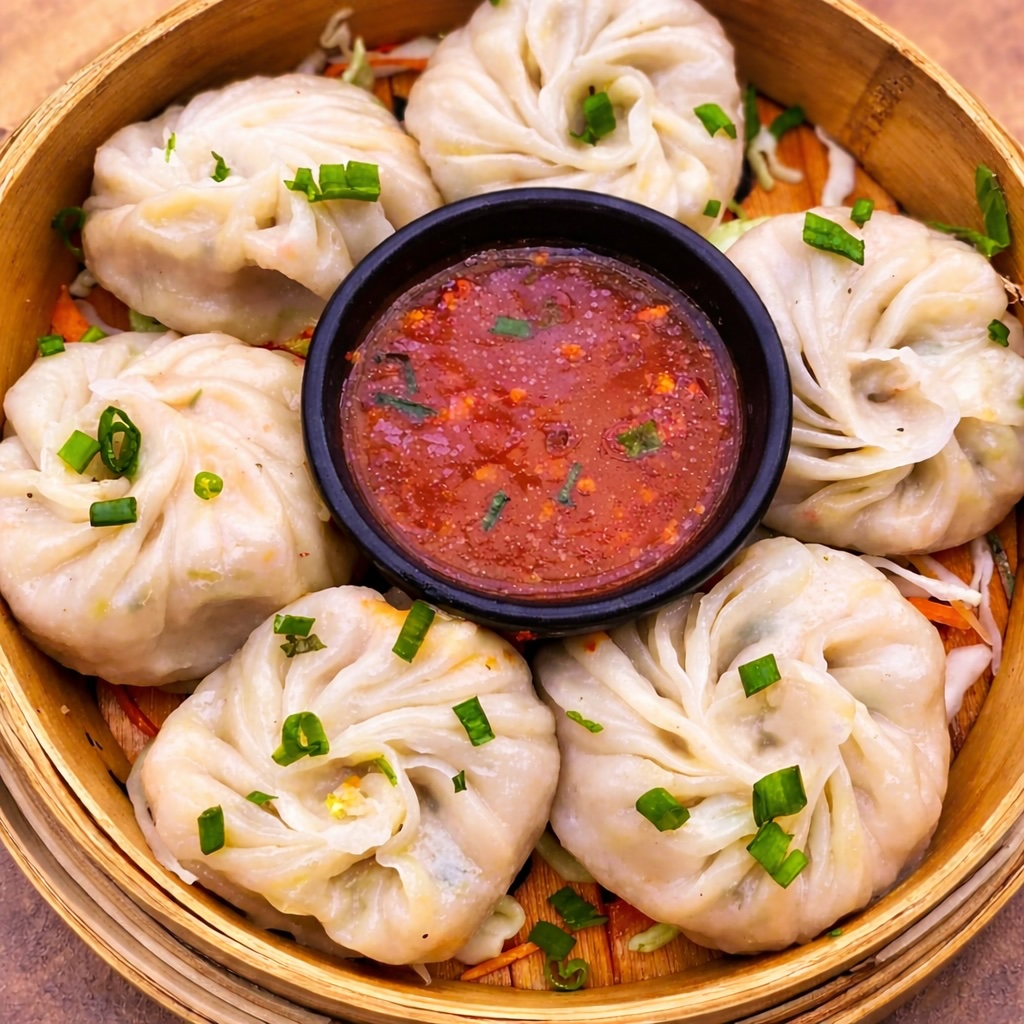
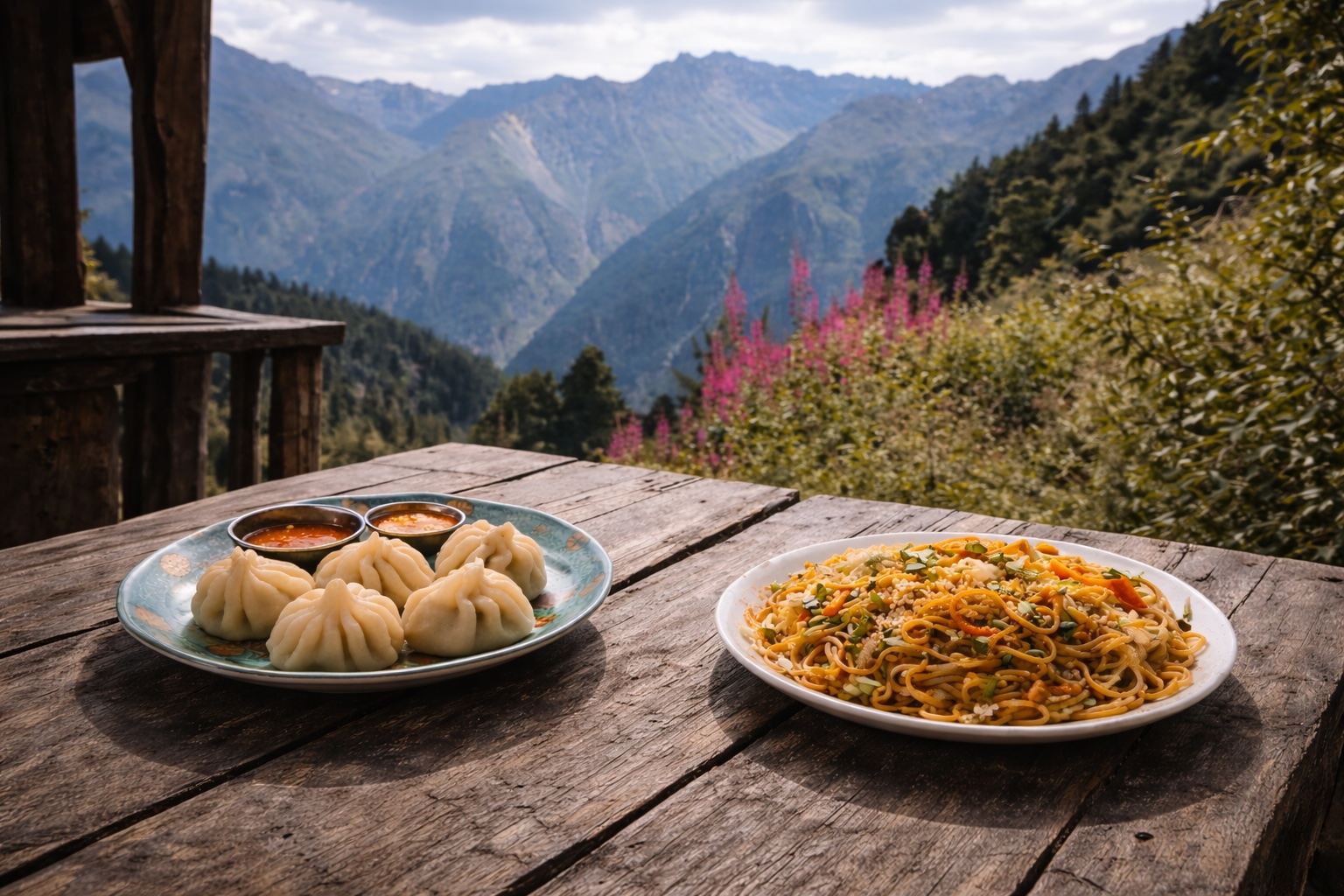
You already know about momos. Every guide mentions them. But here is what most guides don’t tell you.
The best momos in McLeod Ganj are not at the most famous places. The stalls that tourists queue at are often running on reputation, not quality. The momos at smaller Tibetan kitchens, the ones with four plastic tables and a handwritten menu, are almost always better. Fresher filling, thinner wrappers, made to order instead of sitting in a steamer for an hour.
If you’ve read our guide on the best cafés in McLeod Ganj 2026, you’ll notice we briefly mention a few of these local momo spots there too, the kind of places locals quietly return to, not the ones trending on Instagram.
Types you should try:
- Steamed momos: the classic. Thin skin, juicy filling. This is the test of any kitchen.
- Jhol momos: served in a spicy, tangy sesame-tomato soup. This is a Dharamshala adaptation, not a traditional Tibetan dish. It was invented here and it is brilliant.
- Fried momos: crispy outside, soft inside. Best eaten immediately. If the skin is soggy, walk away.
- Tandoori momos: a recent trend. Not traditional at all, but some places do them well.
Best momos in McLeod Ganj:
Tibet Kitchen (Jogiwara Road). Order the steamed buff momos. ₹80-120 per plate.
Best momos in Dharamkot:
Buddha Delight (upper Bhagsu): add your top pick]. Smaller, quieter, and the jhol momos here are excellent. ₹100-140 per plate.
Best veg momos in McLeod Ganj:
Lung Ta (near Temple Road). Most places do veg momos as an afterthought, stuffed with cabbage and nothing else. This place actually seasons them. ₹70-100 per plate.
Best mutton momos in McLeod Ganj:
Norling Restaurant. Richer filling, slightly more expensive. ₹120-160 per plate. Worth it.
If you’re exploring more food spots beyond Tibetan kitchens, our best cafes in Dharamshala guide 2026https://manoratham.com/15-best-cafes-in-dharamshala-2026/ covers the full cafe scene across McLeod Ganj, Dharamkot, and Bhagsu.
Where locals eat momos vs where tourists eat momos: Tourists cluster around Temple Road and the main square. Locals eat at the smaller Tibetan settlements, Gamru, Forsyth Ganj, and the kitchens near the Tibetan Children’s Village. The momos are the same style, half the price, and you won’t wait in line.
Thukpa: The Bowl That Warms You at 1,500 Metres
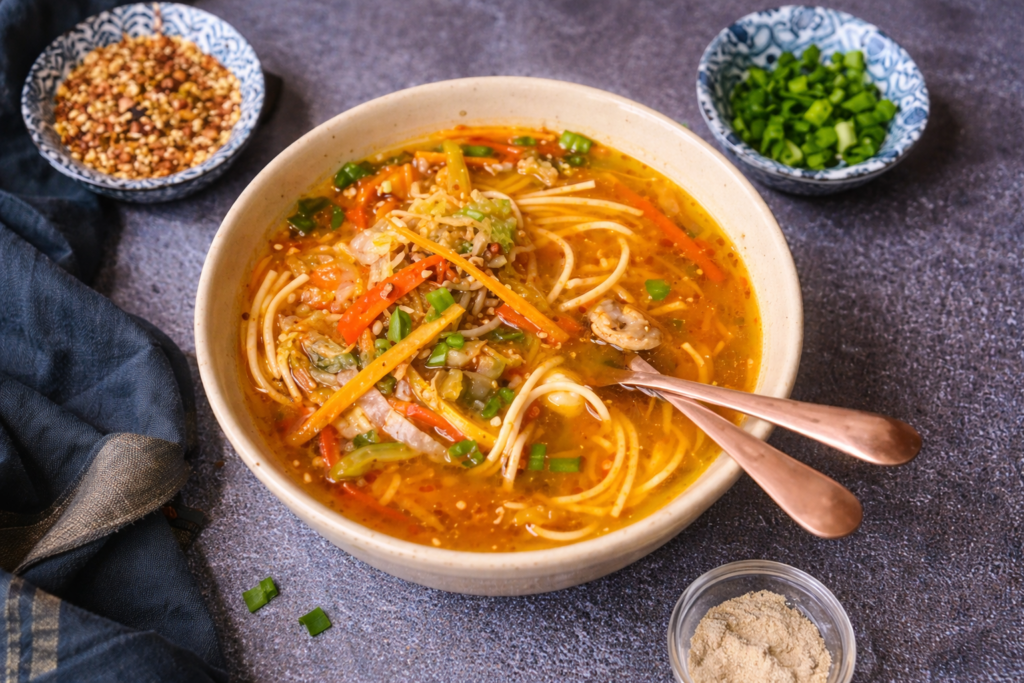
If momos are Dharamshala’s most famous food, thukpa is its most comforting. This is a Tibetan noodle soup, hand-pulled or hand-cut noodles in a slow-cooked broth with vegetables and meat. Every Tibetan kitchen has its own version.
There are two main styles you will find here:
- Clear broth thukpa: lighter, more traditional. The broth should taste like it has been simmering for hours, not like it came from a packet.
- Thenthuk: a thicker, stew-like version with flat, torn noodles instead of pulled ones. Heavier, more filling, and what most Tibetan families cook at home.
Best thukpa in McLeod Ganj:
Yangkhor Tibet Home Kitchen. Their clear broth version is the benchmark. ₹100-140 per plate.
Best thukpa in Dharamkot:
Morgan’s Place. They make a spicier version that works perfectly on cold evenings. ₹120-150 per plate.
Best thukpa in Dharamshala (lower):
Small Tibetan kitchens near Gamru village. Less known, more authentic. ₹80-110 per plate.
A local tip: Thukpa is a winter food. You can get it year-round, but it tastes completely different when you are eating it at 5°C with clouds rolling through the window versus in the middle of a hot May afternoon. Come in November to February for the real experience. Check our Dharamshala weather guide (2026) for the best time to visit.
If you only eat momos and thukpa in Dharamshala, you have experienced maybe 20% of Tibetan food. Here is what else to look for:
- Sha Phaley: deep-fried bread stuffed with spiced meat. Crispy, greasy, satisfying. Think of it as a Tibetan meat pie. Best eaten fresh from the oil. ₹40-60 per piece.
- Tingmo: steamed Tibetan bread, soft and fluffy, served with a spicy meat or vegetable stew. This is the Tibetan equivalent of mopping up curry with naan, except the bread is lighter and the stew is more complex.
- Laphing: cold, spicy mung bean noodles. This is a street snack. Chewy, slippery, doused in chili oil and vinegar. An acquired taste for some. ₹30-50 from street vendors in McLeod Ganj.
- Butter tea (po cha): salted, buttered tea. Most Indian visitors hate it on first sip because they expect sweet tea. It is not sweet. It is savoury, rich, and an entirely different category of hot drink. Try it at least once. Many Tibetan restaurants serve it free or for ₹20-30.
- Sweet rice (desi): saffron-scented rice with raisins and butter. Often served at Tibetan festivals and special occasions. Ask if it is available, it is not always on the menu.
Where to find these: The smaller Tibetan kitchens and settlement canteens are your best bet. Tourist-facing restaurants in McLeod Ganj focus on momos and thukpa because that is what visitors order. The deeper dishes appear on menus at places where Tibetans themselves eat.
Best Tibetan Restaurants in Dharamshala & McLeod Ganj (Where to Eat Authentic Tibetan Food)
Here are the best Tibetan restaurants in Dharamshala and McLeod Ganj, places worth visiting not because they are famous, but because the food is genuinely authentic.
| Restaurant Name | Location (McLeod Ganj / Dharamshala) | Must-Order Dish | Price for Two | Best For (Experience) |
|---|---|---|---|---|
| Tibet Kitchen | McLeod Ganj, Temple Road | Steamed buff momos | ₹300–400 | Quick, reliable Tibetan meal |
| Yangkhor Tibet Home Kitchen | McLeod Ganj, Jogiwara Road | Thenthuk + sha phaley | ₹350–450 | Deeper Tibetan menu |
| Buddha Delight | Dharamkot | Jhol momos + thukpa | ₹300–400 | Quiet atmosphere, good views |
| Norling Restaurant | Near TCV / Forsyth Ganj | Set Tibetan meal | ₹200–300 | Where Tibetans eat |
| Shangrila Tibetan Kitchen | Lower Dharamshala | Tingmo + stew | ₹250–350 | Off the tourist circuit |
If you’re visiting for the first time, start with McLeod Ganj, most of the best Tibetan restaurants are concentrated here.
For the full cafe scene, including places that serve Tibetan snacks alongside good coffee, see our best cafes in Dharamshala guide (complete 2026 guide.
Himachali Food in Dharamshala (Local Cuisine You Shouldn’t Miss)
This is the section you will not find in any other Dharamshala food guide. I am not exaggerating. Search for “Himachali food in Dharamshala” and you will find either nothing, or a two-line mention of dham buried inside a generic travel article.
This is strange, because Dharamshala is in Himachal Pradesh. The Kangra Valley, which Dharamshala sits in, has one of the oldest and most distinctive food traditions in the western Himalayas. But because tourists associate Dharamshala with Tibetan culture, the Himachali food story gets completely ignored.
That ends here.
Himachali Dham: The Feast You Must Experience
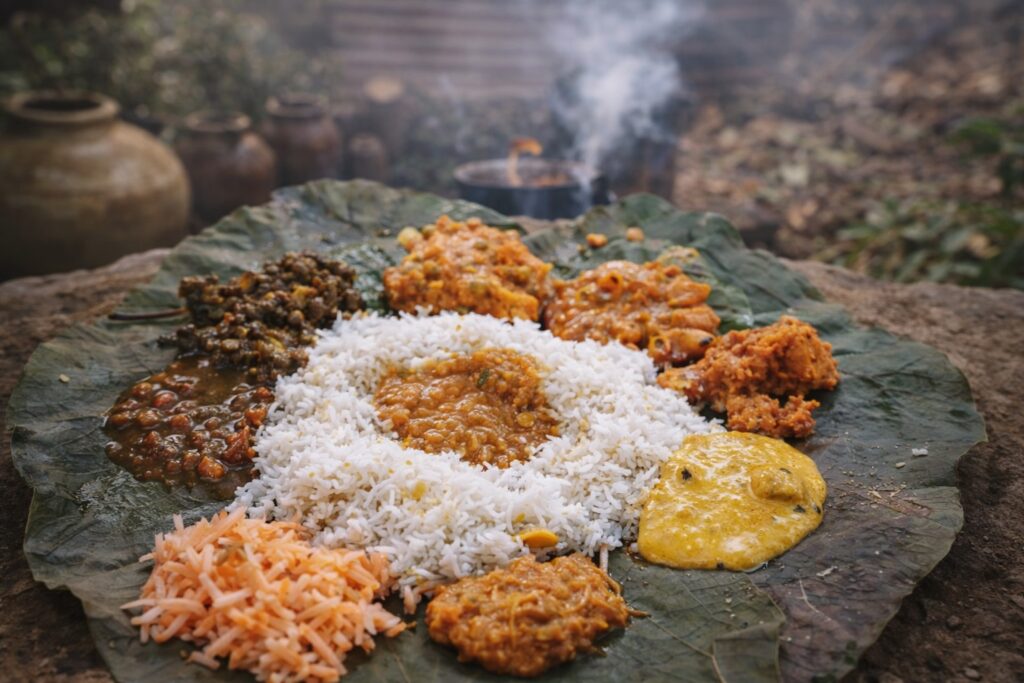
Dham is not a dish. It is an event.
A traditional Himachali dham is a ceremonial feast, served on a leaf plate, eaten sitting on the ground in rows, cooked by designated community cooks called botis who have inherited the recipes across generations. The botis are specialists. They cook for weddings, festivals, and temple gatherings. This is not restaurant food. This is community food.
A typical dham plate includes: rice, dal (cooked in specific Himachali style, more aromatic, less soupy than plains dal), rajma, khatta (a sweet-sour tamarind preparation), madra (chickpeas or kidney beans cooked in yogurt and ghee), meetha (sweet rice or halwa), and sometimes mutton or chicken depending on the occasion.
Where to eat Himachali dham in Dharamshala
The honest answer is that the best dham is not in any restaurant. It is at local festivals, temple events, and weddings. If you are here during a local festival or a temple gathering in Lower Dharamshala or surrounding villages, ask if dham is being served. You will almost certainly be welcomed.
For a restaurant version: Vinod Rashi in Lower Dharamshala serves a dham-style thali. It is not identical to the real thing, but it is the closest you will get without attending a ceremony. ₹200-300 per person.
Takri Natives’ Kitchen & Café isn’t exactly in Dharamshala, it’s on the scenic route toward Palampur, but it’s a well-known local favourite. They serve a traditional Himachali dhaam on pattals (leaf plates), and their thali (₹250–350) gives you a complete taste of the region in one meal.
When dham happens: Most commonly during Navratri, local temple anniversaries, and weddings (winter wedding season – November to February is your best window). Ask locals. Ask your homestay host. This is not something you can Google.
Madra, Siddu, Babru and Other Himachali Dishes
These are the dishes that define Kangra Valley food. None of them are famous outside Himachal. All of them are worth seeking out.
- Madra: the signature dish of Himachali cuisine. Chickpeas (or sometimes rajma) slow-cooked in a yogurt-based gravy with ghee and specific Kangri spices. Rich, creamy, and completely unlike any chickpea dish you have had in the plains. Madra is the centrepiece of every dham.
- Siddu: steamed wheat bread stuffed with a paste of poppy seeds, walnuts, and spices. Dense, nutty, and traditionally eaten with ghee or a meat curry. You will not find this in McLeod Ganj. Lower Dharamshala dhabas occasionally have it, but more commonly it is a home-cooked dish.
- Babru: a deep-fried bread stuffed with a spiced black gram (urad dal) filling. Crispy, hearty, and eaten with tamarind chutney. Think of it as a Himachali kachori but thicker and more substantial.
- Aktori: a sweet buckwheat pancake made during specific festivals. If you happen to be here during the right season and the right village fair, you might find it. Otherwise, this is a home kitchen dish.
- Chha Gosht: lamb marinated in gram flour and slow-cooked in a yogurt gravy. The Himachali version of a rich, slow meat curry. Spectacular in winter.
A reality check: Most of these dishes are not on restaurant menus. Himachali food is fundamentally home and community food. It has not been commercialised the way Tibetan food has. This is what makes it both harder to find and more rewarding when you do.
Where Locals Eat Himachali Food in Dharamshala
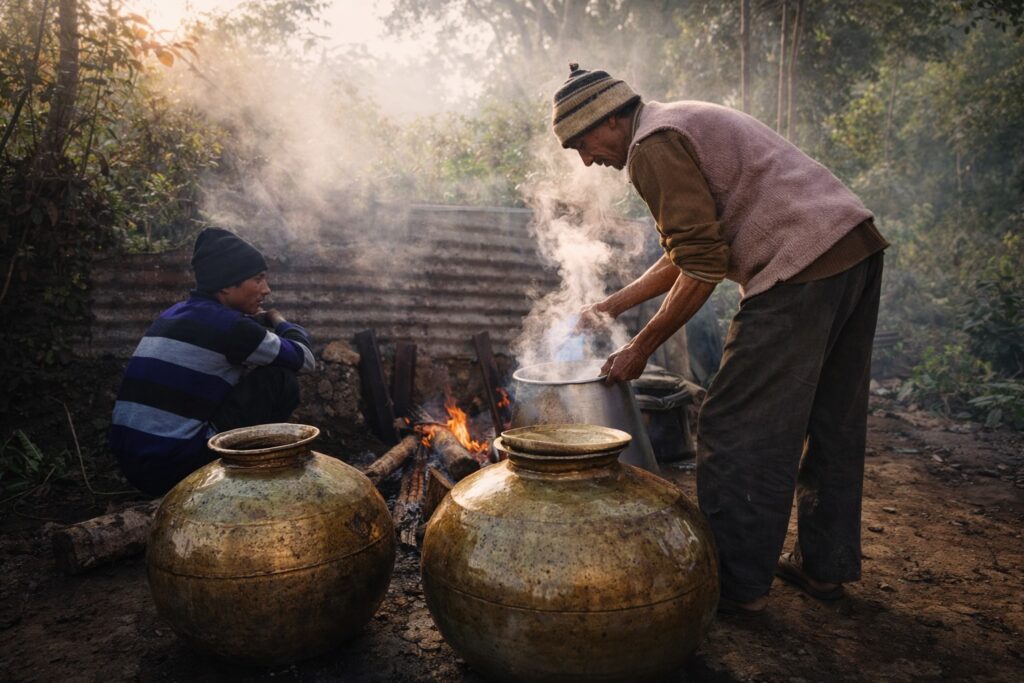
The best Himachali food in Dharamshala is not in McLeod Ganj at all. It is in Lower Dharamshala, the part most tourists drive through on their way up the mountain without stopping.
Sher-e-Punjab, Dhaaba, near Bus Stand, Lower Dharamshala, another local favourite. The rajma here is cooked Kangri style, slower, thicker, with more whole spices than what you get in Delhi or Punjab. ₹70-100.
Vinod Rashi, Kotwali bazar, one of the few places that consciously serves Himachali dishes to a slightly wider audience. ₹150-250.
The honest truth: if you want to eat real Himachali food, stay in a homestay where the host cooks. Home food is where this cuisine lives. Our guide to homestays in Dharamshala explains how to find long-term stays where home-cooked meals are part of the experience.
For a full picture of what living here costs, including daily food expenses, check our cost of living in Dharamshala (2026) breakdown.
Famous Street Food in Dharamshala (Part of Dharamshala’s Local Food Culture)
Street food in Dharamshala is not like street food in Delhi or Mumbai. There are no massive chaat lanes or kulfi carts at every corner. The street food here is smaller in scale, more scattered, and split between two very different worlds: the Tibetan-influenced snacks of McLeod Ganj and the North Indian street food of Lower Dharamshala.
Lower Dharamshala Bazaar: The Street Food Centre
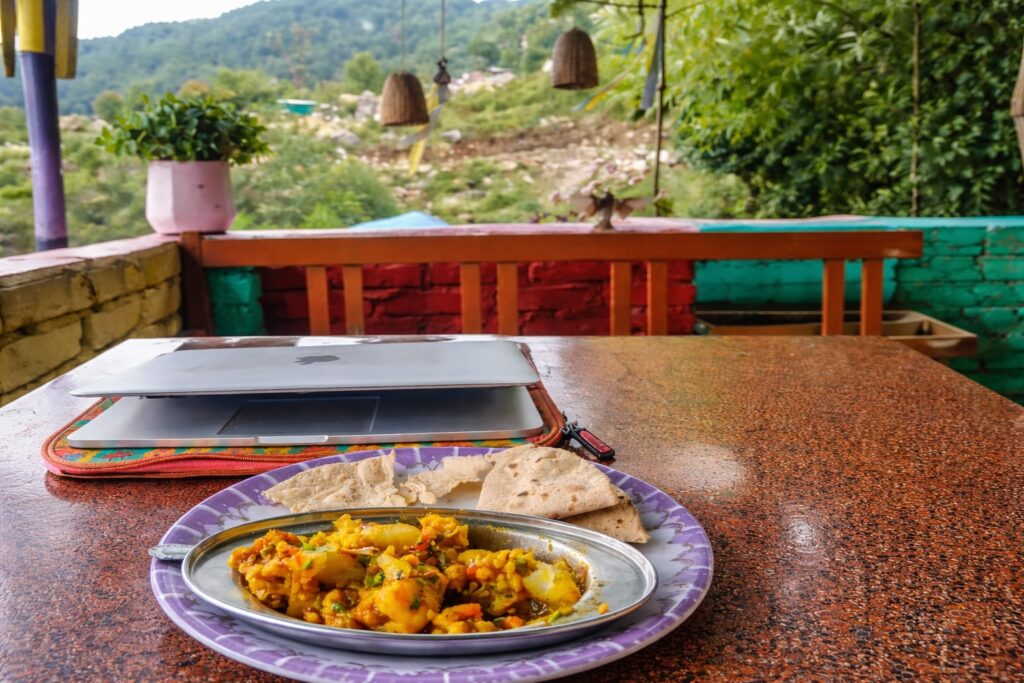
This is where the actual street food lives. Kotwali Bazaar and the lanes around it have the highest density of affordable, local food in the entire Dharamshala area.
What to look for:
- Chana madra at street stalls: sometimes vendors serve small portions of madra with puri for ₹30-50. This is the closest you can get to Himachali food without sitting in a restaurant.
- Samosas and pakoras: standard North Indian street snacks, but the quality here is solid. ₹10-20 per piece.
- Fresh fruit juice stalls: seasonal fruits. In summer, mango and pomegranate. In winter, orange and sugarcane.
- Local mithai shops: Kangri-style sweets that you won’t find elsewhere.
This part of Dharamshala is often skipped by travellers, our offbeat places in Dharamshala guide covers more such local areas beyond McLeod Ganj.
Best time to visit: Late afternoon, between 4–7 PM. That is when the bazaar is busiest and the food is freshest.
McLeod Ganj Market and Jogiwara Road
The street food here is more Tibetan and international.
- Laphing stalls: cold spicy noodles sold by Tibetan vendors. The chili oil makes or breaks it. ₹30-50.
- Momos from window stalls: small shops selling steamed momos through a window. Faster and cheaper than sitting in a restaurant. ₹60-80.
- Tibetan bread: fried and dusted with sugar, sold by street vendors in the morning. ₹20-30.
- Corn on the cob: in season (monsoon and post-monsoon), roasted corn from small carts. ₹30-40.
What to avoid: The generic “chowmein” stalls near the bus stand. Low quality, sitting too long, and not representative of anything Dharamshala does well.
Bhagsu Road and Dharamkot
The food here is geared toward the backpacker and long-stay crowd. Less street food, more casual sit-down spots.
- Falafel wraps and hummus: a nod to the Israeli traveller community. Several stalls along Bhagsu road.
- Fresh juice and smoothie stands: seasonal fruit smoothies, ₹80-150. Overpriced compared to Lower Dharamshala, but that is the tourist area tax.
- Dharamkot bakeries: fresh bread, cinnamon rolls, banana bread. Surprisingly good.
Dharamkot’s cafe scene deserves its own guide, and we wrote one. See our best cafes in Dharamshala for the full breakdown by area.
Best Restaurants in Dharamshala (Area by Area, Budget by Budget)
Here is where things get practical. If you are in a specific area and need to eat well, these are the places I would send you to. No filler recommendations. Every place here has been tested repeatedly, not visited once for a blog photo.
Quick comparison of where to eat in Dharamshala & McLeod Ganj
Here’s a quick comparison of the best restaurants in Dharamshala and McLeod Ganj, based on cuisine, location, and budget.
| Restaurant Name | Location (McLeod Ganj / Dharamshala) | Cuisine Type | Average Cost for Two | Best For (Experience) |
|---|---|---|---|---|
| Tibet Kitchen | McLeod Ganj | Tibetan cuisine | ₹300–400 | Quick, reliable meal |
| Clay Oven | McLeod Ganj | Multi-cuisine (Indian, Tibetan, Continental) | ₹500–700 | Dinner with a view |
| Nick’s Italian Kitchen | Jogiwara Road | Tibetan & Italian cuisine | ₹200–300 | Budget-friendly meals |
| Trek n Dine | Dharamkot | International cuisine | ₹400–600 | Breakfast & brunch |
| Shiva Cafe | Bhagsu | Cafe + meals (multi-cuisine) | ₹350–500 | Casual meals |
| Vinod Rasoi | Lower Dharamshala | Himachali cuisine | ₹150–250 | Authentic local experience |
If you’re deciding where to stay near these restaurants, our Dharamshala hotels guide breaks down the best areas based on budget and location.
For a more local experience, the homestay guide in Dharamshala covers places ideal for home-cooked meals and longer stays.
And if you’re planning your trip day-by-day, this Dharamshala itinerary helps you naturally fit these food spots into your travel plan.
Famous Veg Food in Dharamshala: A Vegetarian’s Paradise
If you are vegetarian, Dharamshala is one of the easiest places in India to eat well.
The Tibetan community has a significant vegetarian tradition, especially around the monasteries. Most Tibetan restaurants offer veg momos, veg thukpa, and veg thenthuk as standard options, not as afterthoughts. The Buddhist influence means several restaurants near the Dalai Lama’s temple complex are entirely vegetarian.
The Himachali side is also vegetarian-friendly. Dham often has a completely vegetarian version. Madra is inherently vegetarian. Rajma and dal are the staples of every local dhaba.
And the backpacker areas, Dharamkot and Bhagsu, are heavily vegetarian and vegan, driven by the yoga and wellness crowd.
Where to eat the best veg food in Dharamshala:
- For Tibetan veg: Tibet kitchen in McLeod Ganj — their veg momos use paneer and fresh herbs instead of just cabbage. Makes a difference. ₹80-100.
- For Himachali veg: Any Lower Dharamshala dhaba. The standard thali (rice, dal, rajma, seasonal sabzi) is vegetarian by default and costs ₹70-100.
- For international veg/vegan: Dharamkot is your base. Most cafes here have extensive veg menus with Israeli, Italian, and Korean options.
If you are considering a longer stay as a remote worker, the vegetarian options are one of the reasons people love working from here. Our guide on why remote workers are choosing Dharamshala covers the full picture.
How Much Does Food Cost in Dharamshala? Budget Breakdown
One of the most common questions: is Dharamshala expensive for food? Short answer, no. But it depends entirely on where and what you eat.
Budget Meals: Under ₹100
- Dal-rice-sabzi thali at a Lower Dharamshala dhaba: ₹70-90
- Plate of steamed momos (veg) from a window stall: ₹60-80
- Street samosas + chai: ₹30-40
- Laphing from a street vendor: ₹30-50
Daily food budget at this level: ₹250-350
This is how most locals eat. It is simple, filling, and good.
Mid-Range Meals: ₹100-300
- Sit-down Tibetan meal (momos + thukpa): ₹200-300
- Cafe breakfast (eggs, toast, coffee): ₹150-250
- Himachali thali at a decent restaurant: ₹150-250
- Pizza or pasta in Dharamkot: ₹250-350
Daily food budget at this level: ₹500-800
This is what most travellers spend. Comfortable, with variety.
Higher-End Meals: ₹300+
- Dinner at a restaurant with a view: ₹500-800 for two
- Multi-course meal at a boutique hotel restaurant: ₹800-1,500 for two
- Cooking class + meal: ₹1,000-2,000 per person
Daily food budget at this level: ₹1,000-1,500
This is unnecessary in Dharamshala. Some of the best food here costs under ₹100. Spending more does not always mean eating better.
For a full breakdown of all living expenses, rent, transport, groceries, and more, see our cost of living in Dharamshala guide (2026).
What to Skip: Tourist Traps and Overhyped Spots
I am not going to name specific restaurants here because menus and management change. But here are the patterns to watch for:
Multi-cuisine restaurants that do nothing well. If the menu has Tibetan, Chinese, Italian, Israeli, Mexican, and Continental sections, the kitchen is stretching too thin. The momos will be average. The pizza will be average. Everything will be average. In Dharamshala, the best food comes from places that do one thing and do it properly.
Restaurants immediately around the McLeod Ganj bus stand. High tourist footfall, low incentive to be good. Prices are 20-30% higher than places two lanes away. Walk five minutes in any direction and you will eat better for less.
“Famous” places running on old reputation. Some restaurants were good five years ago. The original cook left, the portions got smaller, the prices went up, and the Google reviews are from 2019. Ask a local what is good right now, not what was good when they last visited three years ago.
Overpriced “organic” cafes with no substance. Dharamkot has a few of these. Beautiful Instagram aesthetic, ₹300 smoothie bowls, and food that tastes like it was designed for photographs rather than eating. Some organic cafes are genuinely excellent, our best cafes in Dharamshala guide 2026 sorts them out.
The single most useful rule: If a restaurant is full of locals at lunch hour, the food is good. If it is full of tourists and empty of locals, be cautious.
Seasonal Food in Dharamshala: What Changes Through the Year
Dharamshala’s food scene is not the same in January and July. Seasonality matters here in a way it does not in most Indian cities.
Winter (November to February):
This is peak comfort food season. Thukpa and thenthuk are at their best: thick, steaming bowls that make sense when the temperature drops to 2–5°C. Himachali dishes like chha gosht and madra appear more frequently at local gatherings. Winter weddings mean more dham ceremonies. Citrus fruits, oranges, kinnow, are at their peak. Kangra tea tastes better when you are holding a warm cup at a cold altitude.
Spring (March to May):
Tourist season begins. Restaurants are fully staffed and menus are complete. Fresh greens appear in local markets. This is the best season for the widest variety of food because everything is open, the weather is comfortable for eating outdoors, and both Lower Dharamshala and McLeod Ganj kitchens are running at full capacity.
Monsoon (June to September):
Many McLeod Ganj cafes reduce hours or close temporarily. Some Dharamkot restaurants shut down entirely for the season. But Lower Dharamshala keeps running, the dhabas don’t close for rain. Monsoon is actually a good time for fresh corn (roasted on the roadside), seasonal greens, and the kind of hot, spicy food that pairs with rainy weather. Pakoras and chai on a monsoon evening in Dharamshala is an experience in itself.
For a detailed month-by-month breakdown of what to expect, our Dharamshala weather guide covers conditions, safety, and planning tips across every season.
Post-monsoon (October):
The sweet spot. Everything reopens, the air is clear, the mountains are visible, and the food scene comes alive again. If you want the best combination of food variety, good weather, and fewer crowds, October is it.
A Few Things I Want You to Know Before You Eat in Dharamshala
Carry cash. Many of the best places — especially street stalls, Lower Dharamshala dhabas, and small Tibetan kitchens, do not accept UPI or cards. ATMs exist in McLeod Ganj and Lower Dharamshala, but they run out of cash on busy weekends. Withdraw before you need it.
Water. Drink bottled or filtered water. Most restaurants in McLeod Ganj use filtered water, but street stalls may not. If you are staying long-term, invest in a reusable bottle and fill up at your accommodation. Our guide on internet and power in Dharamshala covers practical infrastructure like this, including which areas have the most reliable utilities.
Timing. Dharamshala eats early. Most Tibetan kitchens are at their best for lunch, not dinner. Dhabas in Lower Dharamshala start winding down by 8–9 PM. If you want late-night food, your options narrow to McLeod Ganj and a few places in Bhagsu. Plan accordingly.
Tipping. Not expected at dhabas and street stalls. Appreciated at sit-down restaurants. 10% is generous by Dharamshala standards.
Allergies and dietary needs. Communicate clearly. Many smaller kitchens may not understand “gluten-free” or “nut allergy” in English. If you have serious dietary restrictions, choose restaurants with English menus and staff who can confirm ingredients.
The Real Food Story of Dharamshala
Most people come to Dharamshala for the mountains, the monasteries, or the Dalai Lama. The food is an afterthought, something they figure out when they are hungry.
That is a mistake.
The food here tells the story of this place better than any monument or viewpoint. The Tibetan momos carry sixty years of exile and adaptation. The Himachali dham carries centuries of community cooking. The backpacker cafes carry the energy of a place that keeps reinventing itself.
Eat widely. Eat in Lower Dharamshala, not just McLeod Ganj. Ask locals where they eat. Try the dishes that have no Instagram presence. The best meal I have ever had in Dharamshala was not in a restaurant, it was at a village dham, sitting on the ground, eating from a leaf plate, surrounded by people who have been cooking these recipes for generations.
That experience is not something I can link you to. But I can help you get close. If you want to truly experience the famous food in Dharamshala, don’t just stay in McLeod Ganj, explore Lower Dharamshala, eat where locals eat, and try dishes beyond momos.
If you are planning your trip, our Dharamshala itinerary guide will help you structure your days. And if you are looking for a quiet place to stay in Khaniyara, away from the McLeod Ganj noise but close enough to explore everything, Manoratham Homestay is where we host travellers who want the local Dharamshala experience, food included.
And if you want to explore beyond food, our best treks in Dharamshala guide covers everything from easy walks to Himalayan trails.
Frequently Asked Questions
What is the famous food of Dharamshala?
Dharamshala is famous for Tibetan momos (steamed dumplings), thukpa (noodle soup), and thenthuk (hand-torn noodle stew) from its large Tibetan exile community. Equally important but lesser-known is Himachali cuisine, dham (ceremonial feast), madra (yogurt-chickpea curry), and siddu (stuffed steamed bread). The Kangra Valley’s food tradition is centuries old and best experienced in Lower Dharamshala.
Where can I find the best momos in Dharamshala?
Tibet Kitchen on Jogiwara Road in McLeod Ganj serves the most consistently excellent momos, order the steamed buff momos. For mutton momos, try Norling Restaurant. For vegetarian momos with actual seasoning (not just cabbage), Lung Ta near Temple Road is the best option. Budget momos from window stalls along Jogiwara Road cost ₹60-80 per plate.
How much does food cost in Dharamshala per day?
Budget travellers spend ₹250-350 per day eating at Lower Dharamshala dhabas and street stalls, dal-rice thalis for ₹70-90, momos for ₹60-80, and chai for ₹10-20. Mid-range spending is ₹500-800 per day with sit-down Tibetan meals and cafe breakfasts. Even at the higher end, ₹1,000-1,500 per day covers restaurant dinners with views. Dharamshala is genuinely affordable for food.
What is Himachali dham and where can I eat it in Dharamshala?
Dham is a traditional Himachali ceremonial feast served on leaf plates, cooked by specialist community cooks called botis. It includes rice, dal, madra, rajma, khatta, and meetha. The best dham is at local festivals, temple events, and weddings, not restaurants. For a restaurant version, Vinod’s Rasoi in Kotwali Bazaar serves Himachali Dham every Sunday, and Takri: Natives’ Kitchen offers dham with cultural performances.
Is Dharamshala good for vegetarian food?
Dharamshala is one of the best places in India for vegetarians. The Buddhist-influenced Tibetan community offers excellent veg momos, thukpa, and thenthuk as standard options. Himachali staples like madra, rajma, and dal are inherently vegetarian. Dharamkot and Bhagsu cater heavily to vegan and vegetarian travellers with Israeli, Italian, and Korean menus. Lung Ta in McLeod Ganj is a standout fully-vegetarian restaurant.
What is the difference between food in McLeod Ganj and Lower Dharamshala?
McLeod Ganj serves primarily Tibetan food, international cuisine, and cafe culture, targeting travellers and the Tibetan community. Lower Dharamshala is where Himachali families eat, dhabas with rice, dal, rajma, and seasonal sabzis for ₹70-100. Most visitors never leave McLeod Ganj, which means they miss Himachali food entirely. Both areas are worth exploring for the full Dharamshala food experience.
What street food should I try in Dharamshala?
In Lower Dharamshala’s Kotwali Bazaar, try chana madra with puri (₹30-50), fresh samosas and pakoras (₹10-20), and seasonal fruit juice. In McLeod Ganj, try laphing, cold spicy mung bean noodles from Tibetan street vendors (₹30-50), momos from window stalls (₹60-80), and fried Tibetan bread dusted with sugar in the mornings (₹20-30). Visit Kotwali Bazaar between 4-7 PM for the freshest options.
Is the food safe to eat from street stalls in Dharamshala?
Street food in Dharamshala is generally safe if you follow basic precautions. Eat from stalls with high turnover, busy stalls mean fresh food. Drink bottled or filtered water, not tap water. Avoid pre-cut fruit from roadside vendors. Lower Dharamshala dhabas and Tibetan kitchens in McLeod Ganj maintain good hygiene standards. Carry cash, most street stalls and small kitchens do not accept UPI or cards.
Where can I find the best Tibetan food in Dharamshala?
The best Tibetan food in Dharamshala is found in McLeod Ganj, especially in small, family-run kitchens rather than just popular tourist spots. Places like Tibet Kitchen and Yangkhor Tibet Home Kitchen are known for authentic dishes like momos, thenthuk, and thukpa.
What are the must-try dishes in McLeod Ganj?
When visiting McLeod Ganj, you should try steamed momos, thukpa (noodle soup), thenthuk (hand-pulled noodle soup), and sha phaley (fried Tibetan bread). These dishes are widely available in local Tibetan restaurants and cafés.