Most travellers who come to Bir never make it up to Sherabling Monastery, and to me that is the biggest miss in the whole valley. This guide is the on-the-ground version, not one pieced together from other websites: the real timings (which half the internet gets wrong), how to reach Sherabling, what to look for inside, what a festival here actually feels like, and where to stay close by. I have lived in the Kangra valley long enough to know the place in every mood, from the hush of a weekday morning to the thunder of drums on a festival day.
In short: Sherabling Monastery, set in the pine forests near Bir in Himachal Pradesh’s Kangra valley, is the Indian seat of the 12th Kenting Tai Situpa and the largest Karma Kagyu monastery in the region. It is open daily and free to enter.
Table of Contents
Sherabling Monastery Facts and Visitor Details (2026 Guide)
Sherabling Monastery: The Living Seat of the Tai Situpa
Ask what Sherabling is famous for and the honest answer is not a statue or a viewpoint. It is who lives here. Sherabling is the Indian seat of the 12th Kenting Tai Situpa, one of the senior-most masters of the Karma Kagyu lineage of Tibetan Buddhism. The Palpung tradition he carries traces back centuries to eastern Tibet, and after he left Tibet he rebuilt it here, in the forests above Bhattu, in the early 1990s. The full name you will see on the gate, Palpung Sherabling, is not branding. It is a centuries-old lineage being kept alive on new ground.
That is what makes it feel nothing like a museum monastery. More than five hundred monks live and study here, in a working monastic university with its own school, library and clinic. I have sat at the back of the morning prayers more than once, and it never felt staged. You are simply allowed to be present at something that would carry on with or without you.
The detail almost no guide mentions: inside the main shrine building are private apartments kept for both His Holiness the Dalai Lama and the Gyalwa Karmapa, for their visits. You are standing in a place built to host the very top of Tibetan Buddhism, and Sherabling is one node in a wider web of Tibetan Buddhist monasteries across this part of Himachal.
What It’s Actually Like to Visit Sherabling Monastery
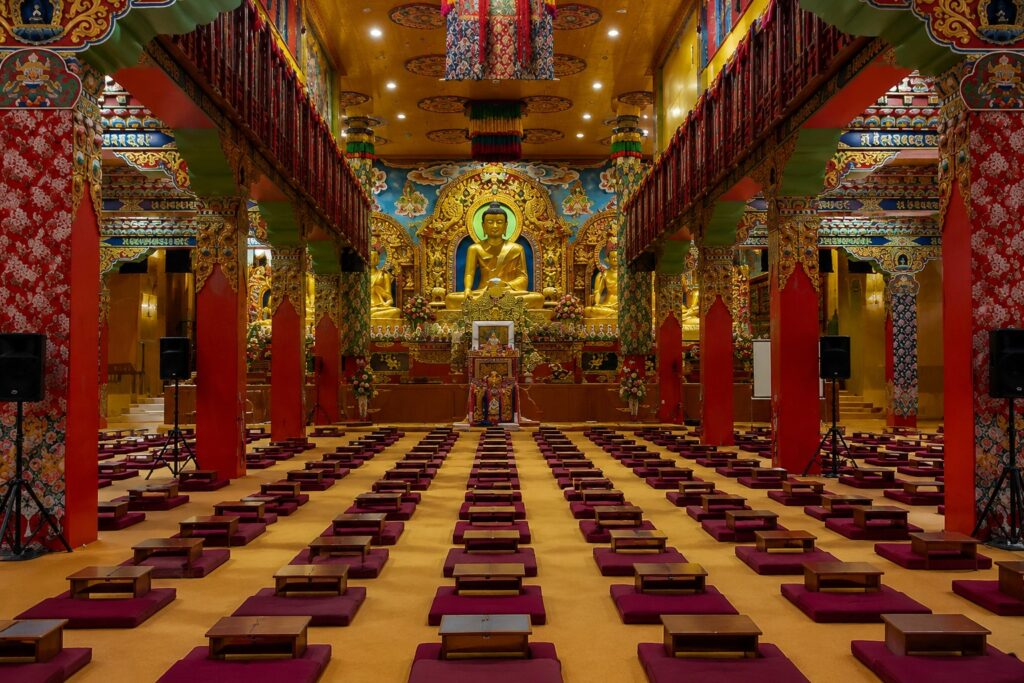
Let me set expectations honestly, because a lot of travel pages oversell this. Sherabling is not a polished tourist attraction with a ticket counter, a viewing deck and a gift-shop circuit. It is a quiet, functioning monastery, and for most of the day not much “happens” in the touristy sense.
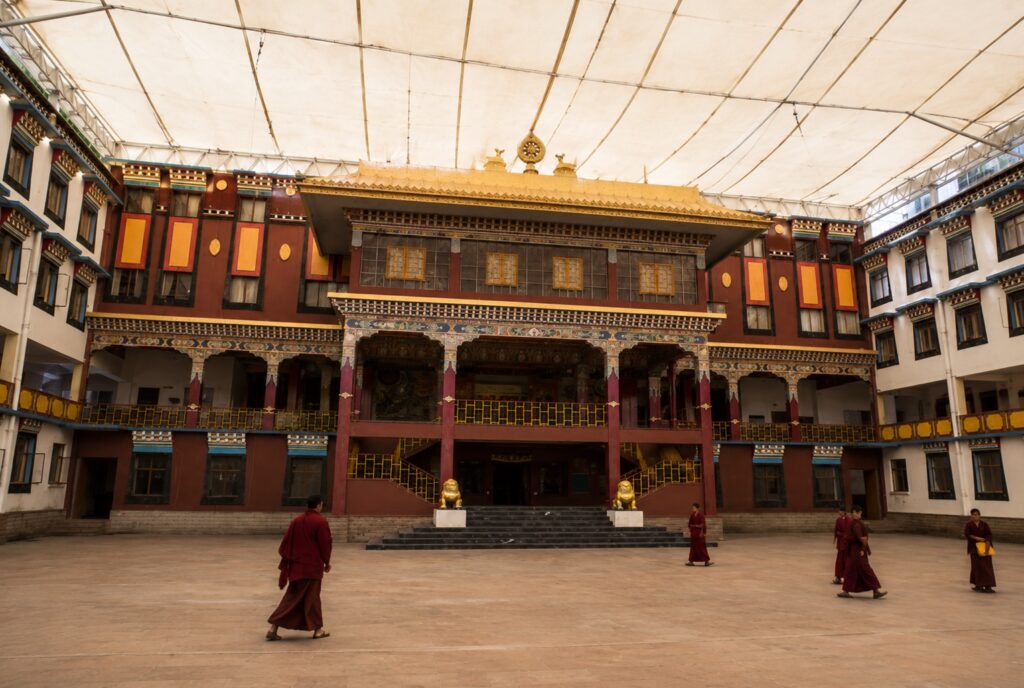
What you get instead is atmosphere. You park, walk up through pine and deodar, and the temperature drops a degree or two under the trees. Usually it is sound before sight: a bell, the low drone of chanting, sometimes the boom of a long horn from inside the hall. The courtyard is wide and still, the golden roofs catch the light, and young monks cross it in maroon robes on their way to class.
So who is it for? If you want a quick photo stop, you will be done in fifteen minutes and slightly underwhelmed. If you are happy to slow down, sit on a step and let the place work on you, it is one of the most peaceful hours you can spend near Bir.
The History of Sherabling Monastery
Sherabling Monastery was established by the 12th Kenting Tai Situpa, Pema Tönyö Nyinje, as the Indian seat of the Palpung lineage, and grew into the monastery you see today over the following decades.
To understand it, you have to look back much further than Bir. The original Palpung Monastery sits in Kham, in eastern Tibet, founded in 1727 by the 8th Tai Situpa, Situ Panchen, a towering figure in Tibetan art and scholarship. For nearly three centuries Palpung was the seat of the Tai Situpa line. When that world was torn apart in the mid-twentieth century and the lineage scattered into exile, the 12th Tai Situpa took on rebuilding it on Indian soil.
He chose this forested ridge above Bhattu, near Bir, partly for its quiet and partly for the Tibetan community already putting down roots nearby. What began as a foothold grew into a full monastic seat: the shrine halls, the Sherab Ling Institute (its college of higher Buddhist studies), retreat centres and a school. The Tibetan families around Bir and the monastery grew up alongside each other, which is why people here speak of Sherabling as family, not a landmark.
Where Is Sherabling Monastery Located?
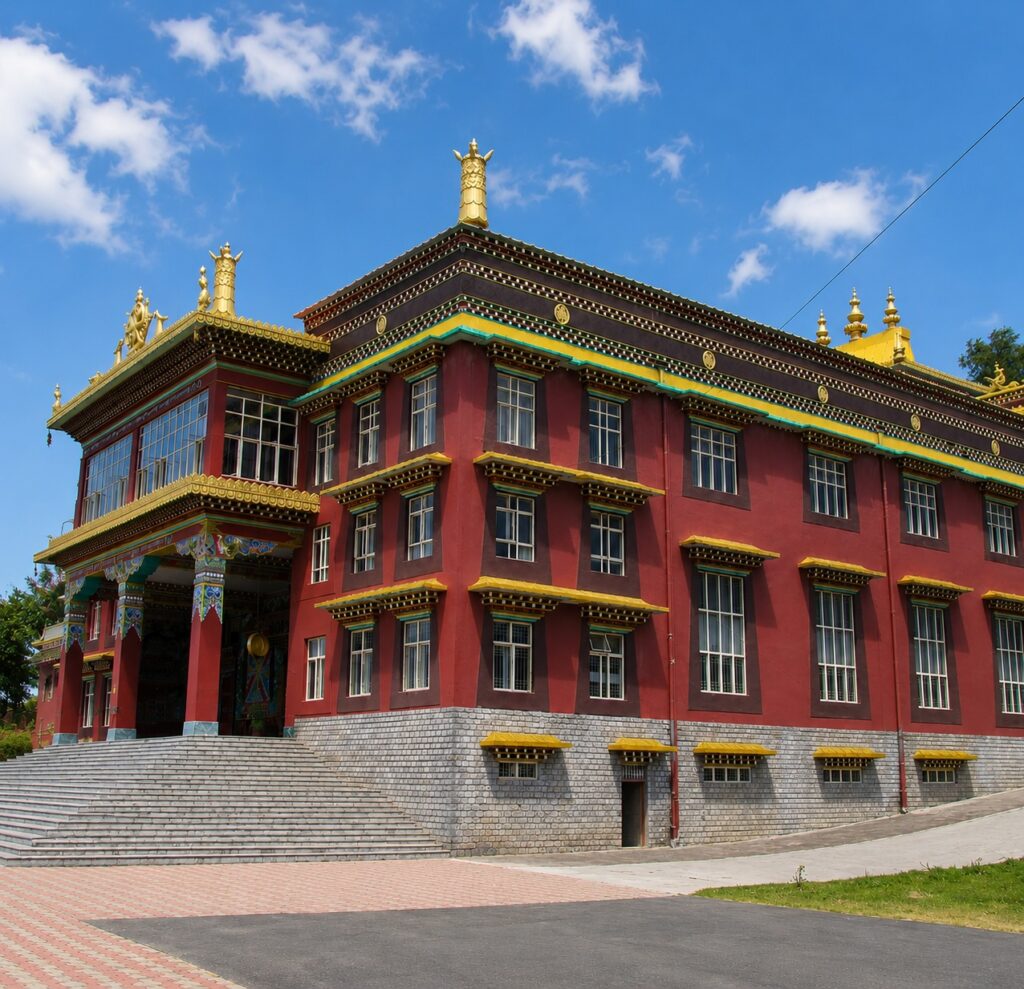
Sherabling Monastery is located at Bhattu, near the village of Keori, in the Baijnath area of Kangra district, Himachal Pradesh (PIN 176125). It sits roughly 5 to 7 km from Bir, the paragliding town, tucked into pine forest above the valley floor.
The full address to drop into Google Maps: Baijnath, Bhattu, Palpung Sherabling Monastery Road, Keori, Himachal Pradesh.
One bit of local guidance, because this is where people get confused. From the Bir side you turn off onto the monastery road and climb a narrow, single-lane forest stretch that locals just call the Sherabling road. It is paved but tight, with few places to pass. Cars and taxis can drive all the way up to the gate, and there is a flat parking area just outside the complex, so you do not have to walk far. On a festival day that lot fills early; on an ordinary morning you will likely have it to yourself.
How to Reach Sherabling Monastery
Reaching Sherabling Monastery is genuinely easy, because it sits beside Bir, which is well connected to the rest of Himachal and to Delhi.
If you are coming from further away, the practical route is to reach Bir first (most people road-trip from Delhi or fly into Gaggal), then cover the short hop up to the monastery. Our guide on how to reach Dharamshala breaks down the Delhi, Chandigarh and airport routes in detail, since you pass through the same corridor, and the wider Dharamshala travel guide helps if you are planning a longer Kangra trip.
On taxis, here are the real local rates, not the inflated ones some hotel sites quote. From the Bir taxi stand, a cab up to Sherabling is usually under ₹1,000. From Palampur, expect under ₹1,500, and from Dharamshala, somewhere around ₹1,500 depending on the vehicle and a bit of bargaining. For the monastery alone you do not need a guide. The real value of hiring a cab is clubbing Sherabling with Chokling and the other nearby spots in one half-day, which I map out further down.
Sherabling Monastery Timings and Entry Fee
Sherabling Monastery is open to visitors every day, entry is free, and no permits are required. The main shrine hall is generally open from about 8:30 AM to 4:30 PM, while the wider campus stays accessible until roughly 6:00 PM.
Here is the part the other guides gloss over. Online sources cannot agree on the timings. Some say 8:30 to 4:30, others list 9:00 to 5:00, and the truth is that the main hall does not always run to a fixed clock. It is a working monastery, so the hall can be shut between prayers, during teachings, or on a quieter day when fewer monks are around. More than one visitor has driven up, found the main doors closed, and assumed they had missed it.
You usually have not. If the hall is locked when you arrive, it is completely normal to find a monk nearby and politely ask. More often than not someone will open it and let you look inside. A little patience and respect goes a long way here.
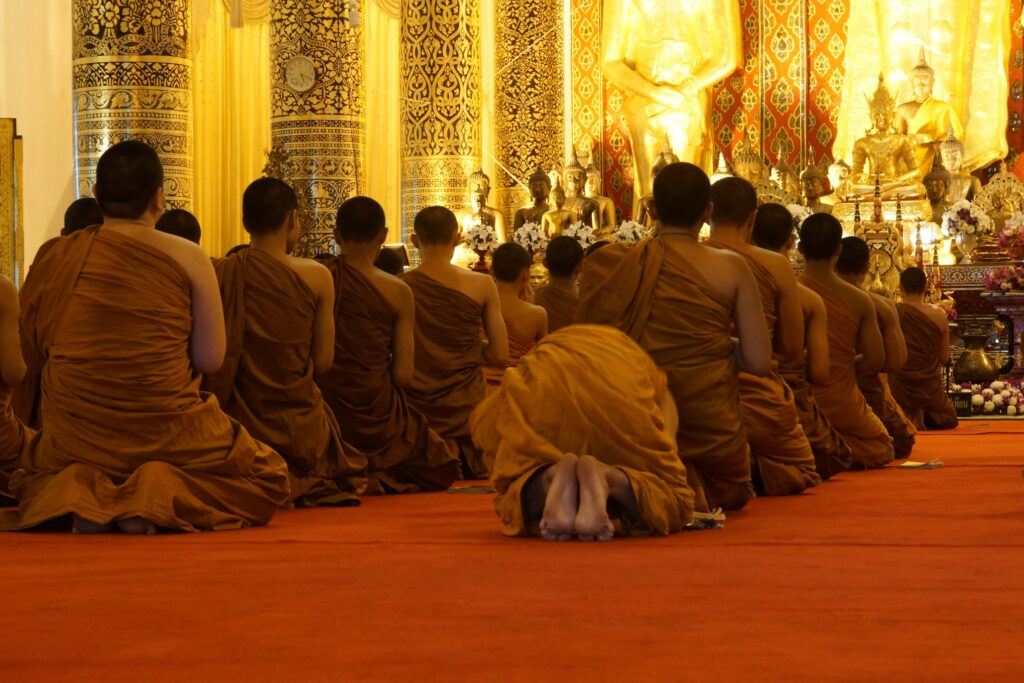
For the prayers themselves, aim for the puja sessions: roughly 6:00 to 7:30 in the morning and around 5:00 to 6:00 in the evening. Those are the times the hall fills with chanting and horns, and the most moving moments to witness, quietly, from the back.
Inside Sherabling: Architecture and What to See
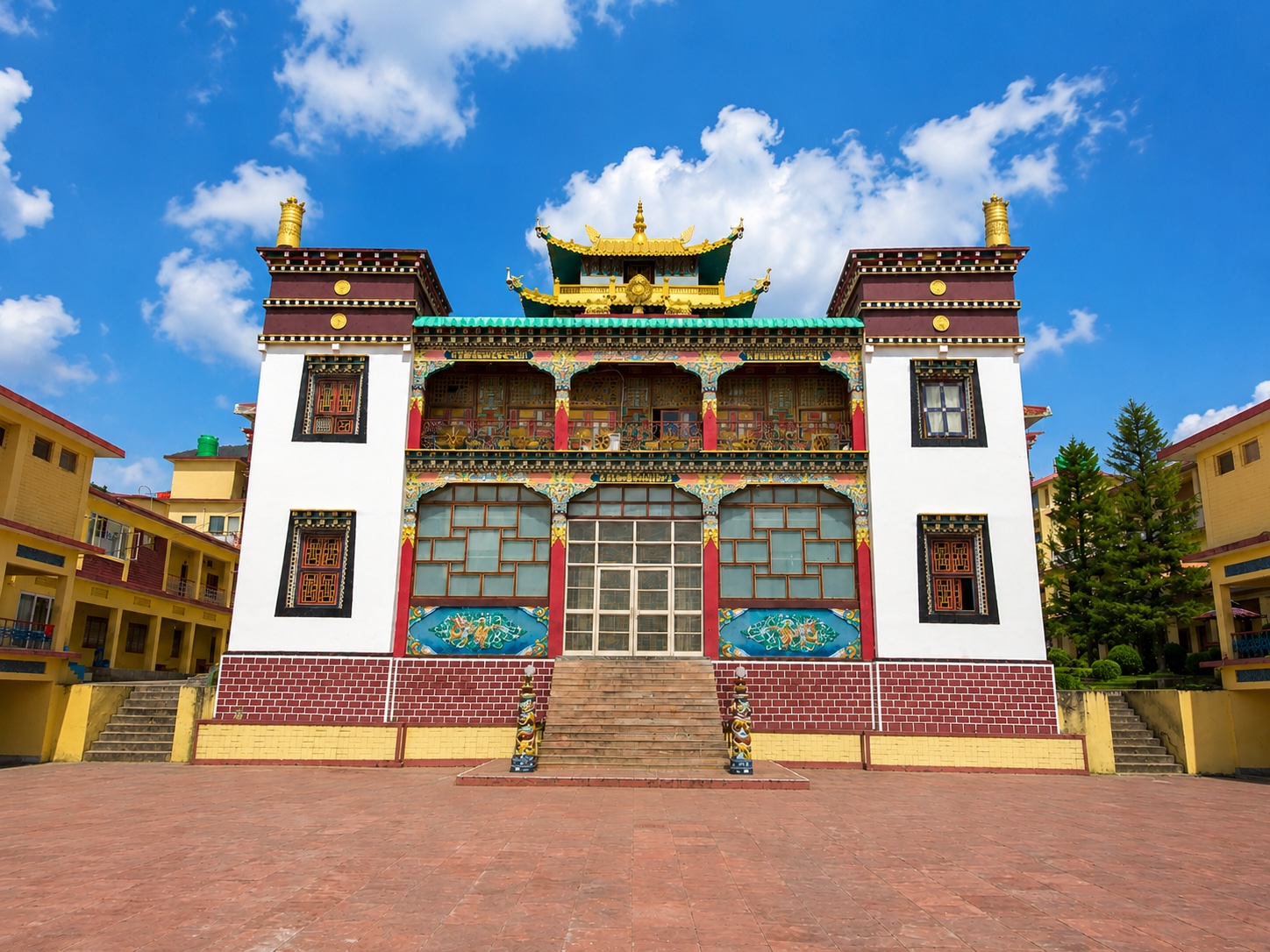
The architecture is the part that surprises people. From outside, the main monastery is a tall, multi-storey block, but it is finished in full traditional Tibetan style: golden roofs, deep red and ochre walls, intricate woodwork, and a wide sandstone courtyard the buildings wrap around. The 12th Tai Situpa designed it himself, in modern materials but old proportions.
Step inside the main shrine hall and look up. The centrepiece is a towering Maitreya, the future Buddha, rising through two floors (the monastery’s own records put it at around 42 feet). The walls are covered in murals and thangka paintings of the lineage masters, and the gold, the light and the scale together do something photographs never quite catch.
If you can, go higher. The upper floors hold a hall lined with ten thousand small gilded Buddha statues, and shrine rooms most day-visitors never realise are there. This is also where those private apartments for the Dalai Lama and the Karmapa sit.
A few of my own favourite details: the snow lion guardians at the main shrine, the carved ceilings, and the way the courtyard glows just before sunset.
Festivals and Best Time to Visit
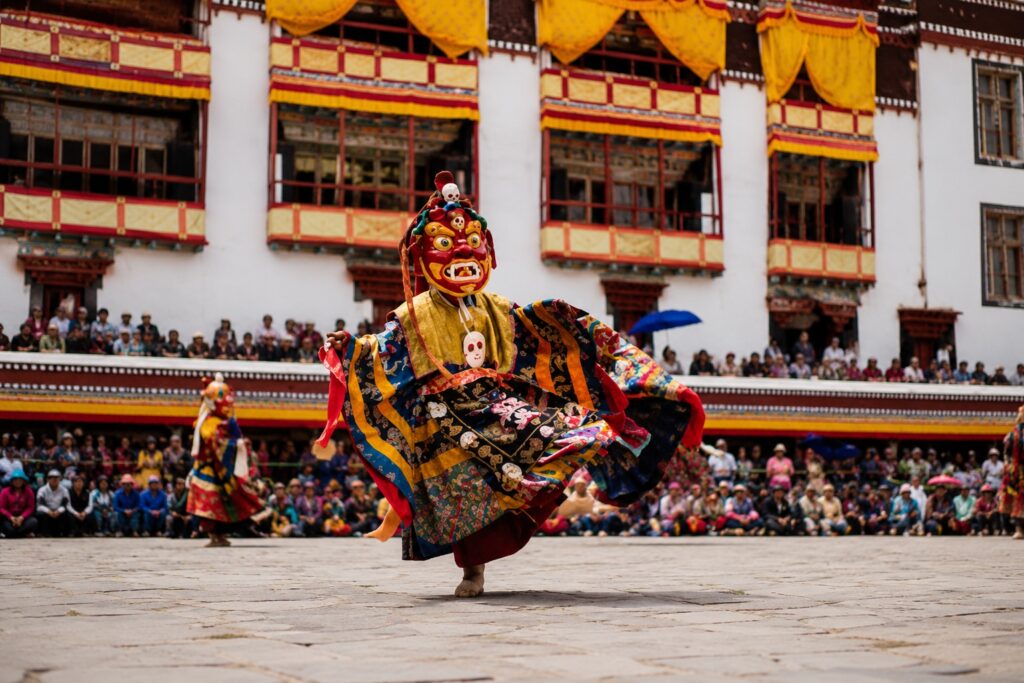
If you can time it, a festival is when Sherabling is unforgettable. For most of the year it is a place of quiet, but on its festival days the courtyard fills with masked Lama dances, the cham, performed by monks in elaborate costumes and masks to the crash of cymbals, drums and long horns. These are not shows for tourists. They are sacred ritual dances, and timing your visit around one is the single best reason to come on a set date rather than just turning up.
Three windows are worth knowing:
- Losar, the Tibetan New Year, falls in late February or early March. Bir comes alive for it: butter lamps, prayer flags, feasting and ceremonies, and Sherabling sits at the heart of it. This is the window I have seen first-hand, and it is the one I would build a trip around.
- The protector dances, held around the Kalachakra calendar New Year, when the monks perform the wrathful protector cham in the main courtyard.
- The Guru Rinpoche dances in early autumn, the second of the monastery’s bi-annual dance ceremonies.
For ordinary visits the rest of the year, the best months are March to June and September to November, when the weather is clear and the forest is at its best. Avoid peak monsoon, when the hill roads turn slippery. Our Dharamshala weather guide breaks down the seasons, and the best time to visit Dharamshala guide helps if you are planning the wider trip. Whenever you come, early morning or the hour before sunset is when the place is most beautiful.
What a Festival at Sherabling Feels Like
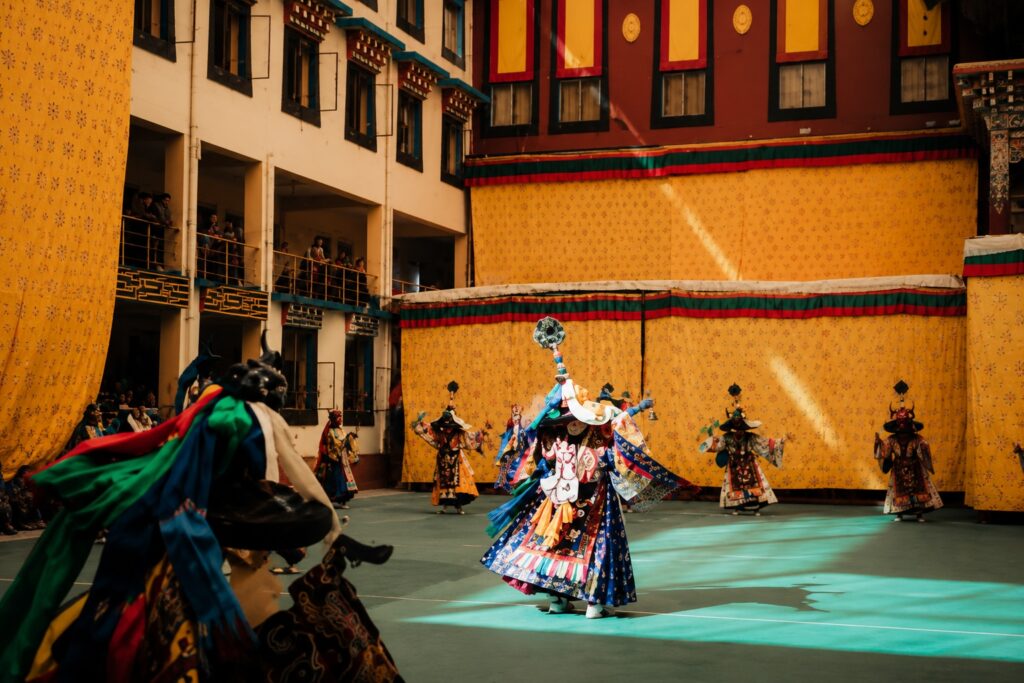
I have only witnessed this once, but it has stayed with me ever since: a cham at Palpung Sherabling, two days before Losar. The masks can look terrifying at first, but once you start to understand them you realise you are watching meditation in motion. Some are protector deities, tasked with warding off negativity. Some are characters from folk tales, standing for the compassion and wisdom you are meant to carry into a new cycle of life. And then there are the black hat dancers, who represent the tantric yogis whose realisations have dissolved the ego, everyone moving together around the idols of the protector deities. A deep dive into cham could open up a whole world of spirituality, but in brief it is a dance to ward off negativity and to inspire you toward wisdom and compassion as you move ahead. At Sherabling, the Black Hat dances are the ones that stay with you: mysterious, ancient and symbolic rather than theatrical.
A festival here is nothing like a typical Indian religious festival. It feels less like an event and more like stepping into a different rhythm of life. Picture waking in a pine forest before sunrise, the air cold enough that your breath hangs in front of you. Somewhere below, deep Tibetan horns begin to sound, and then come the low chants of hundreds of monks, cymbals and drums, until the whole valley seems to vibrate with prayer. It is never loud or chaotic. Even with hundreds of people gathered, there is calm and purpose in it.
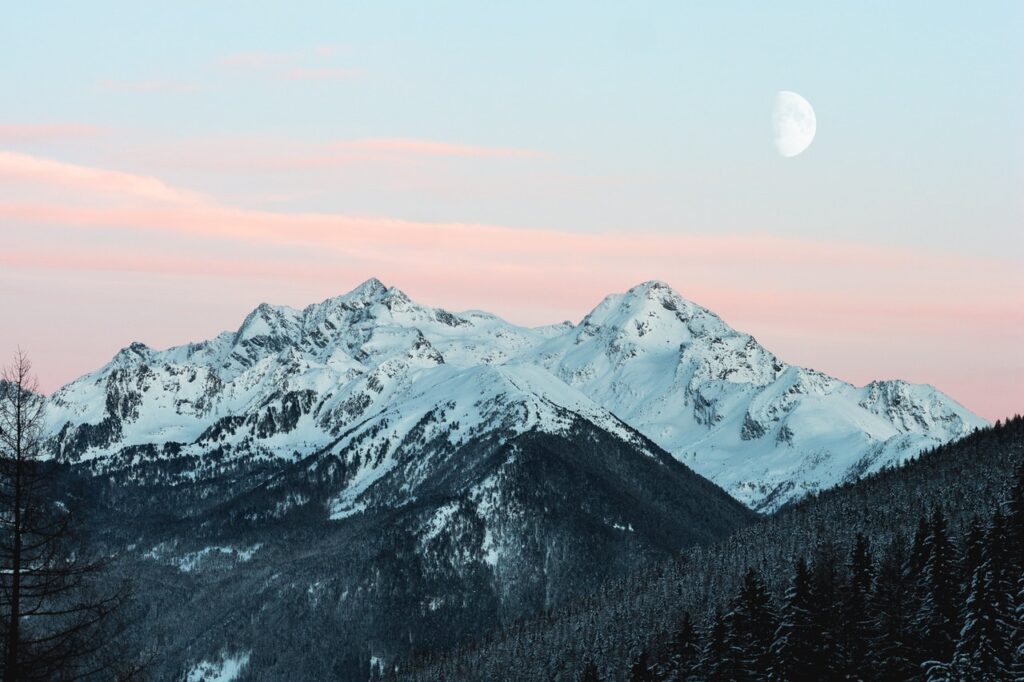
Prayer flags flutter everywhere, monks in maroon robes stream between the buildings, incense drifts through the courtyards, and on a clear day the snow-covered Dhauladhar peaks rise behind it all. What I love most is the mix of people: elderly Tibetan pilgrims turning prayer wheels, young monks chasing each other and laughing like any other children, families who have travelled from Spiti, Ladakh, Arunachal, Sikkim, Bhutan and Nepal, foreign Buddhists who return year after year, and quiet travellers just sitting and watching. Everyone slows down. Conversations happen over tea, not over phones.
The food matters too, though not for its taste. Festival days revolve around communal meals, and you might find yourself sitting beside monks, pilgrims and strangers, sharing thukpa, thenthuk, rice and lentils, Tibetan bread, butter tea and sweet tea. It feels meaningful because everyone eats together.
The evenings may be the most magical part. After the ceremonies, the crowds thin out, the forest goes quiet, and the sunset turns the monastery buildings gold and orange. Monks gather for tea, pilgrims stroll among the stupas and prayer flags, and there is no pressure to do anything at all. You just sit, watch the sky change, and listen. After a few days here, checking your phone feels less important and sitting quietly starts to feel like the most natural thing in the world.
Can You Meditate or Join a Retreat at Sherabling?
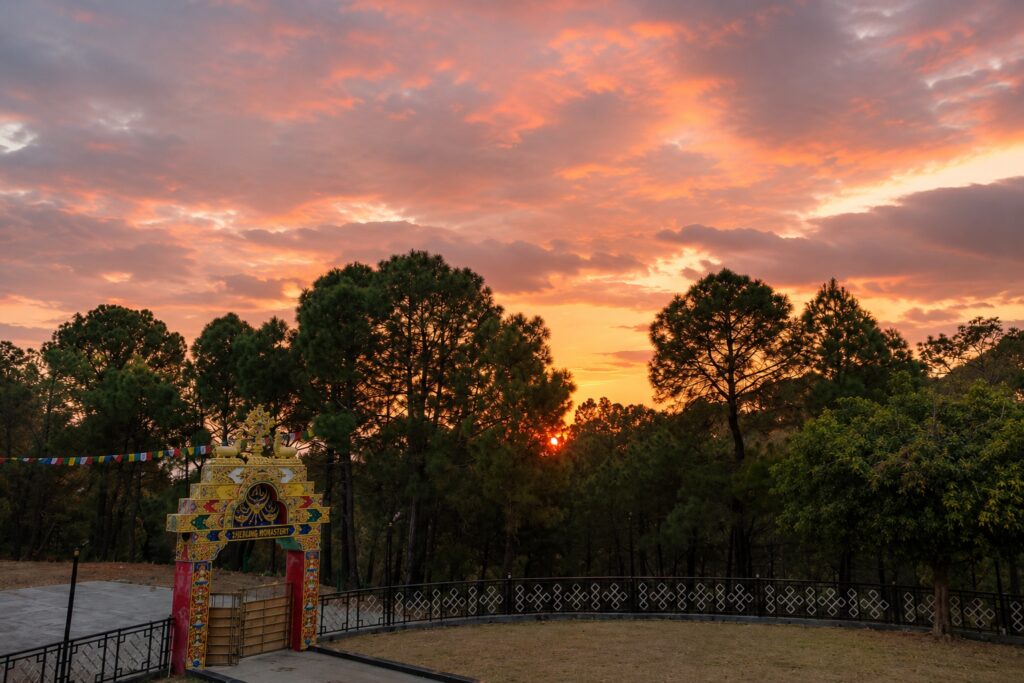
Short answer: yes to quiet meditation, with limits on the rest. You are welcome to sit quietly in or near the shrine hall on your own, and simply observing the monks’ prayers is itself a deeply meditative experience. What you cannot do is walk in and join a structured retreat on the spot.
Through the Sherab Ling Institute, Sherabling does run formal teachings, courses and retreats, but these are organised programmes with their own schedules and registration, often months in advance, and many are meant for committed practitioners. If that is what you want, plan ahead and check with the monastery rather than expecting to drop in.
For most travellers, the realistic experience is the quieter one: arrive, sit, breathe, and let it be enough. If you want more of that monastic stillness while you are in the region, Namgyal Monastery in McLeod Ganj is another worth your time.
The Café, the Forest Walk and Other Things to Do
Beyond the shrine hall, give yourself time to just wander. A few things I always do:
- The café. There is a small canteen just outside the main complex, simple and cheap, serving hot thukpa, noodles, momos and tea. After a quiet hour inside, a bowl of thukpa with the forest around you is the perfect close.
- The campus loop. Walk the paths between the shrine halls, the stupas and the monks’ quarters. Move slowly. This is a place people live and study in, not a trail.
- The sunset. If you can stay till the golden hour, the light pours over the forest, the fields and the villages below, and the whole ridge glows. It is the moment I would never rush.
None of this is on a ticket or a map. It is just the rhythm of the place, if you let yourself slow to its pace.
A Local’s Half-Day Bir Monastery Route
Sherabling is best enjoyed as part of a slow half-day, not a single stop. This is the loop I send my own guests on, and it strings together the best of Bir’s Buddhist side with the forest and the river.
Start early at Sherabling, while the air is cool and the morning prayers are still on. Give it two hours, then drive back down toward Bir and into the Bir Tibetan Colony, the heart of the valley’s exile community. Here you will find Chokling Monastery, smaller and more compact than Sherabling, with a striking golden stupa and a large prayer-wheel hall you can walk right into.
A few minutes away is the Deer Park Institute, a quiet centre for classical Indian and Buddhist study with a lovely garden and a café of its own. If there is time and the weather is kind, finish at Gunehar, the village just past Bir where a short walk through fields leads to a hidden stream and pool, a good place to sit before the drive home.
And if you can give Bir more than a half-day, it rewards it: my full guide to the things to do in Bir Billing covers the waterfalls, treks, and sunsets beyond the monasteries, and my honest guide to where to eat in Bir sorts the cafes worth your time from the ones only selling the sunset.
People often ask which is the best monastery in Bir, Sherabling or Chokling. My honest answer: visit both, because they do different things. Chokling is easy, central and lively, a colourful working temple in the middle of the colony, perfect if you only have an hour. Sherabling is grander, quieter and set apart in the forest, the actual seat of the lineage, and the one that stays with you longer. If I had to send you to just one, it would be Sherabling, but it would be a shame to skip Chokling when it sits so close on the same loop.
Where to Stay Near Sherabling Monastery
There is no hotel at the monastery gate, and that is by design. To stay close to Sherabling, you base yourself in Bir, a five to seven kilometre drive away, and visit from there.
A quick, honest lay of the land. The Bir Tibetan Colony (lower Bir) is the budget and café hub, walkable, social and close to Chokling, but it can get busy in season. Chowgan, near the paragliding landing field, is where most of the buzz and the flight crowds are. Upper Bir and the lanes toward the colony’s edges are quieter and greener, which is what I would pick if peace is the point of the trip. The monastery does keep a simple guesthouse, but that is meant for practitioners on its programmes, not casual visitors, so do not count on it.
If your trip also takes in Dharamshala, and most Kangra itineraries do, it is worth basing yourself there for a few nights and treating Bir as a day out. That is exactly how many of my guests do it, staying up in the quiet of Khaniyara and driving down for the monastery loop. If that suits your plans, here is where we host guests near Dharamshala.
My Honest Tips for Visiting
A monastery is someone’s home and place of worship, not a backdrop, so a little care goes a long way. The things I always tell guests:
- Dress modestly. Cover your shoulders and knees. It is a working monastery, and you will feel out of place in beachwear.
- Shoes off, and go clockwise. Remove your shoes before entering any shrine hall, keep your voice low, and walk clockwise around the hall and the stupas, the way the practice flows.
- Photography, the real rules. Outside, in the courtyard and around the campus, photograph freely. Inside the main shrine hall, photography is often restricted or not allowed, especially during prayers, so look for signs or simply ask first. Never photograph monks, and least of all during a puja, without their consent.
- Phones on silent. If a prayer session begins while you are inside, sit quietly at the back or step out. Do not let a ringtone cut through the chanting.
- Donations, no pressure. There is usually a donation box near the main shrine. A small offering helps maintain the monastery and is always welcome, but no one will ask you for money, and there is no entry fee.
- Go slow. This is not a place to rush. The longer you linger, the more it gives back.
Conclusion
Sherabling Monastery is, to me, the quiet heart of Bir, the part of the valley most visitors fly straight over. It is free, it is open daily, and it asks nothing of you except a little time and respect. Come early or stay for sunset, sit at the back of a prayer, walk the forest paths, and if you can possibly time it for a festival, do. Whether you make it a quick stop or the still centre of a longer Kangra trip, I hope this local’s guide helps you see Sherabling the way we do, not as a sight to tick off, but as a place to slow down inside. When you come, let me know how you find it.
Frequently asked questions
Where is Sherabling Monastery located?
Sherabling Monastery is at Bhattu, near Keori village in the Baijnath area of Kangra district, Himachal Pradesh (PIN 176125), set in pine forest roughly 5 to 7 km from Bir.
Who founded Sherabling Monastery?
It was founded in the early 1990s by the 12th Kenting Tai Situpa, Pema Tönyö Nyinje, as the Indian seat of the Palpung lineage of the Karma Kagyu school of Tibetan Buddhism, after the lineage was scattered into exile from Tibet.
What is Sherabling Monastery famous for?
It is best known as the Indian seat of the 12th Tai Situpa and the principal Karma Kagyu monastery of the Bir region, home to more than 500 monks. Inside, its 42-foot Maitreya Buddha and the hall of ten thousand gilded Buddhas draw visitors, and the building even holds private apartments kept for the Dalai Lama and the Karmapa.
What are Sherabling Monastery timings?
The main shrine hall is generally open daily from about 8:30 AM to 4:30 PM, and the wider campus stays accessible until roughly 6:00 PM. As a working monastery, the hall may be shut between prayers or teachings, so if you find it closed, it is fine to politely ask a monk nearby.
Is there an entry fee?
No. Entry to Sherabling Monastery is free and no permits are required. There is a donation box near the main shrine for those who wish to contribute.
Can you meditate at Sherabling Monastery?
Yes, you are welcome to sit quietly in or near the shrine hall on your own. You cannot drop in on a structured retreat, however. Formal courses and retreats run through the Sherab Ling Institute on their own schedules and usually need registration well in advance.
What is the altitude of Sherabling Monastery?
Bir itself sits at around 1,400 m (about 4,600 ft), and Sherabling is a little higher in the forest above the town. It is a comfortable low-Himalayan altitude with no acclimatisation concerns.
Which is India’s largest Buddhist monastery?
India’s largest Buddhist monastery is Tawang Monastery in Arunachal Pradesh. Sherabling is not the largest in the country, but it is one of the most important Karma Kagyu monasteries in India and the major monastery of the Bir area.
Where is the Dalai Lama in Himachal Pradesh?
His Holiness the Dalai Lama is based in McLeod Ganj, above Dharamshala, at the Tsuglagkhang complex. You can read more in our guide to the Dalai Lama in Dharamshala.
What are the nearby attractions to Sherabling monastery?
The closest are in and around Bir: Chokling Monastery and the Bir Tibetan Colony, the Deer Park Institute, the paragliding landing site at Chowgan, and the hidden waterfall and stream at Gunehar.