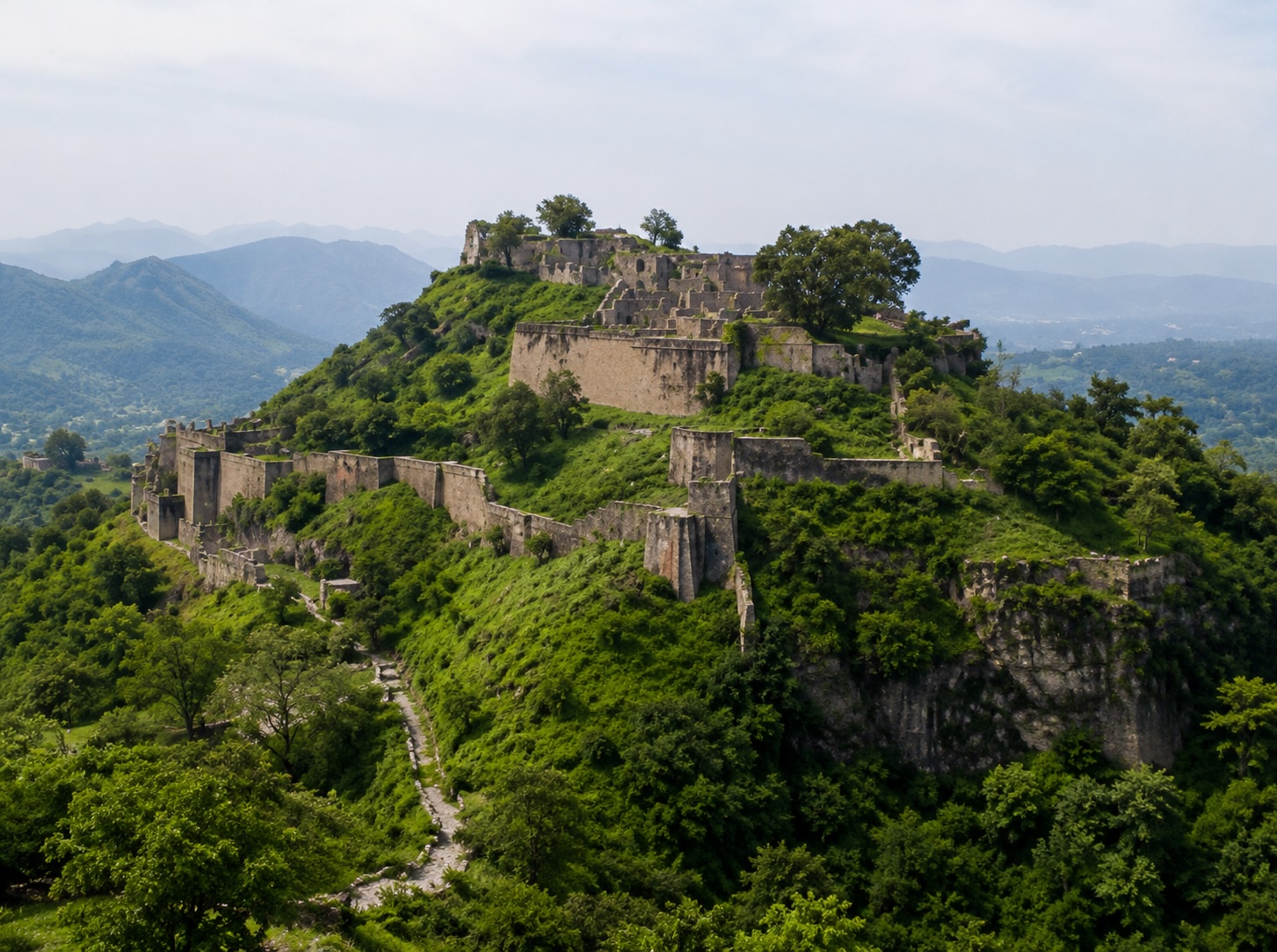
I have driven past Kangra Fort dozens of times on the road to Gaggal airport, and for years I filed it away as scenery. The day I finally climbed it, I understood what I had been ignoring. Even before I reached the entrance, the massive stone walls rising along the edge of that rocky hill made it feel less like a tourist spot and more like a place that had quietly watched centuries go by.
Kangra Fort is the largest fort in the Indian Himalayas, spread across 463 acres, and it has survived more invasions than almost any fortress in India. This is what visiting it is actually like, what it costs, how to reach it, and whether it earns half a day of your Himachal trip.
Table of Contents
Kangra Fort at a glance
What is Kangra Fort famous for?
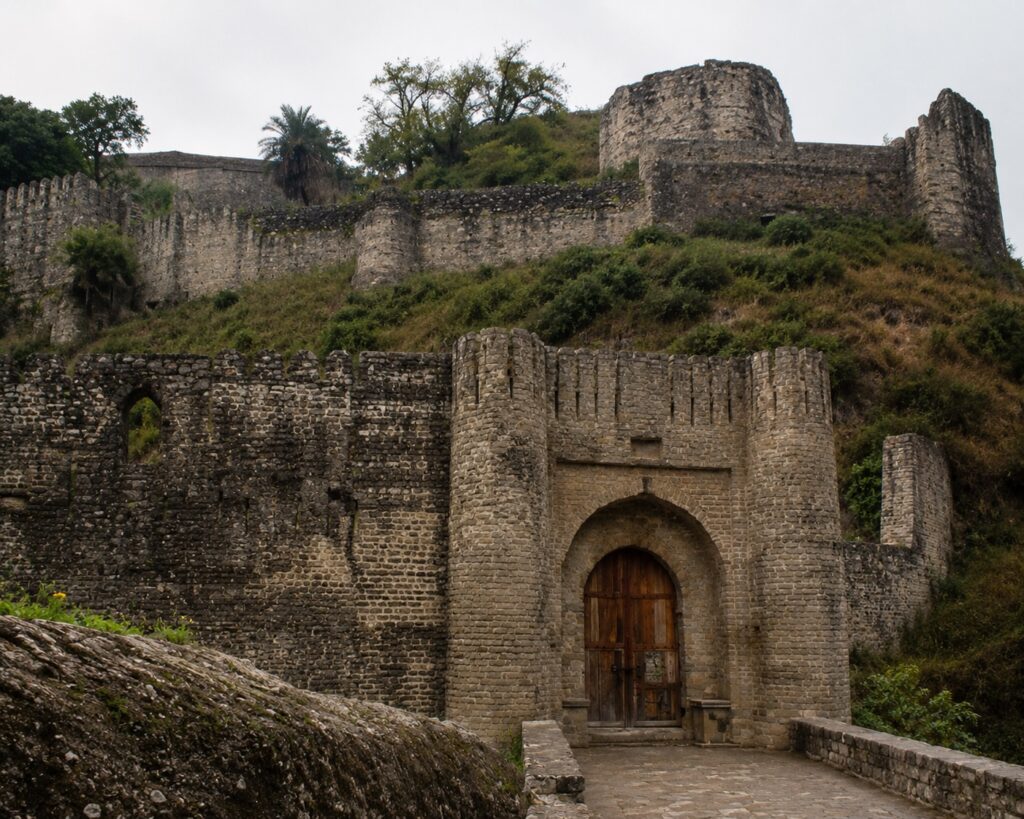
Kangra Fort is famous for being the largest fort in the Indian Himalayas and one of the oldest continuously contested forts in India. It was built by the Katoch dynasty, one of the world’s oldest surviving royal lineages, and its treasury was rich enough that Mahmud of Ghazni, the Tughlaqs, Jahangir, the Sikhs and finally the British all came for it.
That last part is what most guides skip. This fort was never famous for beauty. It was famous for being nearly impossible to take. Two rivers cut in below, the ridge is narrow, and the only approach is a single climbing path, so the location itself does most of the defensive work. Standing at the entrance, you can see exactly why armies took months over it and why the place feels less like a monument than a natural fortress that someone simply reinforced.
Who built Kangra Fort, and how old is it really?
Kangra Fort was built by the Katoch rulers of the Trigarta kingdom, a dynasty named in the Mahabharata. You will see “4,000 years old” repeated everywhere, including on national news sites. The honest version is that the Katoch lineage is that ancient, while the fort’s earliest firm written record is Mahmud of Ghazni’s raid in 1009 AD, and the Jain temple inside carries an inscription dated 854 CE.
So it is comfortably over a thousand years old on documented evidence, and plausibly far older by tradition. I prefer telling visitors that, because the real record needs no exaggeration:
- 1009 AD: Mahmud of Ghazni plunders the Nagarkot treasury of gold, silver and jewels.
- 1337 and 1351: Muhammad bin Tughlaq and Firuz Shah Tughlaq attack.
- 1615: The fort resists Jahangir’s siege, then falls in 1620 when Raja Hari Chand is killed.
- 1780s: Raja Sansar Chand II recovers it for the Katochs.
- 1809: It passes to Maharaja Ranjit Singh, who adds the Ranjit Singh Gate.
- 1846: The British take it after a six week siege in the First Anglo-Sikh War.
- 4 April 1905: The Kangra earthquake destroys in seconds what armies could not.
Why Kangra Fort is also called Nagarkot
Nagarkot is the fort’s older name, and elders in Himachal Pradesh still use it. It comes from the temple town that grew inside and below the walls, and it is the name that appears in medieval invasion accounts, which is why “Nagarkot, Himachal Pradesh” and Kangra Fort are the same place. Kot Kangra is a third name for the same site. If you are reading old records and wondering why the fort seems to have three identities, that is why.
Walking through the gates: what visiting Kangra Fort actually feels like
Expect a continuous uphill walk through a series of gates, not a flat monument circuit. Each gate is deliberately set at an angle to the one before it rather than directly opposite, built to break the momentum of a charging army. Walking it, you feel the design working on you.
The stones are rugged and unpolished, with moss filling the gaps and cracks that look genuinely ancient. It does not read as abandoned. It reads as weathered and still standing. In the narrow passages between gates, with high walls on both sides, it is easy to picture soldiers posted above watching every movement below.
The air inside the fort is noticeably different from the road outside. You hear birds in the trees, wind moving through the open sections, and footsteps echoing off stone, so it is not silent, but it is peaceful in a way that makes you slow down. Visitors around me were speaking softly, as if raising their voice would be rude. I have watched loud groups walk in and go quiet within five minutes.
Every few minutes there is a reason to stop. The wind carries the scent of dry stone mixed with fresh mountain air, and looking at those weathered walls, it is impossible not to think about how many generations have walked the same steps.
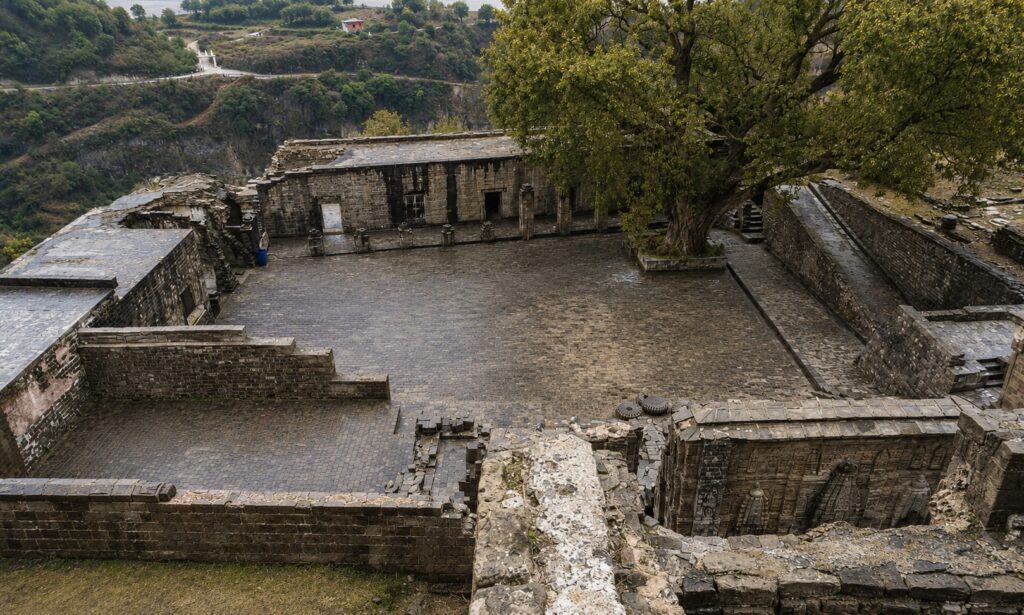
Deeper in are temple ruins, courtyards and empty platforms where royal buildings once stood. Most are incomplete, and that helps. Instead of a restored palace with signage telling you what to feel, the empty spaces invite you to fill them: soldiers holding the gates, merchants coming through with goods, priests at the temples, kings holding court somewhere above. The architecture is practical rather than decorative, thick walls, watchtowers and planned gateways, yet around some temple doorways there is delicate carving that outlasted wars, invasions and an earthquake.
The fort keeps changing character too. One moment you are boxed in by towering walls, then you step onto an open terrace and the whole valley opens up. That alternation is what makes it feel like an adventure rather than a walk around ruins, and by the highest points it stops feeling like visiting a monument at all.
The view from the top: Kangra Valley and the Dhauladhar
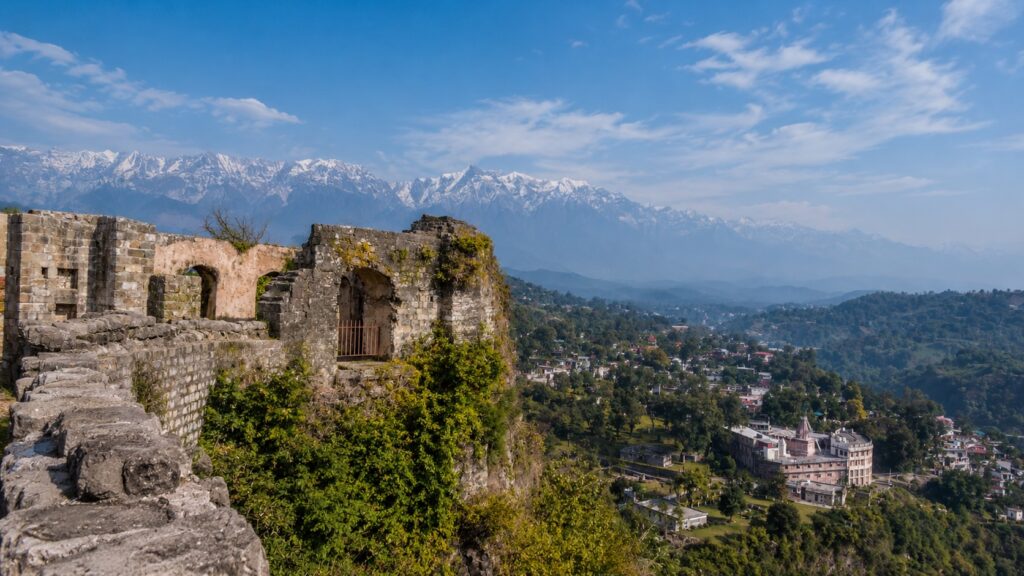
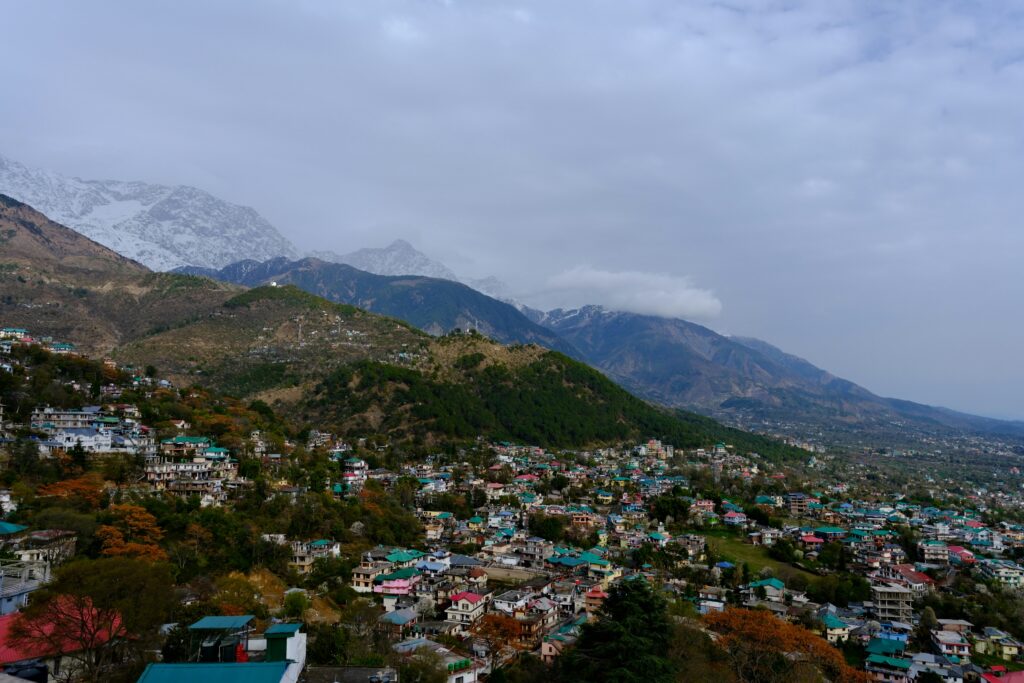
The panoramic view from the upper ramparts is the single strongest reason to come, even if you do not care about history. Green fields stretch out below, broken by small villages and winding roads, and behind them the Dhauladhar range rises straight up. On a clear day the snow line looks almost unreal against all that green.
Standing there with the cool mountain breeze on your face, the choice of site stops being an abstract strategic fact. Those rulers picked a position that was both impossible to attack and genuinely beautiful, and you get to enjoy the second half of that decision.
Come after the monsoon or in winter for that clarity. In peak summer haze the mountains often vanish and you are left with a fine view of farmland, which is pleasant but not the postcard. If you are timing a wider trip around views, our best time to visit Dharamshala guide applies to Kangra town too, since it sits in the same valley.
What the 1905 earthquake destroyed
The Kangra earthquake of 4 April 1905 measured 7.8 and killed more than 20,000 people, destroying around 100,000 buildings across the region. Most of Kangra, Dharamshala and McLeod Ganj came down, including the Bajreshwari temple in town. The British garrison abandoned the site, and what you walk through today is essentially the post-1905 ruin.
If you want to see what was lost, the museum near the ticket gate holds before and after photographs from the earthquake, which is why searching for “Kangra Fort before 1905” turns up such a different building. Seeing those images first and then climbing changes the whole visit, so I would do it in that order. Armies spent centuries trying to break these walls. The earth succeeded in under a minute.
Kangra Fort timings, ticket price and entry fee in 2026
Kangra Fort is an Archaeological Survey of India monument, so carry original photo ID and carry cash. On timings, the practical rule is that ASI sites run sunrise to sunset and the gate stops selling well before dark, so treat 4 pm as your realistic last entry rather than banking on a 6 pm close. There is an audio guide at the fort, and it is genuinely good, so use it instead of picking up a guide at the gate.
How to reach Kangra Fort from Dharamshala, McLeod Ganj and Kangra town
Kangra Fort sits in Old Kangra, about 20 km from Dharamshala, which is a 45 minute to one hour drive on a good road. From McLeod Ganj, add roughly another 30 minutes. Any Kangra-bound bus from Dharamshala drops you at the Kangra bus stand, and from there it is a short auto ride of a few kilometres to the fort.
The nicest approach is the Kangra Valley toy train, which stops at Kangra and turns the journey itself into part of the day. If you are coming from further afield, our how to reach Dharamshala guide covers the Delhi and Chandigarh routes, and the fort slots neatly into day two or three of our Dharamshala itinerary.
There is parking near the ticket gate. On weekends and holidays it fills up by late morning, and the final stretch of road is narrow, so arriving before 10 am saves you a reversing contest with a tour bus.
Almost nobody stays in Kangra town itself, and I would not suggest it either. The fort works best as a half day run out from a Dharamshala base, which is roughly why we put Manoratham Villa where we did, in Khaniyara, far enough out that the evenings are quiet but still an easy start for anything in the valley.
Is Kangra Fort worth visiting? An honest answer
Yes, if you enjoy history, ruins and big mountain views and you are willing to walk uphill for about 20 minutes. No, if you are expecting a restored palace with facilities. It is a two hour visit that rewards curiosity rather than convenience, and it is the most substantial historical site in the Kangra Valley.
Where I will be straight with you: there is very little shade on the climb, the washrooms are poorly maintained, there are almost no food stalls inside, and there are few places to sit. Families with small children or elderly parents should plan around that, carry water, and eat in Kangra town before or after. The reviews complaining about these things are not wrong. They are just not reasons to skip a fort of this significance.
Is Kangra Fort haunted? What locals actually say
No, Kangra Fort has no haunting reputation among the people who live here. The question circulates online because the site is ancient, in ruins, and tied to mass death in the 1905 earthquake, which is exactly the recipe that produces internet ghost stories.
What locals will tell you instead is that this is a temple site. The Ambika Devi temple, the Lakshmi Narayana shrine and the Jain temple inside are still visited, and people walk up to them with devotion rather than dread. The atmosphere is quiet and heavy with age, which is not the same as sinister. I have never met anyone from Kangra who avoids the fort.
A local’s tips for visiting Kangra Fort
- Go early or late. Between 8 and 10 am, or after 4 pm, for softer light, cooler stone and thinner crowds. Midday in May and June on an unshaded climb is genuinely unpleasant.
- Do the museum first, the fort second. The earthquake photographs give you something specific to look for on the walls.
- Wear grip, not fashion. The stone staircases are uneven and polished smooth in places, and monsoon steps are slippery.
- Budget more time than Google suggests. The listed 30 minutes to 2 hours is accurate only if you rush. Two hours is right once you start stopping at the viewpoints, which you will.
- Pair it correctly. Brajeshwari Devi temple is barely over a kilometre from the Kangra bus stand and makes a natural add-on, so fort plus temple plus museum is a comfortable half day. The Masroor rock cut temples are 32 to 40 km away, close to an hour each way, so treat those as a full day plan rather than a quick detour.
- See the art connection. Kangra’s other legacy is its miniature painting tradition, covered in our guide to Kangra painting, and the fort museum holds Kangra School miniatures alongside royal artefacts.
- Network is patchy on the upper ramparts, so download your route before you climb.
Got the fort on your list but not sure which day to go?
Kangra Fort is only as good as the day you pick. Haze hides the Dhauladhar, the climb has almost no shade, and most people try to add Masroor and run out of morning.
WhatsApp me. I will tell you what the weather is actually doing this week, and how to line up the fort, Brajeshwari and the museum without rushing any of it.
💬 Ask Dr. SomyaFrequently asked questions
Which king built Kangra Fort?
The Katoch Rajput rulers of the Trigarta kingdom built it. Raja Sansar Chand II is the name most associated with its golden age, and the museum at the site is named after him.
Who owns Kangra Fort now?
It is a protected monument under the Archaeological Survey of India. The Katoch royal family remains connected to the site and runs the adjacent Maharaja Sansar Chand Museum.
Is Kangra Fort the oldest fort in India?
It is one of the oldest and is frequently called the oldest. Its documented history begins in 1009 AD, with Katoch tradition placing its origins far earlier.
How much time do you need at Kangra Fort?
Ninety minutes to two hours for the climb, the ramparts and the viewpoints, plus about 30 minutes for the museum.
Are there hotels near Kangra Fort?
There are basic options in Kangra town, but almost everyone bases themselves in Dharamshala or McLeod Ganj and comes as a half day trip. Our Dharamshala hotels and areas guide breaks down which area suits which kind of trip.
Still unsure? Ask me
If you are building a Himachal trip and wondering whether Kangra Fort earns a slot, my answer is yes: a clear morning after the monsoon, paired with Brajeshwari and the museum, and back down by lunch. If you want a version of that route that does not double back on itself, or you just want to know what the weather is doing this week, send me a message.
Walking back down towards the exit, I kept turning around for one more look at those walls. Even in ruins they carry the quiet dignity of a place that has outlasted everything thrown at it. They did not just seem old. They felt timeless.
Staying in the valley while you explore it
A fort morning goes better when you are not still worn out from yesterday’s transfer. Manoratham Villa is in Khaniyara, which puts Kangra Fort and Brajeshwari inside an easy half day and Masroor inside a comfortable full one.
Tell me your dates and I will say honestly whether we are the right fit, or point you elsewhere in the valley if we are not.
💬 Ask Dr. Somya