I live in Dharamshala. I have driven the road to Palampur more times than I can count, forty-odd kilometres, an hour if the traffic behaves, past the same tea stalls and the same bends. So when people kept telling me that the valley looks different from the railway tracks, I assumed it was the kind of thing travellers say to make an ordinary journey sound poetic.
Then I finally took the Kangra toy train instead of the car. They were right.
Everything below comes from that morning, and from the years of living here that told me which questions people actually ask before they go. The route, the timings, the fare, the seat to pick. But mostly, what the ride is genuinely like, because that is the part nobody tells you properly.
Table of Contents
What is the Kangra toy train?
The Kangra toy train is the passenger service on the Kangra Valley Railway, a 2 ft 6 in narrow-gauge line running 164 km from Pathankot in Punjab to Joginder Nagar in Himachal Pradesh. It opened to passengers in 1929, it is India’s longest narrow-gauge railway, and it sits on UNESCO’s tentative World Heritage list. There are 33 stations, close to 950 bridges, and only two tunnels on the entire line.
That last number is the one that changes your day. The Kalka to Shimla line spends much of its journey buried inside hillsides. This one stays out in the open almost the whole way. Nothing gets between you and the Dhauladhars.
Kangra Toy Train at a glance
| Detail | Information |
|---|---|
| Official name | Kangra Valley Railway |
| Route | Pathankot Junction to Joginder Nagar |
| Length | 164 km |
| Gauge | 2 ft 6 in (762 mm) narrow gauge |
| Opened | 1929 (freight from December 1928) |
| Stations | 33 |
| Bridges and tunnels | Around 950 bridges, only 2 tunnels |
| Highest point | Ahju station, 1,290 m |
| Traction | Diesel (ZDM3 / ZDM4A) since 1976 |
| Full-route time | Roughly 9 to 10 hours |
| Fare | Around ₹35 to ₹40 for long sections |
| Booking | Unreserved only, no seat reservation |
The morning I finally took the Kangra Toy Train
I reached Kangra railway station a little before nine. Calling it a railway station almost feels too grand. There were no flashing information boards, no crowds hunting for coach numbers, just a yellow station sign, narrow tracks stretching into the distance, and a tea vendor’s call breaking the quiet. School students with backpacks. An elderly couple carrying cloth shopping bags. A few tourists clutching cameras. Locals who clearly knew everyone else standing there.
Long before I saw the train, I heard it. Not the dramatic whistle of an old steam engine, but the steady, throaty growl of a small diesel locomotive echoing across the valley. It was not loud enough to drown conversation. It sounded almost reassuring, like something that had been making this journey every day for decades without ever trying to impress anyone.
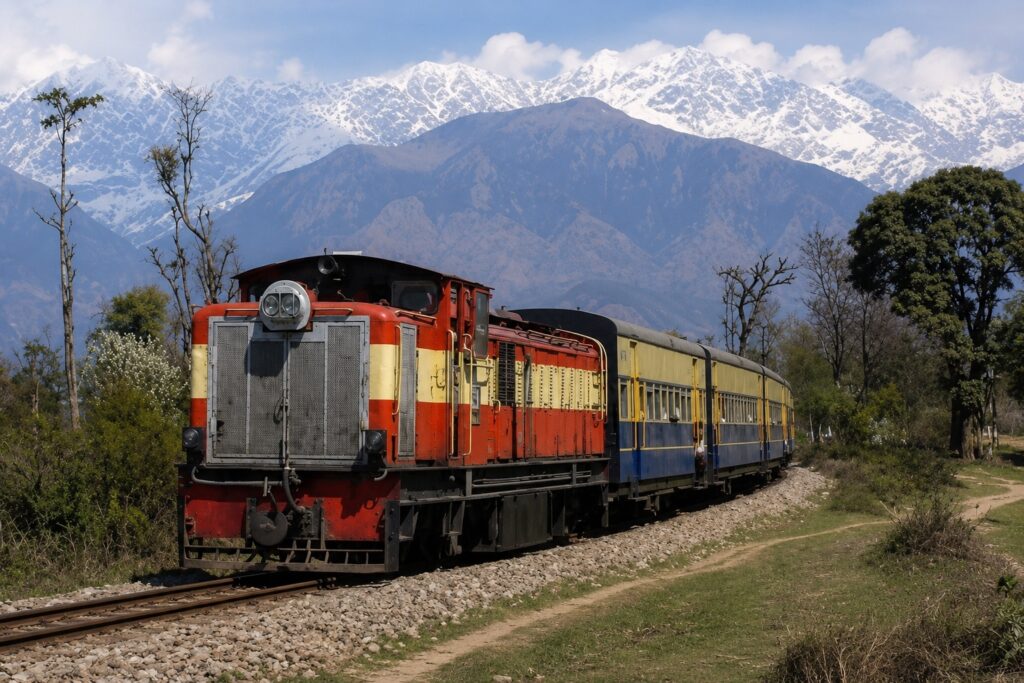
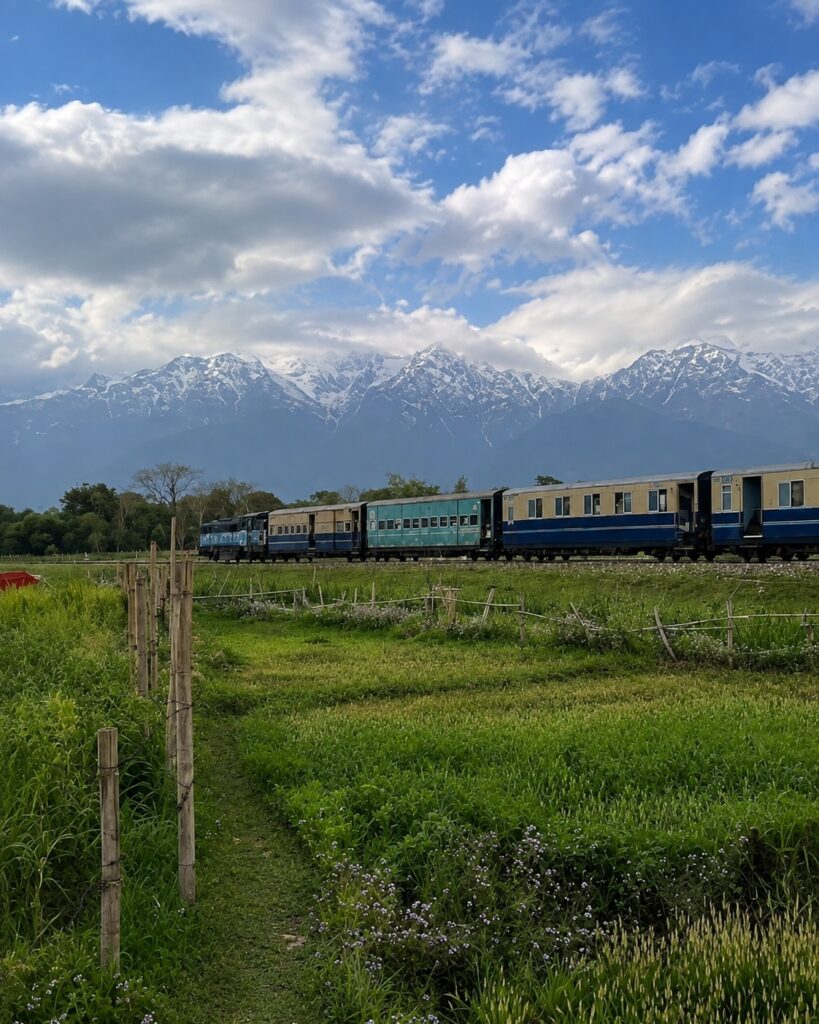
The blue-and-cream coaches rolled in almost shyly. Everything on a narrow-gauge line looks miniature: the locomotive, the coaches, even the doors. I had to duck slightly stepping in. The seats were simple, the windows large and built to slide open completely. No air-conditioning, no tinted glass between me and the mountains, just fresh air pouring in carrying damp earth, pine and diesel.
I deliberately chose a window seat on the left-hand side. I had been told that is where the Dhauladhar views are best once the train leaves Kangra, and it turned out to be the best advice I could have been given. If you take one thing from this piece, take that.
What a ride in the Kangra Toy Train feels like
The train gave a gentle tug and began to move. No dramatic burst of speed, just a soft clunk as the coaches tightened against one another, then the rhythmic tak, tak, tak of steel wheels crossing rail joints. Within minutes the station had disappeared behind us.
What struck me first was not the scenery. It was the silence.
Cars never stop talking. Their engines hum constantly. On the Kangra toy train there are long stretches where the only sounds are the locomotive pulling steadily ahead, the windows rattling gently, birds somewhere outside, and conversations drifting between strangers who somehow become less hurried because the train itself refuses to rush.
The valley opened almost immediately. Fields stretched across both sides of the track, stitched together with narrow irrigation channels that glittered in the morning sun. Farmers were already working, bent over their crops, looking up as the train rolled past. Children stopped their games just long enough to wave, and almost every passenger waved back. It did not feel staged. It felt like something that had been happening every day for years.
Then, almost without my noticing when, the Dhauladhar range appeared. Not a glimpse. Not a photograph between trees. The mountains simply unfolded beside us and stayed there. For nearly the whole journey they accompanied us like silent fellow travellers, grey rock rising sharply from the valley floor, streaked with snow even while the lower hills were warm and green. From the road you catch quick views before the next corner takes them away. From the train you just sit there, watching for mile after mile, never feeling any need to look away.
Somewhere after Nagrota I stopped trying to take photographs. Every picture flattened the mountains into something ordinary. Looking out of the window was infinitely better.
The train ambled across tiny bridges, each one producing a different echo beneath the wheels. We crossed little streams tumbling over smooth rocks, passed sleepy stations where perhaps two passengers got off and one climbed aboard, and rolled through villages where front gardens almost touched the railway line. At level crossings, people waiting on scooters smiled patiently instead of looking annoyed at the delay. Nobody seemed to be in a hurry, not even the people waiting for us.
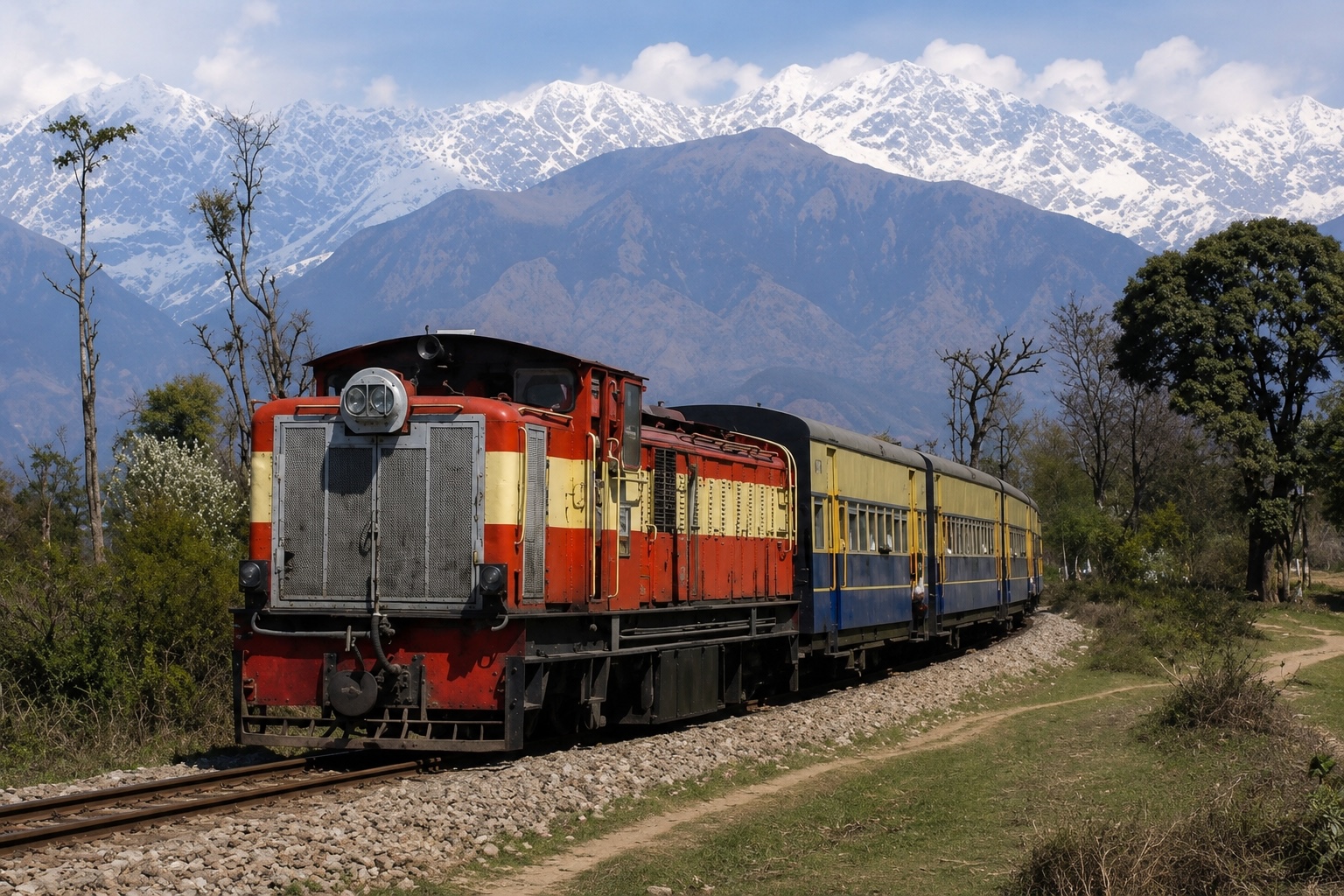
As we drew closer to Palampur the landscape changed again. The fields slowly gave way to the tea gardens that make this part of Himachal so distinctive, long rows of emerald bushes covering the gentle slopes, with the snow-covered Dhauladhars towering impossibly high behind them. It is one of those views that almost feels unfair, as though someone has layered two completely different landscapes on top of each other. The breeze through the open window turned cooler. Pine appeared more often, its scent mixing with the earthy smell of the tea estates after the morning dew.
When the train finally rolled into Palampur Himachal station, barely an hour and a half had passed. It did not feel like I had travelled thirty-odd kilometres. It felt as though I had travelled backwards in time.
The bit I only learned afterwards
I went looking into this line’s history after the ride, and it turned the journey into something else entirely on the second telling.
The railway was not built for tourists. It was sanctioned in 1926 to construct and service the Uhl hydroelectric project at Shanan, and the idea had already been shelved once before that, after surveys in 1912 and 1914 came back looking unprofitable. The Pathankot to Nagrota stretch opened for freight on 1 December 1928, and the full line reached Joginder Nagar by April 1929. It was budgeted at ₹113 lakh and ended up costing ₹296 lakh, which is a very Himachal sort of overrun.
Then, in 1942, at the height of the Second World War, the British pulled up everything beyond Nagrota and shipped the rails to the Middle East for the war effort. The line ran as a stump for twelve years. It was only restored on 15 April 1954. Later, in 1973, a 25 km stretch had to be lifted and rebuilt on higher ground when the Pong Dam reservoir drowned the old alignment. Cross the Mehla viaduct today and you can still see the piers of the abandoned bridge standing in the water below.
The detail I like most is the one you can still hear. Steam ended here in 1976, but the line runs to this day on Neale’s Ball Token signalling, a 1930s electro-mechanical system where the stationmaster physically hands the loco pilot a metal ball on a ring as permission to enter the next section of single track. Almost nowhere else in India still uses it. That small metallic clink at a crossing station is not a bit of heritage theatre. It is the safety system doing its job.
Kangra Toy Train route and major stations
| Station | Why It Matters |
|---|---|
| Pathankot Jn | Starting point, railhead from Delhi, Amritsar and Jammu |
| Nurpur Road | Serves Nurpur town and its old fort |
| Jawalamukhi Road | Get off here for Jwala Ji temple |
| Kangra / Kangra Mandir | Kangra Fort, Brajeshwari Devi temple, around 17 km from Dharamshala |
| Nagrota | Forest section, one of the prettiest stretches |
| Chamunda Marg | Nearest halt for Chamunda Devi temple |
| Palampur Himachal | Tea gardens, Neugal Khad, the best short-ride finish |
| Baijnath Paprola | 13th-century Baijnath temple, most trains terminate here |
| Ahju | Highest station on the line, closest railhead for Bir Billing |
| Joginder Nagar | End of the line, gateway to Barot Valley |
Half the pleasure of this route is that every one of these stops is a place worth getting off at, not just a name on a board. Our Kangra Valley travel guide covers what is actually worth your time in each of them.
Kangra Toy Train timings
These are daytime passenger services, and I would treat any published timing as a starting point rather than gospel. They shift with maintenance, weather and track work.
| Train | From | Departs | To | Arrives |
|---|---|---|---|---|
| 52465 | Pathankot | 5:00 AM | Baijnath Paprola | 12:00 PM |
| 52467 | Pathankot | 7:00 AM | Baijnath Paprola | 1:40 PM |
| 52473 | Baijnath Paprola | 8:00 AM | Joginder Nagar | 9:35 AM |
| 52470 | Baijnath Paprola | 2:15 PM | Nurpur road | 9:45 PM |
One thing worth knowing before you build a day around this. The line was shut for nearly four years after the 2022 monsoon tore out the bridge over the Chakki river, and it only reopened in June 2026, flagged off from Kangra station. Living here, you get used to this rhythm.
Rain, landslides and bridge inspections still take sections of the line out at short notice, and nobody announces it loudly. Our Dharamshala monsoon and weather guide explains why July to September is the fragile window. Check NTES or simply call the station before you set off.
Fare and tickets for the Kangra toy train
The fare is the part that makes people laugh when I tell them. Pathankot all the way to Baijnath Paprola costs roughly ₹35 to ₹40. The bus over the same ground runs closer to ₹390.
There is no seat reservation on these services. Tickets are unreserved, you buy them at the counter before you board, and seating is first come, first served. That sounds casual until a school crowd or a weekend rush turns up and the coaches fill.
So the one piece of practical advice I would push hardest is this: reach the station 30 to 45 minutes early. Not for the ticket, which takes two minutes, but for the seat. Boarding early is the only thing standing between you and a left-side window, and on this line the window is the entire point.
If you are travelling as a group, you can also charter the train outright. Four first-class coaches and a guard van work out at roughly ₹20,000 for a Pathankot to Palampur round trip, arranged through the Traffic Inspector at Nagrota station or via IRCTC. Split enough ways, it costs less per head than taxis, and you get the valley to yourselves.
Best time to ride the kangra toy train
| Season | What to Expect |
|---|---|
| March to June | Pleasant, clear, dependable mountain views. Best overall. |
| July to September | Beautifully green, but rain delays and closures are common. |
| October to November | The sharpest Dhauladhar visibility of the year. My pick. |
| December to February | Cold, atmospheric, snow sitting low on the range. Layer up. |
I took the train in clear weather and I would not do it any other way. On an overcast day this route loses its single best feature and becomes a slow train through fields. If you are planning a longer trip, our best time to visit Dharamshala guide lines up with these same windows.
Which stretch should you actually ride?
The full Pathankot to Joginder Nagar run takes nine to ten hours. Almost nobody needs that, and I would not recommend it as a first experience.
- Kangra to Palampur, around 1.5 hours. The sweet spot, and the one I took. Dhauladhars for nearly the entire ride, ending in tea gardens.
- Palampur to Baijnath Paprola, around 45 minutes. Tea estates, and the steepest gradient on the whole line, 1 in 25, just past Baijnath Paprola.
- Baijnath Paprola to Ahju and Joginder Nagar. The highest and wildest section, and the easiest way to reach Bir Billing by rail if you are going for paragliding or the quiet lanes of the Bir Tibetan Colony.
- Pathankot to Kangra. The long approach past Pong Dam. Genuinely scenic, but the mountains arrive late and you spend the good light getting there.
Getting to the train, and what to do at either end
From Dharamshala, Kangra station is about 17 km, an easy taxi or local bus, roughly 40 minutes. Kangra Mandir and Nagrota work too, depending on which section you want. If you are still sorting out logistics, how to reach Dharamshala covers the routes in, and our Dharamshala itinerary guide shows where a train day sensibly fits.
My one regret is that I did not give Palampur the afternoon it deserved. Do not turn straight back. Walk the tea estate paths, sit a while by Neugal Khad, and let the day stay slow, because that is the mood the train puts you in and it is a shame to break it. If you are basing yourself in Dharamshala for a few days, our guides to where to stay, and what to eat locally will save you the trial and error I went through.
Things I would tell a friend before they go
- Sit on the left-hand side heading towards Palampur. I will keep saying it.
- Carry water, snacks and cash. The small stations have very little, and no card machines.
- Take a light jacket even in summer. Open windows in the hills get cold faster than you expect.
- Toilets are basic or missing on the shorter formations. Sort that out before boarding.
- Keep luggage manageable. Narrow-gauge coaches have small, stepped entrances and limited storage.
- Travelling with elderly parents or small children? Boarding needs a helping hand, and the doors stay open through the journey.
- Travel in daylight. A night ride on this line is a wasted ticket.
Is the Kangra toy train worth it?
The Kangra toy train is not the fastest way to get anywhere. It is probably the slowest. That is exactly why I would recommend it.
The roads help you reach the mountains. The railway gives you time to notice them. Every bend, every bridge, every tiny station reminds you that the Kangra Valley is not somewhere to rush through. It is somewhere to watch unfold, one gentle kilometre at a time.
And if it is that older, slower Himachal you are chasing, the valley still holds on to a few more pieces of it, like the Kangra painting tradition, which very few people still practise.
Frequently asked questions
Is the Kangra toy train running in 2026?
Yes. Services resumed in June 2026 after nearly four years of suspension caused by 2022 monsoon damage to the Chakki river bridge. Sections can still close temporarily for heavy rain, landslides or bridge inspections, so check the NTES app or your nearest station before travelling.
How long does the Kangra toy train take?
The full 164 km Pathankot to Joginder Nagar journey takes roughly nine to ten hours. Shorter sections are far more practical. Kangra to Palampur takes about 90 minutes, and Palampur to Baijnath Paprola around 45 minutes. Both cover the best Dhauladhar views on the line.
What is the Kangra toy train fare?
Fares are very low because these are ordinary passenger services. Pathankot to Baijnath Paprola costs approximately ₹35 to ₹40, against around ₹390 by bus. Shorter hops cost less. Tickets are unreserved and sold at station counters, so carry cash with you.
Can I book Kangra toy train tickets in advance?
No. Regular services are unreserved, with no advance seat booking. Buy your ticket at the station counter or an AVTM machine before departure and take any free seat. Arrive 30 to 45 minutes early during weekends, holidays and peak tourist season.
Which is the best section of the Kangra toy train?
Kangra to Palampur is the best short ride. The Dhauladhar range stays visible for almost the entire stretch, the route crosses small bridges and village halts, and it finishes among Palampur’s tea gardens. Sit on the left-hand side for uninterrupted mountain views.
How is it different from the Kalka to Shimla toy train?
Kalka to Shimla climbs steeply through more than 100 tunnels and is far busier. The Kangra toy train has only two tunnels, runs gently along the Dhauladhar foothills, carries mostly local passengers, and costs a fraction as much. It is quieter, more open and far less touristed.
How do I reach the Kangra toy train from Dharamshala?
Kangra railway station is roughly 17 km from Dharamshala and reachable by taxi or local bus in about 40 minutes. Kangra Mandir and Nagrota stations are also nearby options, depending on which section of the line you plan to cover.